In modern foundation engineering, steel piles play a critical role in transferring structural loads and improving ground stability. Among the most widely used systems are steel pipe piles and steel sheet piles. Although both are manufactured from structural steel and installed below ground level, their engineering functions, structural behavior, and installation purposes are significantly different.
Steel pipe piles are primarily designed for deep foundation load-bearing applications, while steel sheet piles are mainly used for earth retention, excavation support, and waterfront structures. Selecting the correct pile type depends on factors such as soil conditions, axial load requirements, groundwater level, construction environment, and project design life.
What Is a Steel Pipe Pile?
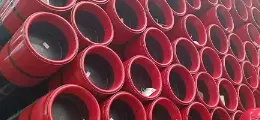
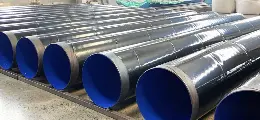
A steel pipe pile is a cylindrical steel foundation member used to transfer vertical and lateral loads from a structure into deeper and more stable soil or rock layers. These piles are commonly manufactured from carbon steel plates through welding processes such as SSAW (Spiral Submerged Arc Welded), LSAW (Longitudinal Submerged Arc Welded), or seamless pipe production.
Due to their high compressive strength and torsional resistance, steel pipe piles are suitable for projects requiring deep foundations and large load-bearing capacity.
Common standards include:
ASTM A252
API 5L
EN 10219
JIS A5525
What Is a Steel Sheet Pile?
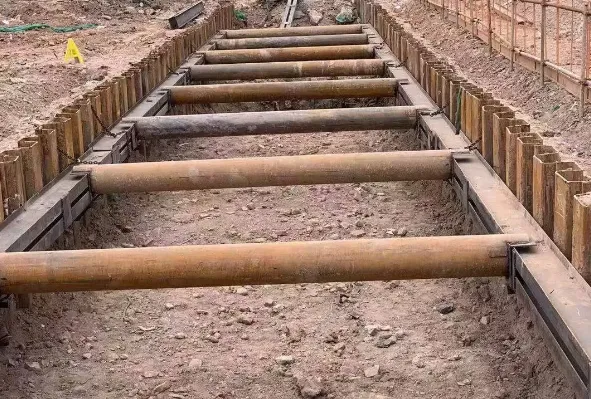
A steel sheet pile is a rolled steel section with interlocking edges designed to form a continuous retaining wall. Unlike pipe piles, sheet piles are not primarily intended to support heavy vertical structural loads. Their main function is soil retention, water cutoff, and excavation stabilization.
Steel sheet piles are commonly manufactured in:
U-shaped profiles
Z-shaped profiles
Straight-web sections
Differences Between Steel Pipe Piles and Steel Sheet Piles
1. Structure and Design
Steel Pipe Piles: These are cylindrical steel pipes installed vertically in the ground to provide structural support. They come in various sizes and thicknesses to meet different load requirements and ground conditions.
Steel Sheet Piles: These are flat steel sheets that are shaped into "U" or "Z" profiles and interlock to form a continuous barrier. They are more flexible than steel pipe piles and are used primarily for earth and water retention.
2. Installation Method
Steel Pipe Piles: These are typically installed using piling equipment, where the piles are driven into the ground using a hydraulic or impact hammer. Some steel pipe piles may be filled with concrete to increase their strength.
Steel Sheet Piles: These are installed by driving the steel sheets vertically into the ground and interlocking the edges to create a continuous wall. The installation method depends on soil conditions, required depth, and available equipment.
3. Function
Steel Pipe Piles: Their primary function is to support heavy vertical loads and provide deep foundation support for structures such as bridges, buildings, and offshore platforms.
Steel Sheet Piles: These are mainly used for earth retention, cofferdam construction, and excavation support in projects like waterfront structures, bulkheads, and foundation pits.
4. Load-bearing Capacity
Steel Pipe Piles: These have a higher load-bearing capacity due to their cylindrical shape and greater structural rigidity. They are ideal for supporting heavy vertical loads in deep foundations.
Steel Sheet Piles: While excellent for retaining earth and water, their load-bearing capacity is lower than that of steel pipe piles due to their thinner, more flexible design.
5. Durability
Steel Pipe Piles: Made from high-strength steel, these piles are resistant to corrosion and other environmental factors. Their thicker and more rigid design makes them less prone to deformation during installation.
Steel Sheet Piles: Although also made from high-quality steel, their thin and flexible nature makes them more susceptible to damage during installation. However, they are highly effective in environments where flexibility is key.
6.Manufacturing process:
1. Steel pipe piles are usually manufactured by welding steel plates together to form a cylindrical shape. According to the manufacturing process, steel pipe piles can be divided into Welded Pipe Piles: These piles are manufactured by welding together steel plates to form a cylindrical shape. The welded seams provide strength and structural integrity.
2. Steel sheet piles are manufactured by rolling steel sheets into a U or Z shape. U-shaped sheet piles have one interlocking element, while Z-shaped sheet piles have two interlocking elements, providing greater stability and design flexibility
Installation Methods
Steel Pipe Pile Installation
Steel pipe piles are generally installed using:
Impact hammer driving
Vibratory hammer driving
Rotary drilling
Hydraulic pressing
For offshore or bridge projects, piles are often driven to rock strata to achieve high bearing capacity. In some cases, concrete is poured into the pipe after installation to increase compressive strength and corrosion resistance.
Steel Sheet Pile Installation
Steel sheet piles are installed by driving individual sections vertically into the ground while connecting adjacent sheets through interlocks.
Common installation equipment includes:
Vibratory hammers
Diesel hammers
Hydraulic press-in systems
Accurate alignment is essential to maintain wall straightness and interlock integrity, especially in deep excavation projects.
Conclusion
Steel pipe piles and steel sheet piles serve different but equally important roles in civil engineering and foundation construction. Steel pipe piles are designed for high-capacity deep foundation support, while steel sheet piles are engineered for lateral soil retention and water control.
Understanding the structural behavior, manufacturing process, installation technique, and application range of each system is essential for selecting the most suitable foundation solution. Proper pile selection not only improves structural safety but also optimizes construction efficiency and long-term project durability.

 English
 Español
 بالعربية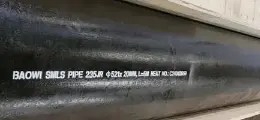
 Phone :
  Whatsapp :
  Email :


