Rectangular Hollow Section (RHS) is a structural steel tube with a rectangular cross-section, designed primarily for construction and load-bearing applications rather than fluid transportation. Compared with circular hollow sections (CHS), RHS provides different structural performance along its major and minor axes. The wider face delivers greater bending strength and stiffness, while the closed profile also offers excellent torsional resistance. These characteristics make RHS a preferred choice for beams, columns, bridges, building frames, and other structures where loads are mainly applied in one direction.
Rectangular Hollow Section Specifications
| Specification | Details |
| Section Type | Rectangular Hollow Section (RHS) |
| Outside Dimensions (H × W) | 40 × 20 mm – 500 × 300 mm |
| Wall Thickness | 1.6 mm – 25 mm |
| Length | 6 m, 9 m, 12 m, or customized |
| Manufacturing Method | Cold-Formed ERW |
| Applicable Standards | ASTM A500, EN 10219, EN 10210, JIS G3466, GB/T 6728 |
| Steel Grades | ASTM A500 Gr.B/Gr.C, S235JRH, S275JRH, S355J2H, Q235B, Q355B |
| Surface Finish | Black, Oiled, Painted, Pre-Galvanized, Hot-Dip Galvanized |
| Ends | Plain Ends |
| Inspection | Chemical Analysis, Tensile Test, Yield Strength Test, Elongation Test, Weld Inspection, Dimensional Inspection |
Standards of Rectangular Hollow Section
Rectangular Hollow Sections are manufactured according to various international standards to ensure consistent dimensions, mechanical properties, and welding quality. Common standards include:
ASTM A500
EN 10219
EN 10210
JIS G3466
GB/T 6728
AS/NZS 1163
CSA G40.21
Materials of Rectangular Hollow Section
RHS is mainly manufactured from carbon steel due to its high strength, excellent weldability, and cost-effectiveness. Common materials include:
1.Carbon Steel RHS
Carbon steel is the most widely used material for structural applications. It provides good mechanical properties and is suitable for general construction, industrial buildings, and infrastructure projects.
Common grades include:
ASTM A500 Grade B and Grade C
EN S235JRH
EN S275JRH
EN S355J2H
Q235B
Q355B
2.High Strength Low Alloy (HSLA) RHS
For projects requiring higher load capacity and reduced structural weight, high-strength low-alloy steel grades are often selected. These materials provide improved yield strength while maintaining good weldability.
3.Stainless Steel RHS
Stainless steel rectangular hollow sections are used in environments requiring corrosion resistance, hygiene, or decorative appearance, such as architectural structures, food processing equipment, and marine applications.
4.Common stainless steel grades include:
304/304L Stainless Steel
316/316L Stainless Steel
Applications of Rectangular Hollow Section
Square and rectangular steel tubes combine high strength, excellent stability, and attractive appearance, making them suitable for various structural and industrial applications.
Construction and Architecture
Steel frames, columns, and beams
Roof trusses and wall systems
Purlins and support structures
Machinery and Equipment
Machine frames and equipment supports
Construction machinery bases
Industrial structures
Furniture and Commercial Use
Table and chair frames
Storage racks and display stands
Agriculture and Solar Structures
Greenhouse frameworks and fencing systems
Solar panel mounting structures with galvanized tubes for outdoor use
SHS is available in seamless and welded types. Seamless SHS is formed from seamless round steel tubes, while welded SHS is manufactured by forming and welding steel strip into a round tube before reshaping it into a square section. Both types provide reliable mechanical performance for structural applications.
Square Hollow Section (SHS) Specifications
| Parameter | Specification |
| Size Range | 20 × 20 mm – 500 × 500 mm |
| Wall Thickness | 1.5 mm – 30 mm |
| Length | 6 m, 12 m, or Customized Length |
| Manufacturing Process | Cold-formed welded, hot-finished welded |
| Standards | EN 10219, EN 10210, ASTM A500, GOST 30245 |
| Steel Grades | S235, S275, S355 (EN); ASTM A500 Grade B, Grade C; 09G2S (GOST); Q235, Q355 (China) |
| Surface Treatment | Black steel, hot-dip galvanized, painted, powder coated |
| End Treatment | Plain ends, beveled ends, cut-to-length, drilled ends |
Square Hollow Section Standard:
ASTM A500 Grade B,
ASTM A513 (1020-1026)
ASTM A36 (A36)
EN 10210:S235,S355,S235JRH,
S355J2H,S355NH
EN 10219:S235,S355,S235JRH,
S275J0H, S275J2H, S355J0H, S355J2H
Square Hollow Section Materials and Grades
Square Hollow Sections are produced from different steel materials depending on application requirements, including strength, corrosion resistance, weldability, and environmental conditions.
1. Carbon Steel SHS
Carbon steel is the most widely used material for structural hollow sections due to its excellent strength, weldability, and cost efficiency.
| Standard | Common Grades |
| ASTM A500 | Grade A, Grade B, Grade C |
| EN 10219 | S235JRH, S275J0H, S355J2H |
| EN 10210 | S355NH, S420NH |
| GB/T 6728 | Q235, Q355 |
2. Stainless Steel SHS
Stainless steel square hollow sections provide excellent corrosion resistance and aesthetic appearance.
Common grades:
ASTM A554 304
ASTM A554 316
EN 10088 stainless steel grades
3. Alloy Steel SHS
Alloy steel SHS provides enhanced mechanical performance for heavy-duty applications requiring higher strength and durability.
Manufacturing Process of Square Hollow Section
Square Hollow Sections (SHS) are produced through several forming and finishing processes to achieve accurate dimensions, reliable strength, and suitable surface performance.
Cold Forming & Welding
Steel strips or plates are shaped at room temperature and welded into square sections. This method provides excellent dimensional accuracy and is widely used for structural, industrial, and general fabrication applications.
Hot Forming
Steel is heated before forming, allowing the production of larger sizes and thicker walls. It is commonly applied in heavy-duty structures, bridges, and high-load engineering projects.
Surface Treatment
Processes such as hot-dip galvanizing, painting, and powder coating improve corrosion resistance and extend service life, especially for outdoor and harsh environments.
Applications of Square Hollow Section
Architectural Structures: Building frames, columns, roof trusses, facades, and modern steel structures.
Heavy Machinery: Equipment supports, machine bases, and structural components requiring high load capacity.
Transportation Equipment: Frames and components for trailers, vehicles, and transport systems.
Industrial Structures: Factory buildings, platforms, supports, and infrastructure projects.
Food Processing Equipment: Hygienic structural frames, equipment supports, and processing facilities.
Decorative Frameworks: Railings, display structures, furniture frames, and architectural features.
Marine Environments: Offshore structures, ship components, and coastal engineering applications requiring corrosion resistance.

Square Hollow Section
Square Hollow Section (SHS) sizes are usually specified by outside dimensions and wall thickness. Common SHS sizes range from small structural tubes for fabrication projects to large sections for heavy-duty steel structures.
The following table shows commonly used SHS dimensions and theoretical weights. Custom sizes and thicknesses are available according to project requirements.
| SHS Size (mm) | Wall Thickness (mm) | Weight (kg/m) |
| 20 × 20 | 2 | 1.1 |
| 25 × 25 | 2.5 | 1.7 |
| 30 × 30 | 3 | 2.5 |
| 40 × 40 | 3 | 3.4 |
| 50 × 50 | 5 | 6.9 |
| 60 × 60 | 6 | 9.9 |
| 70 × 70 | 3.6 | 7.4 |
| 80 × 80 | 6 | 14 |
| 100 × 100 | 6 | 17.8 |
| 150 × 150 | 8 | 35 |
Rectangular Hollow Section
Rectangular Hollow Section (RHS) sizes are specified by outside width, height, and wall thickness. The selection of RHS dimensions depends on structural requirements, load conditions, fabrication methods, and application environment.
| RHS Size (mm) | Wall Thickness (mm) | Weight (kg/m) |
| 50 × 25 | 2.5 | 2.7 |
| 50 × 30 | 3 | 3.4 |
| 60 × 40 | 4 | 5.6 |
| 80 × 40 | 5 | 8.4 |
| 90 × 50 | 6 | 11.8 |
| 100 × 50 | 6.3 | 13.3 |
| 100 × 60 | 6 | 13.6 |
| 120 × 80 | 8 | 22.6 |
| 150 × 100 | 6.3 | 23.1 |
| 200 × 100 | 10 | 43.1 |
| 250 × 150 | 12 | 69.6 |
| 300 × 200 | 12 | 89 |
The above table shows commonly used Rectangular Hollow Section (RHS) sizes. Steel products with other specifications, wall thicknesses, and steel grades can be supplied in accordance with international standards such as EN 10210, EN 10219, and ASTM A500.
To view the full version, please refer to:Standard Rectangular Tube Size Table
EN 10210:S235JRH,S355J2H,S355NH,S355J0H
EN 10219:S235JRH,S355J2H,S355NH,S355J0HASTM A312 TP304,304L,316,316L
Steel Grades:
S235 / S275 / S355, ASTM A500 Gr.B / Gr.C, Q235 / Q355 / 09G2S
Hollow sections are manufactured from different types of steel materials to meet the requirements of structural strength, corrosion resistance, welding performance, and environmental conditions. The most commonly used materials include carbon steel, stainless steel and alloy steel.
1. Carbon Steel Hollow Section
Carbon steel is the most common material used for Square Hollow Section (SHS) and Rectangular Hollow Section (RHS). It offers high strength, excellent weldability, and good machinability, making it suitable for general structural applications.
Common grades include ASTM A500, S235, S275, and S355, which are widely applied in construction, bridges, machinery frames, and general structural projects.
2. Stainless Steel Hollow Section
Stainless steel hollow sections are selected when corrosion resistance, appearance, and long service life are important. Compared with carbon steel, stainless steel contains chromium, which creates a protective oxide layer on the surface.Common grades of stainless steel hollow profiles include 304, 316L, and 201.
3. Alloy Steel Hollow Section
Alloy steel hollow sections contain additional elements such as chromium, nickel, or molybdenum to improve strength, toughness, and heat resistance.
Hollow Section is a hollow rectangular cross-section lightweight thin-walled steel tube, that is, a steel tube with unequal side lengths. Its structure is simple and stable, and its bearing capacity is high. The specifications of square tubes are usually expressed by side length and wall thickness. Rectangular tubes
Rectangular steel pipe is made of seamless pipe as base material, through double drawing or cold drawing, also known as round to square. The main processing flow of rectangular steel pipe is: round steel → pipe blank → inspection → heating → perforation → sizing → hot rolling → flat head → inspection → pickling → spheroidizing annealing → cold drawing → forming → flat end → inspection.
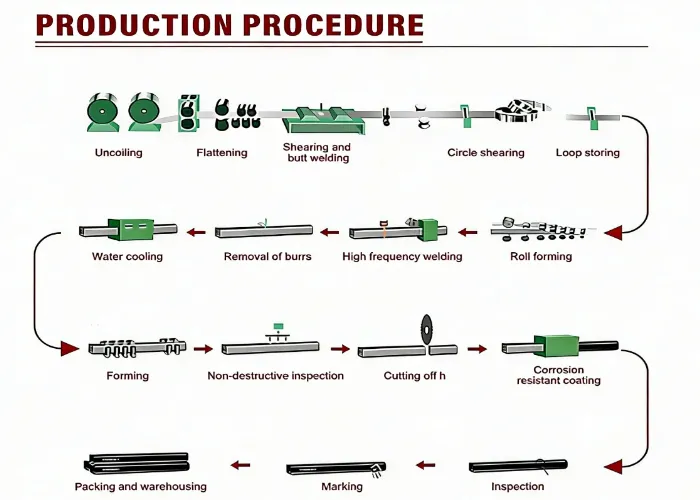
Hollow sections are mainly manufactured using the ERW (Electric Resistance Welding) process.
Production Steps