The correct BSP tap drill pipe size depends on the thread size, pitch, and whether the thread is BSPP (parallel) or BSPT (tapered). In most machining applications, the recommended drill size provides approximately 70–75% thread engagement, offering the best balance between thread strength, cutting torque, and tool life.
The most commonly used BSP tap drill sizes are:
|
BSP Thread Size
|
Tap Drill (mm)
|
Tap Drill (inch)
|
|
1/8 BSP
|
8.8
|
11/32
|
|
1/4 BSP
|
11.8
|
29/64
|
|
3/8 BSP
|
15.25
|
19/32
|
|
1/2 BSP
|
19
|
3/4
|
|
3/4 BSP
|
24.5
|
31/32
|
|
1 BSP
|
30.75
|
1-13/64
|
This guide provides complete BSPP (parallel) and BSPT (tapered) tap drill charts, explains how drill sizes are determined, compares BSP with NPT threads, and helps engineers select the correct drill for different materials and applications.
What Is a BSP Thread?
BSP (British Standard Pipe) is one of the world's most widely used pipe thread systems for connecting pipes, valves, fittings, and hydraulic components. Originally developed in the United Kingdom, BSP threads are now widely adopted throughout Europe, Asia, Australia, the Middle East, and many international industrial markets.
Unlike metric machine threads, BSP threads are specifically designed for pipe connections where sealing performance is just as important as mechanical strength.
The BSP thread profile uses the 55° Whitworth thread form, which differs from the 60° thread profile used by NPT (National Pipe Thread). Because of this difference, BSP and NPT threads are not interchangeable, even when their nominal sizes appear similar.
Complete BSP Tap Drill Size Chart (Metric & Inch)
The following table summarizes the most commonly used BSP thread sizes for general machining applications.
|
Nominal Size
|
TPI
|
Major Diameter (inch)
|
BSP Tapping Drill Size
|
BSPT Tapping Drill Size
|
|
1/16"
|
28
|
0.304
|
6.6 mm
|
6.4 mm
|
|
1/8"
|
28
|
0.383
|
8.8 mm
|
8.4 mm
|
|
1/4"
|
19
|
0.518
|
11.8 mm
|
11.2 mm
|
|
3/8"
|
19
|
0.656
|
15.25 mm
|
14.75 mm
|
|
1/2"
|
14
|
0.825
|
19.0 mm
|
18.25 mm
|
|
5/8"
|
14
|
0.902
|
21.0 mm
|
—
|
|
3/4"
|
14
|
1.041
|
24.5 mm
|
23.75 mm
|
|
7/8"
|
14
|
1.189
|
28.25 mm
|
—
|
|
1"
|
11
|
1.309
|
30.75 mm
|
30.0 mm
|
|
1-1/4"
|
11
|
1.65
|
39.50 mm
|
38.5 mm
|
|
1-1/2"
|
11
|
1.882
|
45.5 mm
|
44.5 mm
|
|
1-3/4"
|
11
|
2.116
|
51.0 mm
|
—
|
|
2"
|
11
|
2.347
|
57.0 mm
|
56.0 mm
|
Note: Recommended drill sizes are intended for approximately 70–75% thread engagement. Slight adjustments may be appropriate depending on material hardness, machining tolerance, and thread class requirements.
Common BSP Thread Dimensions
Many engineers search for individual BSP thread dimensions rather than a complete chart. The following reference covers several of the most frequently used BSP sizes.
1/8 BSP Thread Size
A 1/8 BSP thread has a major diameter of 9.73 mm, 28 TPI, and a recommended tap drill size of 8.80 mm (11/32 inch). It is commonly used in instrumentation, pressure gauges, pneumatic controls, and compact hydraulic systems.
1/4 BSP Thread Dimensions
The 1/4 BSP (G1/4) thread features a major diameter of 13.16 mm, 19 TPI, and a standard tap drill size of 11.80 mm (29/64 inch). It is one of the most widely used BSP sizes for hydraulic adapters, air manifolds, and industrial fittings.
3/8 BSP Thread Dimensions
A 3/8 BSP thread has a major diameter of 16.66 mm, 19 TPI, and a recommended tap drill size of 15.25 mm (19/32 inch). This size is frequently used in compressed air systems, coolant lines, and medium-flow process piping.
Engineering Notes for Selecting Tap Drill Sizes
Choosing the correct drill size involves more than simply matching a chart. Material properties, tapping method, lubrication, and production requirements all influence the final result.
Thread Engagement
Most industrial applications target 70–75% thread engagement because it provides sufficient mechanical strength while reducing cutting forces. Increasing thread engagement beyond this level offers minimal additional strength but significantly increases tapping torque and the risk of tap breakage.
Material Selection
Different materials require different machining strategies.
|
Material
|
Recommendation
|
|
Carbon Steel
|
Standard drill size
|
|
Stainless Steel (304/316)
|
Increase drill size by approximately 0.05–0.10 mm if necessary to reduce tapping torque
|
|
Aluminum
|
Standard drill size produces excellent thread quality
|
|
Brass
|
Standard drill size with high cutting speed
|
|
Cast Iron
|
Dry machining is often acceptable due to graphite lubrication
|
BSPP vs BSPT – What's the Difference?
One of the most common questions engineers ask is whether BSPP and BSPT require different tap drill sizes.
Although the recommended drill sizes are often very similar, the two thread systems serve different purposes and use different sealing methods.
|
Feature
|
BSPP (G Thread)
|
BSPT (R Thread)
|
|
Thread Type
|
Parallel
|
Tapered
|
|
Thread Profile
|
55° Whitworth
|
55° Whitworth
|
|
Sealing Method
|
Gasket, O-ring, or bonded washer
|
Thread interference
|
|
Standard
|
ISO 228-1
|
ISO 7-1
|
|
Typical Applications
|
Hydraulic fittings, adapters
|
Water, gas, compressed air pipelines
|
|
Interchangeable
|
No
|
No
|
BSPP (British Standard Pipe Parallel)
BSPP, also known as the G thread, features parallel threads that do not create a pressure seal by themselves. Instead, sealing is achieved using an O-ring, bonded washer, gasket, or machined sealing face.
Because the threads are straight, BSPP connections are widely used in hydraulic systems where repeated assembly and disassembly are required.
BSPT (British Standard Pipe Taper)
BSPT threads are tapered at approximately 1 in 16, allowing the male and female threads to tighten progressively as they engage.The sealing action is created by thread interference, often combined with PTFE tape or liquid thread sealant. BSPT is commonly used in water, steam, gas, and industrial pipeline systems.Although many drill sizes overlap between BSPP and BSPT, always use the correct tap designed for the corresponding thread standard.
How to Calculate BSP Tap Drill Size
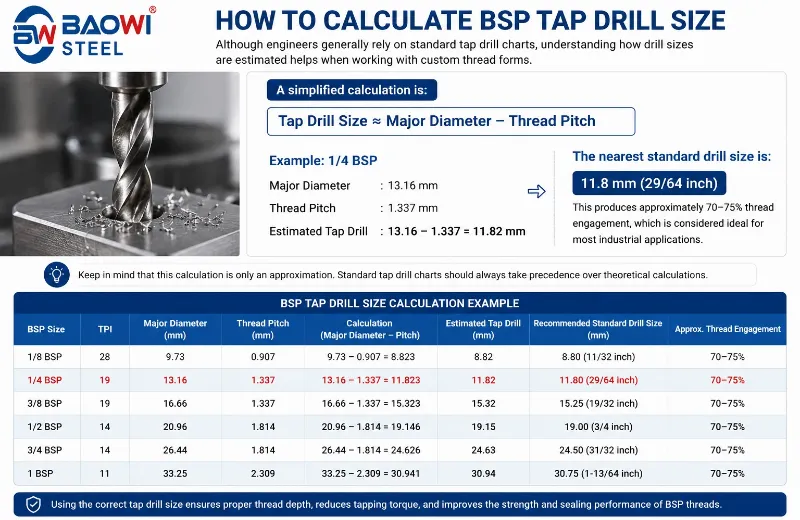
Although engineers generally rely on standard tap drill charts, understanding how drill sizes are estimated helps when working with custom thread forms.
A simplified calculation is:
Tap Drill Size ≈ Major Diameter − Thread Pitch
For example:
Example: 1/4 BSP
Major Diameter:
13.16 mm
Thread Pitch:
1.337 mm
Estimated Tap Drill:
13.16 − 1.337 = 11.82 mm
The nearest standard drill size is:
11.8 mm (29/64 inch)
This produces approximately 70–75% thread engagement, which is considered ideal for most industrial applications.
Keep in mind that this calculation is only an approximation. Standard tap drill charts should always take precedence over theoretical calculations.
How to Choose the Correct BSP Tap Drill Size ?
Selecting the correct BSP tap drill size depends on more than just thread dimensions. Engineers should also consider the thread type, workpiece material, machining method, and required thread engagement to achieve reliable results.
For most industrial applications, a thread engagement of 70–75% is recommended. This provides sufficient mechanical strength while reducing tapping torque and minimizing the risk of tap breakage.
When selecting a tap drill:
Confirm whether the thread is BSPP (G) or BSPT (R).
Use the recommended drill size from a standard BSP tap drill chart.
Apply a suitable cutting lubricant, especially when machining stainless steel.
Inspect the finished thread using a thread gauge or a matching BSP fitting before installation.
Following these practices helps improve machining efficiency, extend tool life, and ensure leak-free threaded connections.
Tip: Most machining operations target 70–75% thread engagement, which provides an excellent balance between thread strength, tapping torque, and tool life.
BSP vs NPT Threads
One of the most common sources of confusion is the difference between BSP and NPT threads.
Although they appear similar, they are manufactured to different standards and should not be used interchangeably.
|
Feature
|
BSP
|
NPT
|
|
Thread Angle
|
55° Whitworth
|
60° Unified
|
|
Thread Form
|
Rounded crest and root
|
Flat crest and root
|
|
Standard
|
ISO 7-1 / ISO 228-1
|
ASME B1.20.1
|
|
Thread Types
|
BSPP & BSPT
|
NPT & NPTF
|
|
Primary Markets
|
Europe, Asia, Australia
|
United States, Canada
|
|
Sealing Method
|
Parallel gasket or tapered thread
|
Tapered thread interference
|
|
Interchangeable
|
No
|
No
|
Even when the nominal pipe size is the same, BSP and NPT threads have different thread angles and pitches. Mixing the two standards can result in poor thread engagement, leakage, or permanent damage to fittings.
If your project follows American standards, refer to an NPT Tap Drill Size Chart instead of BSP specifications.
Common Applications of BSP Threads
BSP threads are widely used across industrial piping systems due to their standardized dimensions and excellent sealing performance.
|
BSP Thread Size
|
Typical Applications
|
|
1/8 BSP
|
Pressure gauges, pneumatic controls, instrumentation
|
|
1/4 BSP
|
Hydraulic fittings, air manifolds, quick couplings
|
|
3/8 BSP
|
Compressed air systems, coolant lines, industrial equipment
|
|
1/2 BSP
|
Water supply, pumps, valves, process piping
|
|
3/4 BSP
|
Industrial pipelines, HVAC systems, fire protection
|
|
1 BSP
|
Oil & gas, chemical processing, heavy-duty piping
|
Because BSP is an internationally recognized thread standard, it is commonly specified for projects involving seamless steel pipes, forged fittings, valves, and pressure piping systems.
Common Mistakes When Using BSP Tap Drill Sizes
Using the wrong drill size or thread standard can affect machining quality and sealing performance. The following mistakes are among the most common:
Confusing BSP and NPT thread standards.
Using an undersized drill, which increases tapping torque and tool wear.
Using an oversized drill, resulting in insufficient thread engagement.
Selecting the wrong tap for BSPP or BSPT threads.
Tapping without adequate cutting lubricant, especially in stainless steel.
Carefully following the recommended drill sizes and thread standards helps reduce machining errors and improve the service life of both taps and threaded components.
Frequently Asked Questions
What is the drill size for G1/4 BSP?
The recommended tap drill size for G1/4 BSP (1/4 BSP, 19 TPI) is 11.8 mm (29/64 inch). This size provides approximately 70–75% thread engagement for most industrial applications.
What drill size is used for a 3/8 BSP thread?
A 3/8 BSP thread requires a 15.25 mm (19/32 inch) tap drill and has a major diameter of 16.66 mm with 19 TPI.
What is the drill size for 1/8 BSP?
The standard tap drill size for 1/8 BSP is 8.8 mm (11/32 inch). This thread size is commonly used in instrumentation and pneumatic fittings.
Are BSPP and BSPT tap drill sizes the same?
The recommended drill sizes are generally similar, but BSPP uses parallel threads while BSPT uses tapered threads. Always select the correct tap according to the specified thread standard.
Can BSP and NPT threads be used together?
No. BSP and NPT have different thread angles, pitches, and sealing methods. They are not designed to be interchangeable.
Conclusion
Choosing the correct BSP tap drill size is essential for producing accurate threads, achieving reliable sealing, and extending tool life. By understanding the differences between BSPP and BSPT, selecting the appropriate drill size, and following recognized machining practices, engineers can produce consistent, high-quality threaded connections across a wide range of industrial applications.
This guide provides a practical reference for BSP tap drill sizes, BSP thread dimensions, G thread drill sizes, and BSPP/BSPT standards in both metric and inch units. Whether you are machining hydraulic fittings, industrial valves, or seamless steel pipe connections, using standardized dimensions helps ensure compatibility, safety, and long-term performance.
At
BAOWI STEEL, we supply high-quality seamless steel pipes, flanges, and pipe fittings manufactured to international standards for oil & gas, petrochemical, construction, and mechanical engineering projects worldwide.
Related Resources
To learn more about pipe threads and industrial piping standards, you may also find these guides helpful:
API 5D Drill Pipe Specifications
How to choose the right drill pipe?
Drill Pipe Classification and Grading Explained

 English
 Español
 بالعربية

 Phone :
  Whatsapp :
  Email :