Transporting spiral-welded steel pipes (SSAW pipes) requires more than just loading them onto a truck — improper handling, packing, or environmental exposure can lead to surface damage, deformation, corrosion, or even structural compromise. This article outlines the best practices to protect SSAW pipes during transportation, based on industry standards and proven methods.
Why Transportation Protection Matters?
Surface damage (scratches, dents) — can occur from metal-to-metal contact, rough loading/unloading, or shifting during transit. Once the protective coating or surface is damaged, corrosion can initiate quickly.
Deformation or bending — poor support or unsecured bundles may allow pipes to roll, sag, or collide, especially for long or thin-walled pipes.
Corrosion or coating damage — exposure to moisture, salt water, or corrosive environments during transport (especially sea or coastal transport) can degrade coatings or allow rust if pipes are unprotected.
How to prevent spiral steel pipe from being damaged during transportation?
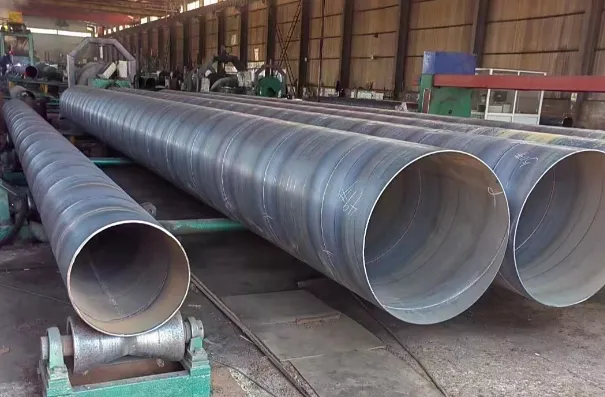
As we all know, large-diameter spiral steel pipe (SSAW) has a wide range of applications. It can be used for oil and gas pipelines, as well as for waterproofing and leak-proofing of concrete structures such as sewage tanks, toilets, and basements. In short, its application range is very wide and can be used in many places, and many people buy it. Due to the large size of the product, manufacturers generally provide consignment services when purchasing. So, what are the precautions for the storage and transportation of large-diameter spiral steel pipes?
1. The length of the spiral steel pipe can be not tied.
2. For both ends of the spiral steel pipe, if there is a thread buckle, it should be protected by a thread protector. Apply lubricant or rust inhibitor to the thread. Both ends of the spiral steel pipe are broken, and the nozzle protector can be added at both ends according to requirements.
3. Spiral steel pipe packaging should be able to avoid looseness and damage during normal handling, transportation and storage.
4. If the customer requests that the spiral steel pipe cannot be damaged by bumps or the like on the outer surface, it may be considered to adopt a protection device between the spiral steel pipes. The protective device can use rubber, straw, fiber cloth, plastic, cap, and the like.
5. Thin-walled spiral steel pipe due to thick wall can be used to support the inside of the pipe or the protection of the outer frame. The material of the bracket and the outer frame is made of steel material which is consistent with the material of the spiral steel pipe.
6. If the buyer has special requirements on the packaging materials and packaging methods of the spiral steel pipe, it should be indicated in the contract; if not specified, the packaging materials and packaging methods are selected by the supplier.
7. The packaging materials should comply with the relevant regulations. If packaging materials are not required, they should meet the intended use to avoid waste and cause environmental pollution.
8. The state stipulates that spiral steel pipes are in bulk. If the customer asks for bundling, it can be considered as appropriate, but the caliber must be between 159MM and 500MM. The bundled material is packed and fastened with steel strips. Each lane should be twisted into at least two strands and moderately increased according to the outer diameter and weight of the spiral steel pipe to prevent looseness.
9. If the spiral steel pipe is placed in the container, the container is covered with a soft moisture-proof device such as a woven fabric or a straw mat. In order to scatter the spiral steel pipe in the container, a protective bracket or the like may be welded or welded outside the spiral steel pipe.
Additional Considerations & Industry Standards
Follow recognized standards and handling codes, such as general steel pipe transport norms or specific standards for oil/gas pipeline steel pipe transport, to ensure consistency and liability control.
SSAW pipes are produced according to various international standards, including:
Chinese Standards: GB/T 14291, GB/T 3091, GB/T 9711.1, GB/T 9711.2
SY/T Standards: SY/T 5037, SY/T 5040
American Standards: ASTM A53, ASTM A252
European Standards: EN 10217-2, EN 10217-5, EN 10219-1, EN 10219-2
International Pipeline Standards: API 5L PSL1/PSL2, API 5CT / ISO 11960 PSL1
Conclusion
Protecting SSAW pipes during transportation is critical to preserve their structural integrity, surface quality, and long-term service life. By combining adequate packaging, secure bundling, careful loading/unloading, environmental protection, and proper documentation and inspection, you can minimize the risk of damage, corrosion, and deformation. For sensitive or high-value pipes — especially coated or thin-walled ones — these precautions are not optional but essential.

 English
 Español
 بالعربية
 Phone :
  Whatsapp :
  Email :


