Casing and Tubing Manufacturing Flow
Steel Billet Inspection → Billet Heating → Rotary Piercing or Other Approved Piercing Method → Pipe Elongation and Rolling → Reheating (When Required) → Sizing → Cooling → Straightening → Cutting → Heat Treatment (When Required) → End Finishing → Nondestructive Examination and Other Required Testing → Threading → Thread Inspection → Marking → Packaging
Casing and tubing manufacturing involves several controlled production stages, including raw material selection, pipe forming, heat treatment, threading, inspection, and final finishing. These steel pipes are manufactured for oil and gas wells, where they must withstand internal pressure, external loads, temperature variations, and demanding downhole conditions.
The manufacturing process depends on the pipe type. Seamless casing and tubing are produced from solid round steel billets through heating, piercing, and hot rolling, while ERW casing and tubing are formed from steel strip or coil and joined by electric resistance welding. Both manufacturing routes require additional finishing operations to meet the dimensional, mechanical, and quality requirements of the applicable
API 5CT specification.
This guide explains how casing and tubing are manufactured, from raw steel preparation to final inspection, including the differences between seamless and ERW production, heat treatment, pipe-end processing, threading, and quality control.
Raw Material Selection for Casing and Tubing
Raw material selection is the foundation of casing and tubing manufacturing. The chemical composition and mechanical properties of the steel directly affect the finished pipe's strength, toughness, hardness, and resistance to downhole service conditions.
Steel grades are selected according to the intended application, well depth, operating pressure, temperature, and corrosive environment.
Common API 5CT casing and tubing grades include:
|
Steel Grade
|
Main Characteristics
|
Typical Applications
|
|
H40
|
Basic strength grade
|
Relatively low-demand well conditions
|
|
J55
|
General-purpose casing and tubing grade
|
Conventional oil and gas wells
|
|
K55
|
Higher specified strength than J55
|
Casing applications requiring greater strength
|
|
N80
|
Higher strength than J55 and K55
|
Deeper wells and more demanding conditions
|
|
L80
|
Controlled yield strength and hardness requirements
|
Applications requiring specified material properties
|
|
P110
|
High-strength grade
|
High-pressure and deeper well applications
|
|
Q125
|
High-strength casing grade
|
Particularly demanding well conditions
|
The selection of steel must consider more than tensile strength. Yield strength, chemical composition, hardness, impact toughness where specified, and resistance to environmental cracking may also affect the suitability of the material.
Before production, steel billets or hot-rolled coils are checked against the purchasing specification and applicable material requirements.
Seamless Casing and Tubing Manufacturing Process
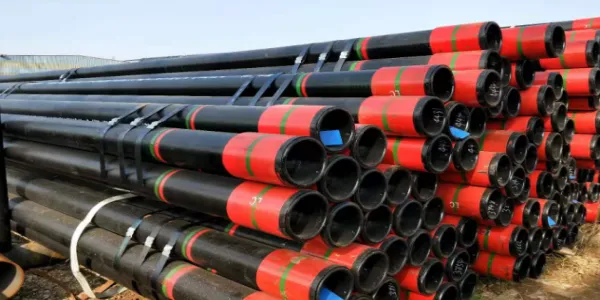
Seamless casing and tubing are manufactured from solid round steel billets. The billets are heated and pierced to create hollow shells, which are then rolled and sized into steel pipes with the required outside diameter and wall thickness.
The typical seamless production process is:
Round Steel Billet → Billet Heating → Rotary Piercing → Hot Rolling → Stretch Reduction or Sizing → Cooling → Straightening → Cutting → Inspection
1.Billet Heating
Solid round steel billets are loaded into a rotary or annular heating furnace. The furnace heats the billets to a controlled temperature suitable for hot piercing and rolling.
Uniform heating is important because temperature variations can affect deformation behavior, wall thickness consistency, and surface quality.
2.Rotary Piercing
After heating, the billet enters a rotary piercing mill. Two inclined rollers rotate and push the billet over a piercing plug or mandrel, creating a hollow steel shell.
This operation converts the solid billet into a tubular structure without a longitudinal weld seam.
3.Hot Rolling
The hollow shell is rolled through a mandrel mill, plug mill, or another suitable rolling system to reduce its wall thickness and adjust its dimensions.
The rolling operation improves dimensional consistency and prepares the pipe for subsequent sizing.
4.Stretch Reduction and Sizing
The hot-rolled pipe passes through a stretch-reducing or sizing mill to achieve the specified outside diameter and dimensional tolerances.
This stage is particularly important for controlling the final diameter, wall thickness, and roundness of the casing or tubing.
5.Cooling and Straightening
After rolling and sizing, the pipe is cooled on a cooling bed under controlled conditions.
Once the temperature is suitable, straightening equipment corrects bending and helps ensure that the finished pipe meets straightness requirements.
6.Cutting to Length
The pipe is cut into specified lengths according to the order requirements. The cut ends are prepared for subsequent inspection and finishing operations.
7.Heat Treatment of Casing and Tubing
Heat treatment is an important manufacturing stage used to obtain the required mechanical properties of casing and tubing.
During hot forming and subsequent processing, the steel may develop an internal microstructure that does not meet the required strength, hardness, or toughness. Heat treatment helps control this structure and achieve the specified material properties.
8.Normalizing
Normalizing involves heating the steel pipe to an appropriate temperature above its transformation range, holding it for a controlled period, and then allowing it to cool in air.
This process refines the steel microstructure and can improve mechanical property uniformity.
9.Quenching
Quenching involves heating the pipe to the specified austenitizing temperature and then rapidly cooling it using a suitable cooling medium.
This process increases strength and hardness but may also produce high internal stresses and brittleness if not followed by appropriate tempering.
10.Tempering
Tempering is generally performed after quenching. The pipe is reheated to a controlled temperature below the critical transformation temperature and held for a specified period.
The process helps reduce brittleness and improve toughness while maintaining the required strength.
Heat Treatment Requirements for Different Grades
Not every casing or tubing product follows the same heat treatment schedule. The required treatment depends on the steel grade, manufacturing method, product specification, and ordered mechanical properties.
|
Heat Treatment
|
Main Purpose
|
Typical Application
|
|
Normalizing
|
Refine microstructure and improve uniformity
|
Products requiring normalized properties
|
|
Quenching
|
Increase strength and hardness
|
Quenched-and-tempered products
|
|
Tempering
|
Improve toughness and reduce quenching stresses
|
Products requiring quenched-and-tempered properties
|
For example, L80 and P110 products require their specified mechanical properties to be achieved and verified through appropriate manufacturing and heat treatment controls.
The actual heat treatment cycle must be established according to the applicable product requirements rather than applying one temperature or process to every grade.
Casing and Tubing Threading and Coupling Manufacturing
Threading is one of the most critical finishing operations in OCTG manufacturing.
Casing and tubing are commonly supplied with threaded connections so that individual pipe lengths can be connected to form a continuous string.
A connection must have the correct thread dimensions, tolerances, surface condition, and make-up characteristics.
Thread Cutting
The pipe ends are machined to produce the specified thread profile.
Common API connection types include:
|
Connection Type
|
Application
|
|
Short Round Thread (STC)
|
Casing connection
|
|
Long Round Thread (LTC)
|
Casing connection
|
|
Buttress Thread (BTC)
|
Casing connection
|
|
Non-upset (NU)
|
Tubing connection
|
|
External-upset (EU)
|
Tubing connection
|
Premium connections may also be specified for applications requiring particular sealing or mechanical performance characteristics.
Coupling Manufacturing and Connection Assembly
A coupling is a short threaded component used to connect two pipe joints.
Couplings are manufactured from suitable coupling material or coupling stock according to the applicable requirements.
After threading and inspection, the coupling is assembled with the pipe when the product is ordered with a coupled connection.
The connection must be checked for correct dimensions and compatibility.
Frequently Asked Questions
1. How are casing and tubing pipes manufactured?
Casing and tubing are manufactured through seamless or electric-resistance-welded production routes, where permitted by the applicable requirements. The process includes raw material preparation, pipe forming, dimensional control, heat treatment when required, end finishing, threading, inspection, and packaging.
2. What is the difference between seamless and ERW casing pipe?
Seamless casing is manufactured from a solid steel billet through heating, piercing, and rolling. ERW casing is manufactured from steel strip or coil that is formed into a tube and joined along a longitudinal weld seam. Their suitability depends on the specified grade, dimensions, manufacturing requirements, and service conditions.
3. Is all casing pipe seamless?
No. Casing pipe may be manufactured using seamless or electric-welded processes when permitted by the applicable specification and purchase agreement. The permitted manufacturing route should be confirmed for the specific product and grade.
4. What raw materials are used to manufacture seamless casing and tubing?
Seamless casing and tubing are generally manufactured from solid round steel billets. The billet must meet the specified chemical composition and material requirements before heating and piercing.
More related content
Steel Casing Pipe Size Chart

 English
 Español
 بالعربية

 Phone :
 Whatsapp :
 Email :