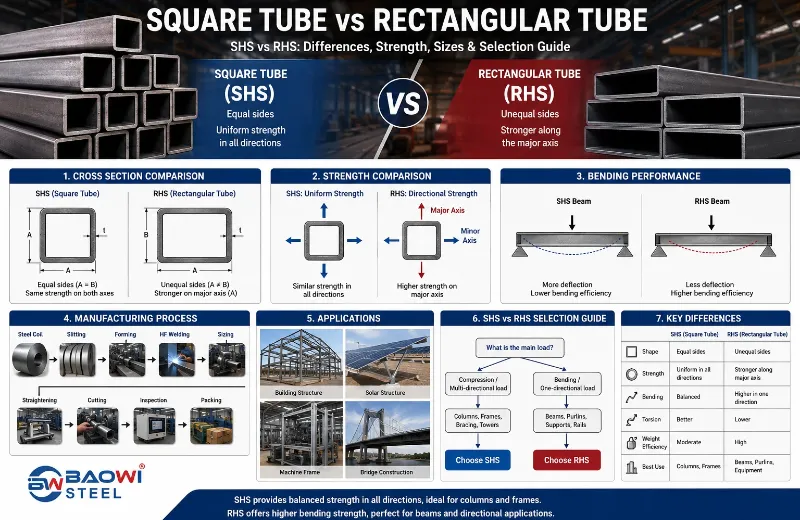
The main difference between square tubes (SHS) and rectangular tubes (RHS) lies in their cross-sectional shape and structural performance.Square tubes have four equal sides, providing balanced strength and stiffness in all directions, making them ideal for columns, frames, and structures subjected to multi-directional loads.Rectangular tubes have unequal sides, creating a stronger axis and a weaker axis.
This allows them to provide higher bending resistance and better material efficiency when loads act in one direction, making them more suitable for beams, purlins, supports, and long-span structures.
Although both products are manufactured according to standards such as ASTM A500, EN 10219, and EN 10210, they are not always interchangeable. Selecting the correct hollow section can improve structural efficiency, reduce steel consumption, and lower overall project costs.
What Are Square and Rectangular Steel Tubes?
Square and rectangular steel tubes belong to the
Hollow Structural Section (HSS) family. They are closed steel profiles manufactured from steel coils or plates through cold-forming and high-frequency welding, or produced as seamless hollow sections for special applications.
Compared with open steel sections such as channels or angles, hollow sections provide higher torsional rigidity, improved buckling resistance, and a better strength-to-weight ratio because material is distributed around a closed cross-section.
1.Square Hollow Section (SHS)
A square tube, also known as a square hollow section (SHS) or square steel tubing, is a hollow structural profile with four equal sides. It is valued for its excellent strength, high load-bearing capacity, and efficient use of material. Manufactured from carbon steel, stainless steel, or aluminum, square tubes are widely used in construction, structural engineering, machinery, furniture, and industrial fabrication.
2.Rectangular Hollow Section (RHS)
Rectangular tubing is a rectangular hollow structural section (RHS) designed to provide high structural strength with reduced weight. Its closed-section design offers excellent bending and torsional resistance while maintaining a clean, modern appearance. Available in carbon steel, stainless steel, and galvanized steel, rectangular tubes are widely used in building structures, machinery, infrastructure, furniture manufacturing, and other engineering applications where strength, durability, and cost efficiency are essential.
Square Tube vs Rectangular Tube: What Is the Difference?
Although SHS and RHS are manufactured using similar materials and production methods, their structural behavior differs considerably.
1. Cross-Section Shape
The most obvious difference is the cross-sectional shape.
Square tubes have equal width and height, forming a perfectly symmetrical profile. Rectangular tubes have different width and height dimensions, creating a deeper section in one direction.
This seemingly simple geometric difference directly affects stiffness, bending strength, and structural efficiency.
|
Property
|
SHS
|
RHS
|
|
Width & Height
|
Equal
|
Different
|
|
Principal Axes
|
Equal
|
Major & Minor
|
|
Structural Symmetry
|
Excellent
|
Directional
|
|
Design Flexibility
|
Moderate
|
High
|
From an engineering perspective, the geometry of RHS allows more steel to be distributed farther from the neutral axis, which increases bending resistance while keeping the overall weight relatively low.
2. Strength Comparison: SHS vs RHS
The structural performance of SHS and RHS is mainly determined by load direction, section properties, and design requirements.
Square Hollow Sections (SHS) have equal width and height, providing similar strength and stiffness around both axes. This balanced geometry makes SHS suitable for columns, vertical supports, and structures exposed to multi-directional loads.
Rectangular Hollow Sections (RHS) have different width and height dimensions, creating a stronger major axis. This allows RHS to achieve higher bending resistance in a specific direction, making it widely used for beams, frames, and horizontal structural members.
In practical applications:
SHS is commonly used for columns, steel frames, and structural supports where balanced strength is required.
RHS is preferred for beams, roof structures, equipment supports, and other applications where bending performance is the main consideration.
The selection between SHS and RHS should be based on the required load capacity, structural design, and material efficiency rather than simply comparing which shape is stronger.
3. Load-Bearing Performance
Under the same steel grade, wall thickness, and approximate cross-sectional area, RHS generally provides higher bending capacity along its major axis because its greater depth increases the section modulus.
However, this advantage exists only when the load acts in the intended direction. If the member is rotated or subjected to multi-directional loading, the weak axis becomes a design limitation.
SHS, on the other hand, offers balanced load-bearing capacity regardless of orientation. Although it may not achieve the highest bending resistance in a single direction, it provides predictable structural behavior under complex loading conditions.
For this reason:
Choose SHS when load direction is uncertain or varies over time.
Choose RHS when the primary bending direction is known during structural design.
4. Standard Sizes and Dimensional Comparison
Although both SHS and RHS are manufactured according to similar international standards, they offer different dimensional combinations to meet various structural requirements.
Square tubes provide equal width and height, making sizing straightforward and interchangeable in many structural designs. Rectangular tubes offer a wider variety of width-to-height ratios, allowing engineers to optimize bending performance without unnecessarily increasing steel weight.
Common SHS Sizes
|
Width × Height (mm)
|
Typical Wall Thickness (mm)
|
|
20 × 20
|
1.2–3.0
|
|
40 × 40
|
1.5–5.0
|
|
50 × 50
|
1.5–6.0
|
|
75 × 75
|
2.0–8.0
|
|
100 × 100
|
2.0–12.0
|
|
150 × 150
|
3.0–16.0
|
|
200 × 200
|
4.0–20.0
|
|
250–500 × 250–500
|
Up to 25 mm
|
Common RHS Sizes
Width × Height (mm)
|
Width × Height (mm)
|
Typical Wall Thickness (mm)
|
|
40 × 20
|
1.2–4.0
|
|
50 × 30
|
1.5–5.0
|
|
80 × 40
|
2.0–6.0
|
|
100 × 50
|
2.0–8.0
|
|
120 × 60
|
2.5–10.0
|
|
150 × 100
|
3.0–12.0
|
|
200 × 100
|
3.0–16.0
|
|
300 × 150 to 600 × 400
|
Up to 25 mm
|
To view the full size chart, please click here. Standard Rectangular Tube Size Table
5. Weight Comparison: SHS vs RHS
The weight of a hollow section depends on its outer dimensions, wall thickness, and steel density. For SHS and RHS with similar cross-sectional areas, the difference in weight is usually small.. Weight and Material Efficiency
Material efficiency directly affects project costs, transportation expenses, and installation efficiency. Although both SHS and RHS can satisfy structural requirements, they distribute steel differently. Therefore, their efficiency varies depending on the loading condition.
Because a rectangular tube places more material farther from the neutral axis, it achieves a higher section modulus without significantly increasing weight. As a result, RHS often requires less steel to carry the same bending load.
In contrast, SHS distributes material evenly around the section. This balanced design improves stability but may use more steel in applications where loads act primarily in one direction.
|
Section
|
Size
|
Wall Thickness
|
Weight
|
|
SHS
|
100 × 100 mm
|
5 mm
|
Approx. 14.9 kg/m
|
|
RHS
|
120 × 80 mm
|
5 mm
|
Approx. 15.2 kg/m
|
Key Difference: RHS provides higher bending efficiency when loads are applied in one direction, while SHS offers more balanced strength and better torsional resistance in multi-directional loading conditions.
6. International Standards and Steel Grades
Square and rectangular tubes are manufactured according to various international standards depending on the project location and structural requirements.
|
Standard
|
Description
|
|
ASTM A500
|
Carbon structural tubing for buildings and bridges
|
|
ASTM A513
|
Mechanical tubing for machinery and equipment
|
|
EN 10219
|
Cold-formed welded structural hollow sections
|
|
EN 10210
|
Hot-finished structural hollow sections
|
|
JIS G3466
|
Japanese structural square and rectangular tubes
|
|
GB/T 6728
|
Chinese cold-formed hollow sections
|
7. Space Utilization
Space utilization becomes increasingly important in industrial buildings, warehouses, equipment frames, and modular structures.
Since RHS has a lower profile in one direction, it fits more easily within limited installation spaces. Moreover, engineers can increase structural depth without excessively increasing width.
SHS, however, provides a symmetrical appearance that simplifies architectural detailing and connection design.
|
Feature
|
Square Tube (SHS)
|
Rectangular Tube (RHS)
|
|
Cross Section
|
Square
|
Rectangle
|
|
Strength Distribution
|
Equal in all directions
|
Higher along the major axis
|
|
Best Structural Use
|
Columns, frames
|
Beams, purlins, supports
|
|
Bending Performance
|
Balanced
|
Superior in one direction
|
|
Weight Efficiency
|
Good
|
Better for bending members
|
|
Material Utilization
|
Moderate
|
Higher
|
|
Structural Appearance
|
Symmetrical
|
Directional
|
|
Typical Industries
|
Buildings, towers, machinery
|
Warehouses, bridges, trailers
|
SHS vs RHS vs CHS
Besides square and rectangular tubes, Circular Hollow Sections (CHS) are another common structural profile.
|
Feature
|
SHS
|
RHS
|
CHS
|
|
Shape
|
Square
|
Rectangle
|
Circular
|
|
Compression
|
Excellent
|
Good
|
Excellent
|
|
Bending
|
Good
|
Excellent
|
Moderate
|
|
Torsional Resistance
|
Good
|
Moderate
|
Excellent
|
|
Structural Appearance
|
Excellent
|
Good
|
Excellent
|
|
Typical Application
|
Columns
|
Beams
|
Towers, Poles
|

Applications: When to Use SHS vs RHS?
The choice between SHS and RHS depends on the structural function rather than the material itself.
SHS is ideal for columns, bracing systems, and structural frames because it provides uniform strength in both directions. This balanced performance improves stability under multidirectional loads, making SHS a common choice for steel building columns and frame structures.
RHS is better suited for beams, purlins, equipment platforms, and support structures where bending is the primary load. Its greater section depth delivers higher bending strength with less steel, improving material efficiency.
When appearance and connection consistency are important, SHS offers a clean, symmetrical profile. However, when installation space is limited or higher bending performance is required, RHS provides a more efficient structural solution.
FAQ
Is RHS stronger than SHS?
Not necessarily. RHS provides higher bending strength along its major axis, while SHS offers balanced strength in all directions.
Which is better for columns?
Square Hollow Sections are generally preferred because they provide uniform compression resistance and symmetrical stiffness.
Why do engineers use RHS for beams?
The greater section depth increases the section modulus, allowing higher bending resistance with similar steel weight.
Can SHS replace RHS?
Only after structural verification. Although they may have similar weight, their mechanical properties differ significantly.
Which is more economical?
For beam applications, RHS generally reduces material consumption. For columns and symmetrical structures, SHS often provides the most practical solution.
Are SHS and RHS manufactured to the same standards?
Yes. Both are commonly produced according to ASTM A500, EN 10219, EN 10210, JIS G3466, and GB/T 6728, depending on the project requirements.
Read more related articles
Rectangular Tube Thickness Chart: Standard Wall Thickness Guide

 English
 Español
 بالعربية






 Phone :
  Whatsapp :
  Email :


