A drill collar is a heavy, thick-walled tubular component used in the bottom hole assembly (BHA). It is normally positioned between the drill pipe and the drill bit.The main purpose of a drill collar is to provide weight on bit (WOB) and stiffness near the bottom of the drill string. Its weight helps the bit penetrate the formation, while its high stiffness improves BHA stability and reduces excessive bending.
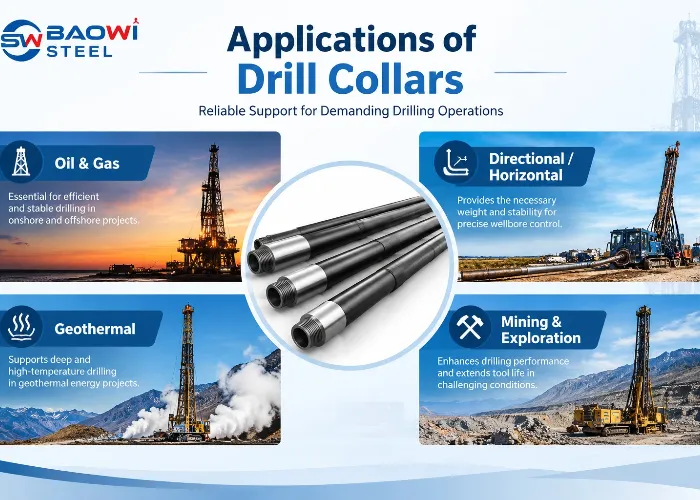
Drill collars are widely used in oil and gas drilling. They are also used in directional, horizontal, geothermal, mining, exploration, and water well drilling. The required design depends on the well depth, hole size, formation, drilling method, and downhole tools.
Where Are Drill Collars Used?
Drill collars are used in several types of drilling operations. The application determines the required collar size, material, configuration, and connection design.
1.Oil and Gas Drilling
Oil and gas drilling is the most common application for drill collars.In conventional vertical wells, drill collars provide WOB and maintain stability near the bit. They form an important part of the BHA and help transfer drilling loads to the formation.
In deeper wells, the BHA must withstand higher mechanical loads and more demanding downhole conditions. Drill collar selection therefore considers factors such as:
Well depth
Hole size
Required WOB
Formation strength
BHA configuration
Drilling speed
Downhole temperature and pressure
Drill collars are also used with specialized downhole tools in modern drilling systems.
2.Directional and Horizontal Drilling
Directional and horizontal wells place additional demands on BHA design.
As the well deviates from vertical, gravity and contact between the drill string and wellbore can change the mechanical behavior of the BHA. Properly selected drill collars provide the stiffness and weight needed for controlled drilling.
In these applications, engineers consider more than collar weight. They also evaluate:
Collar diameter
Collar stiffness
Collar length
Stabilizer position
Wellbore trajectory
Bit design
Required directional tendency
The drill collar is therefore part of a larger directional drilling system rather than an isolated component.
3.Geothermal Drilling
Geothermal wells can expose drilling equipment to high temperatures, substantial mechanical loads, and potentially corrosive fluids.
Drill collars used in geothermal drilling must therefore be selected according to the actual operating environment. Material strength, fatigue resistance, temperature capability, corrosion conditions, and connection performance can all affect service life.
The exact material should be determined by the drilling design and operating conditions rather than by application name alone.
4.Mining and Exploration Drilling
Drill collars can also be used in mining and exploration drilling where additional weight and stiffness are required near the bit.
Hard rock formations can create significant vibration and mechanical loading. A properly designed BHA helps maintain drilling stability and transfer the required force to the bit.
For exploration work, the collar configuration may also depend on hole diameter, drilling depth, core or non-core drilling requirements, and the type of downhole equipment being used.
5.Water Well Drilling
Drill collars are used in some water well drilling operations to add weight and improve BHA stability.
The requirements are often different from those of deep oil and gas wells. Selection may focus on achieving sufficient drilling force while maintaining a practical balance between equipment cost, durability, and operating conditions.
The appropriate drill collar size should be determined according to the drilling rig, hole size, formation, and required drilling performance.
What Is a Drill Collar Used For?
Drill collars have several functions in a drilling system. Their primary purpose is to place controlled weight and stiffness close to the drill bit.
Providing Weight on Bit
The most important function of a drill collar is to provide weight on bit.The drill bit needs sufficient WOB to break and penetrate the formation. Drill collars add concentrated mass to the lower part of the BHA. This allows the drilling system to apply the required force to the bit without relying entirely on the weight of the drill pipe.
The required WOB varies with the bit type, formation strength, hole size, and drilling parameters. Therefore, the number, size, and weight of drill collars are selected as part of the overall BHA design.
Stabilizing the Bottom Hole Assembly
Drill collars also help stabilize the lower drill string.
Their large outside diameter and thick walls give them much higher stiffness than conventional drill pipe. This stiffness helps control lateral movement and unwanted vibration near the bit.A stable BHA can improve drilling efficiency and help maintain more consistent contact between the bit and formation.
Reducing Drill String Bending
Drilling creates both axial and lateral loads. Excessive bending can increase stress in the drill string and contribute to fatigue or premature failure.The larger cross-section of a drill collar provides greater resistance to bending. When properly positioned in the BHA, drill collars help keep the lower drill string stable under compressive loading.This is particularly important in deviated and directional wells, where the drill string is exposed to more complex mechanical forces.
Supporting Directional Control
Drill collar placement also affects the behavior of the BHA during directional drilling.
The stiffness, diameter, and position of the collars influence how the BHA responds to the wellbore. Engineers can adjust the BHA configuration to support the required build, hold, or drop tendency.
For this reason, drill collars are not simply weights attached above the bit. Their mechanical characteristics are an important part of directional drilling design.
How Do Drill Collars Work in a Bottom Hole Assembly?
A typical drilling string contains several sections with different functions.
A simplified arrangement is:
Drill Pipe → Heavy Weight Drill Pipe → Drill Collars → Stabilizer → Drill Bit
The exact BHA configuration varies according to the well design.
Position of the Drill Collar in the BHA
Drill collars are normally placed in the lower portion of the BHA, close to the drill bit.
This position is important because weight placed near the bit is more effective for controlling the mechanical behavior of the lower drill string.
The drill pipe mainly provides the length needed to reach the bottom of the well and transmits torque and drilling fluid. Drill collars provide greater mass and stiffness in the lower BHA.For more information about drill pipe, see our Drill Pipe product page.
Drill Collar Types for Different Applications
Different drilling conditions may require different drill collar designs.
1.Conventional Steel Drill Collars
Conventional steel drill collars are widely used where high strength, stiffness, and durability are required.They are manufactured with thick walls and suitable threaded connections for integration into the BHA.
Material selection depends on the required mechanical properties and service conditions.For available drill collar products and specifications, see our Drill Collars product page.
2.Spiral Drill Collars
Spiral drill collars have machined spiral grooves along the outside surface.
The grooves reduce the external contact area between the collar and wellbore. They can also provide additional space for drilling fluid and cuttings around the collar.Spiral designs are particularly useful when reducing differential sticking risk and improving downhole circulation around the collar are important considerations.
3.Non-Magnetic Drill Collars
Non-magnetic drill collars are used when magnetic interference could affect downhole measurement tools.
They are commonly associated with measurement while drilling (MWD) and logging while drilling (LWD) systems. These tools use downhole sensors to obtain information about well trajectory and formation conditions.A non-magnetic section around the measurement equipment can help provide the required magnetic environment for accurate directional measurements.For a more detailed explanation, see our guide to What Are Non-Magnetic Drill Collars?.
FAQ
Can drill collars be used in directional drilling?
Yes. Drill collars are an important part of many directional drilling BHAs. Their weight, stiffness, diameter, and placement influence BHA behavior and directional control.
Why are drill collars used below drill pipe?
Drill collars are placed near the bit because their high weight and stiffness are most useful in the lower BHA. This arrangement helps provide WOB and maintain stability while reducing excessive bending in the drill string.
Are non-magnetic drill collars used with MWD and LWD?
Yes. Non-magnetic drill collars can be used around magnetic-sensitive MWD and LWD equipment when magnetic interference needs to be minimized.
How many drill collars are needed in a BHA?
There is no universal number. The required quantity depends on WOB, hole size, well trajectory, BHA design, collar dimensions, formation conditions, and drilling parameters.
What is the difference between a drill collar and a drill pipe?
A drill collar is heavier, thicker, and much stiffer than drill pipe. Its primary role is to provide weight and stiffness near the bit. Drill pipe mainly transmits torque, drilling fluid, and mechanical loads between the surface and BHA.
Conclusion
Drill collars are more than heavy components added to a drill string. They are important mechanical elements of the bottom hole assembly.Their main functions are to provide weight on bit, increase BHA stiffness, reduce unwanted bending, improve stability, and support directional drilling.
The most common applications include oil and gas drilling, directional and horizontal drilling, geothermal drilling, mining and exploration, and some water well operations.The correct drill collar depends on the drilling environment and BHA design. Size, weight, wall thickness, material, magnetic properties, well trajectory, and downhole conditions should all be considered before selection.For drilling projects that require reliable BHA components,
Baowi Steel's Drill Collars can be selected according to the required specifications and application.

 English
 Español
 بالعربية

 Phone :
  Whatsapp :
  Email :


