Galvanized seamless steel pipe is manufactured by forming a seamless steel tube and applying a protective zinc coating, usually through hot-dip galvanizing. Unlike welded galvanized pipe, it has no longitudinal weld seam and combines the structural properties of seamless steel with the corrosion protection provided by zinc.
It is commonly selected for industrial piping, mechanical applications, construction projects, and fluid transportation where both pipe strength and surface corrosion resistance are required. Its performance depends on the base steel grade, manufacturing process, zinc coating quality, and applicable product standards.
This guide explains galvanized seamless steel pipe specifications, available steel grades, hot-dip galvanizing methods, coating requirements, inspection procedures, and common applications to help buyers make informed purchasing decisions.
What Is Galvanized Seamless Steel Pipe?
Galvanized seamless steel pipe is a steel pipe manufactured without a welded joint and subsequently coated with zinc to improve its resistance to corrosion.
The manufacturing process generally involves two main stages:
1.Seamless pipe production: Solid steel billets are heated, pierced, rolled, or drawn into hollow steel pipes.
2.Galvanizing: The finished seamless pipe is cleaned and coated with zinc, commonly through hot-dip galvanizing.
The seamless construction eliminates the longitudinal weld seam found in welded pipes, while the zinc coating provides an additional barrier against moisture and corrosive environments.
Galvanized seamless pipe is different from ordinary galvanized welded pipe. Although both have zinc coatings, their manufacturing processes and mechanical characteristics are different.
Galvanized Seamless Pipe vs. Galvanized Welded Pipe
|
Comparison
|
Galvanized Seamless Pipe
|
Galvanized Welded Pipe
|
|
Manufacturing
|
Hot rolling or cold drawing
|
Formed from steel strip or plate
|
|
Pipe seam
|
No longitudinal weld seam
|
Contains a welded seam
|
|
Base material
|
Solid steel billet
|
Steel strip or plate
|
|
Production cost
|
Generally higher
|
Generally lower
|
|
Typical applications
|
Mechanical and demanding industrial service
|
General construction and piping
|
The choice depends on working pressure, design requirements, dimensions, applicable standards, and project budget.
Seamless construction does not automatically make a pipe suitable for every high-pressure application; the specified grade, wall thickness, and test requirements must also be considered.
How Is Hot-Dip Galvanized Seamless Steel Pipe Manufactured?
Hot-dip galvanizing is a common method for producing corrosion-resistant seamless steel pipes. It involves immersing a properly prepared steel pipe in molten zinc so that a protective zinc coating forms on its surface.
The process generally includes the following steps.
1. Seamless Steel Pipe Production
A solid steel billet is heated and pierced to create a hollow shell. The shell is then rolled or drawn to obtain the required outside diameter and wall thickness.
Depending on the production method, seamless pipes can be classified as hot-rolled or cold-drawn seamless steel pipes.
2. Surface Preparation
Before galvanizing, the pipe surface must be cleaned to remove oil, grease, rust, scale, and other contaminants.
Typical preparation stages include:
Degreasing to remove oil and grease.
Pickling to remove rust and iron oxide.
Water rinsing to remove residual chemicals.
Flux treatment to prepare the steel surface for zinc coating.
Drying before immersion in molten zinc.
Proper surface preparation is essential for achieving consistent coating adhesion.
3. Hot-Dip Galvanizing
The cleaned and prepared seamless pipe is immersed in a molten zinc bath, typically maintained at approximately 450°C.
The molten zinc reacts with the steel surface to form zinc-iron alloy layers, usually covered by an outer zinc layer. This metallurgical bond provides corrosion protection and coating adhesion.
4. Cooling and Surface Inspection
After galvanizing, the pipe is removed from the zinc bath and cooled under controlled conditions.
The finished pipe is then inspected for coating continuity, surface defects, dimensional compliance, and other specified requirements.
Hot-Dip Galvanized vs. Electro-Galvanized Seamless Steel Pipe
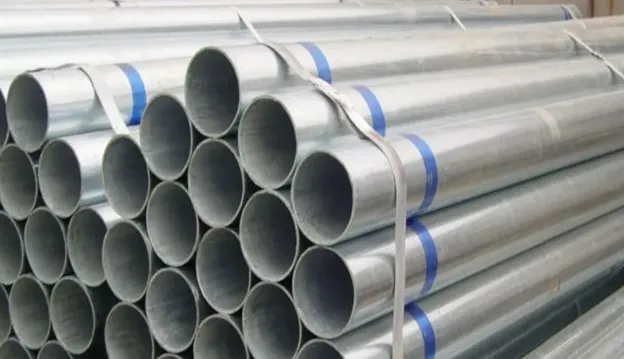
Not all galvanized steel pipes have the same zinc coating. Hot-dip galvanizing and electro-galvanizing use different processes and produce different coating characteristics.
|
Comparison
|
Hot-Dip Galvanizing
|
Electro-Galvanizing
|
|
Process
|
Immersion in molten zinc
|
Electrolytic zinc deposition
|
|
Coating thickness
|
Generally thicker
|
Generally thinner
|
|
Coating structure
|
Zinc-iron alloy layers and outer zinc
|
Deposited zinc layer
|
|
Corrosion protection
|
Generally better for demanding exposure
|
Generally suitable for less corrosive conditions
|
|
Typical use
|
Industrial and outdoor applications
|
Indoor and less demanding applications
|
Hot-dip galvanized seamless pipes are generally preferred where longer-lasting corrosion protection is required.
Electro-galvanizing may be suitable for applications requiring a thinner, more uniform zinc finish, depending on the project requirements.
The two methods should not be considered interchangeable. Buyers should specify the coating process, coating thickness, and applicable standard when placing an order.
Galvanized Seamless Steel Pipe Grades and Specifications
The properties of galvanized seamless steel pipe depend primarily on the base steel grade and the dimensional requirements.
Common material grades vary according to the applicable product standard and intended application.
|
Steel Grade
|
Material Category
|
Typical Characteristics
|
|
ASTM A53 Grade A
|
Carbon steel
|
General mechanical and pressure applications
|
|
ASTM A53 Grade B
|
Carbon steel
|
Higher specified strength than Grade A
|
|
20#
|
Carbon steel
|
Commonly used for mechanical and fluid applications
|
|
45#
|
Medium-carbon steel
|
Higher strength potential after suitable heat treatment
|
|
Q235B
|
Carbon structural steel
|
General structural applications
|
|
Q355B
|
Low-alloy structural steel
|
Higher-strength structural applications
|
These grades belong to different material specifications and are not automatically interchangeable. For example, ASTM A53 Grade B and Q355B should not be treated as equivalent materials.
The correct material should be selected according to chemical composition, mechanical properties, manufacturing requirements, and the applicable standard.
Main Dimensional Specifications
Galvanized seamless steel pipes are available in different outside diameters, wall thicknesses, and lengths.
|
Specification
|
Description
|
|
Outside Diameter (OD)
|
The external diameter of the pipe
|
|
Wall Thickness (WT)
|
The thickness of the steel pipe wall
|
|
Nominal Pipe Size (NPS)
|
Standard pipe size designation
|
|
Schedule
|
Nominal wall thickness designation
|
|
Length
|
Fixed or random lengths according to order requirements
|
|
Zinc Coating
|
Specified coating mass or thickness
|
For projects using NPS dimensions, ASME B36.10M is commonly referenced for the dimensions of welded and seamless wrought steel pipes.
The actual dimensions and tolerances should be confirmed against the selected product specification and purchase order.
Standards for Galvanized Seamless Steel Pipe
Selecting the correct standard is important because the base pipe and its zinc coating have different technical requirements.
ASTM A53/A53M
ASTM A53/A53M is one of the important standards for galvanized seamless steel pipe. It covers black and hot-dipped zinc-coated welded and seamless steel pipes.
The standard includes three manufacturing types:
Type F: Furnace-butt-welded pipe.
Type E: Electric-resistance-welded pipe.
Type S: Seamless pipe.
For seamless pipe, Type S is available in Grades A and B.
ASTM A53 galvanized pipe requirements include zinc coating on both the inside and outside surfaces. The standard also specifies coating requirements and inspection provisions.
Other Relevant Standards
|
Standard
|
Main Scope
|
|
ASTM A53/A53M
|
Black and hot-dip galvanized welded and seamless steel pipe
|
|
ASME B36.10M
|
Dimensions of welded and seamless wrought steel pipe
|
|
ASTM A106/A106M
|
Seamless carbon steel pipe for high-temperature service
|
|
ASTM A123/A123M
|
Hot-dip galvanized coatings on applicable iron and steel products
|
|
ISO 1461
|
Hot-dip galvanized coatings on fabricated iron and steel articles
|
Important: ASTM A53 is particularly relevant because it directly covers hot-dip galvanized seamless pipe. ASTM A123 and ISO 1461 should not automatically be applied to every galvanized pipe.
Their scopes contain exclusions for certain pipe and tube products galvanized on specialized or automatic production lines.
Always confirm the coating requirements under the applicable pipe product standard and the purchaser's specification before ordering.
Zinc Coating Thickness and Quality Requirements
Zinc coating thickness is one of the important factors affecting the corrosion resistance of galvanized seamless steel pipe.
A thicker coating generally provides more zinc for corrosion protection, but coating thickness alone does not determine service life. Environmental exposure, coating continuity, surface condition, and installation practices also matter.
ASTM A53 Zinc Coating Requirement
For galvanized pipe ordered under ASTM A53/A53M, the coating requirement includes a minimum zinc coating mass of 0.55 kg/m² (1.8 oz/ft²), based on the specified test results.
This is a coating mass requirement, not a universal thickness value for every galvanized seamless pipe.
Buyers should distinguish between:
Zinc coating mass, expressed in g/m² or kg/m².
Zinc coating thickness, expressed in μm.
Local coating thickness and average coating thickness.
These measurements are related but should not be used interchangeably without considering the applicable test method and coating density.
How to Inspect Zinc Coating Quality ?
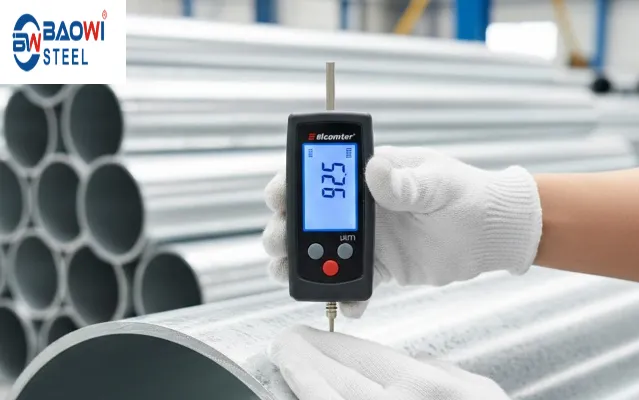
Several inspection methods can be used to evaluate the galvanized coating.
|
nspection Method
|
What It Checks
|
|
Visual Inspection
|
Uncoated areas, blisters, zinc lumps, and surface defects
|
|
Magnetic Thickness Gauge
|
Local zinc coating thickness
|
|
Coating Mass Test
|
Zinc coating mass per unit area
|
|
Adhesion Inspection
|
Coating bonding and resistance to handling damage
|
|
Dimensional Inspection
|
Outside diameter, wall thickness, and length
|
For accurate inspection, the sampling method and acceptance criteria should follow the specified product standard.
Applications of Galvanized Seamless Steel Pipe
Galvanized seamless steel pipe combines the mechanical properties of seamless steel with the corrosion protection of zinc coating.
Its suitability depends on the working pressure, temperature, fluid properties, and environmental conditions.
|
Industry
|
Typical Applications
|
|
Construction
|
Structural supports and industrial piping
|
|
Mechanical Engineering
|
Mechanical components and equipment
|
|
Petroleum Industry
|
Selected auxiliary and utility piping
|
|
Chemical Industry
|
Suitable process and utility piping
|
|
Power Generation
|
Auxiliary piping and supporting systems
|
|
Water Systems
|
Selected water transportation and distribution applications
|
Advantages and Limitations of Galvanized Seamless Steel Pipe
Advantages
No longitudinal weld seam: Seamless construction eliminates the welded joint along the pipe body.
Corrosion protection: The zinc coating helps protect the steel surface against atmospheric corrosion.
Mechanical strength: The base steel grade provides the required mechanical properties when correctly specified
Versatile applications: Available in different dimensions and grades for various industrial uses.
Longer service potential: A suitable zinc coating can reduce corrosion-related maintenance under appropriate conditions.
Limitations
Higher purchase cost: Seamless production and additional galvanizing processes generally increase manufacturing costs.
Limited availability: Some galvanized seamless pipe sizes and grades may require special production arrangements.
Coating damage: Cutting, threading, welding, or mechanical handling can damage the zinc layer.
Application restrictions: Zinc coatings may not be suitable for every fluid, temperature, or chemical environment.
Frequently Asked Questions About Galvanized Seamless Steel Pipe
1. What is galvanized seamless steel pipe?
Galvanized seamless steel pipe is a seamless steel tube coated with zinc to improve corrosion resistance. It is manufactured without a longitudinal weld seam and is commonly hot-dip galvanized after seamless pipe production.
2. Is galvanized seamless steel pipe hot-dip galvanized?
Most industrial galvanized seamless steel pipes use hot-dip galvanizing. However, the coating method should always be confirmed in the product specification and purchase documents.
3. What is the difference between galvanized seamless pipe and galvanized welded pipe?
The main difference is the manufacturing process. Seamless pipe is produced from solid steel billets without a longitudinal weld, while welded pipe is formed from steel strip or plate and joined by welding.
4. What standard covers galvanized seamless steel pipe?
ASTM A53/A53M covers both welded and seamless black and hot-dip galvanized steel pipes. Type S refers to seamless pipe, which is available in Grades A and B.
5. What is the zinc coating thickness of galvanized seamless steel pipe?
The required coating depends on the applicable product standard and purchase specification. ASTM A53 specifies a minimum coating mass of 0.55 kg/m² for galvanized pipe. Actual coating thickness should be verified using the specified inspection method.
Conclusion
Galvanized seamless steel pipe is a suitable option for projects that require seamless pipe construction combined with zinc-based corrosion protection. Selecting the right product requires more than checking its appearance. Buyers should evaluate the steel grade, pipe dimensions, manufacturing method, zinc coating requirements, applicable standards, and inspection documentation.
BAOWI Steel supplies seamless steel pipes and other steel products for international industrial and construction projects. Contact us with your required steel grade, dimensions, coating specifications, and quantity to discuss product availability and customized supply requirements.
References
HDG vs GI Steel Pipe: Understanding the Key Differences

 English
 Español
 بالعربية
 Phone :
 Whatsapp :
 Email :