What Is an MS Rectangular Tube?
MS rectangular tube refers to a Mild Steel Rectangular Tube, also known as a mild steel rectangular hollow section (RHS). It is a hollow steel profile with a rectangular cross-section and is widely used in structural, mechanical, and fabrication applications.
The term “MS” means Mild Steel, which refers to low-carbon steel containing a relatively small amount of carbon. Due to its excellent weldability, good formability, and cost-effectiveness, mild steel is one of the most commonly used materials for manufacturing rectangular tubes.
Unlike solid steel bars, MS rectangular tubes have a hollow structure that provides an excellent strength-to-weight ratio. This design reduces material consumption and overall weight while maintaining sufficient structural strength.
MS rectangular tubes are commonly manufactured from carbon steel and are available in different sizes, wall thicknesses, and grades according to project requirements and international standards.
What Does MS Mean in Steel Products?
In the steel industry, MS stands for Mild Steel, a type of low-carbon steel that typically contains a small amount of carbon. It is widely used in structural and fabrication applications due to its good weldability, machinability, and formability.
Compared with higher-carbon steels, mild steel is easier to cut, bend, and weld, making it suitable for manufacturing products such as rectangular tubes, pipes, plates, and structural components. Its balance of strength, flexibility, and affordability makes MS one of the most commonly used steel materials in construction, machinery, and general engineering projects.
MS Rectangular Tube Material and Grades
MS rectangular tubes are mainly produced from carbon steel, especially low-carbon structural steel. The selected steel grade depends on the required strength, fabrication method, and application environment.
Common materials include:
|
Material Type
|
Description
|
|
Mild Steel
|
Low-carbon steel with good weldability and formability
|
|
Carbon Structural Steel
|
Used for general construction and engineering applications
|
|
Low-Alloy Steel
|
Provides higher strength for demanding applications
|
|
Standard
|
Typical Grades
|
|
ASTM
|
ASTM A500 Grade B, Grade C
|
|
EN
|
S235JR, S355JR
|
|
JIS
|
SS400
|
|
China Standard
|
Q235, Q355
|
Among these grades, ASTM A500 is one of the most widely used specifications for structural rectangular tubes in North America.
For detailed ASTM requirements, dimensions, and mechanical properties, refer to:What Is ASTM A500 Rectangular Tube?
Characteristics of MS Rectangular Pipes
Some of the notable features of mild steel pipes and steel tubes are high tensile strength, these pipes comply with the American Society for Testing and Materials (ASTM) specifications, MS pipes are very strong, low carbon content, can be easily welded, simple to manufacture, easy to work with, not very expensive compared to other metals, and exist for 100 years or more. Some of the major applications of mild steel pipes are structural purposes, mechanical reasons, general construction, residential applications, planning transport bodies, fencing, building structures, and water supply steel pipes.
Rectangular mild steel pipes have notable features such as high quality, large consumption barriers, high strength, and easy deformation. Round MS pipes are used in some applications, for example, modern water pipelines, plant access, agribusiness and water supply systems, incentive steel fences, street barriers, stop boundaries, fences, steel doors and windows, roadside railings, foundation and construction works, water supply pipelines, etc.
MS Rectangular Tube Specifications
MS rectangular tubes are available in a wide range of dimensions to meet different structural and fabrication requirements.
The selection of tube size mainly depends on:
Required load capacity
Structural design requirements
Installation conditions
Fabrication methods
Weight limitations
Common specification parameters include:
|
Item
|
Description
|
|
Material
|
Mild Steel / Low Carbon Steel
|
|
Section Shape
|
Rectangular Hollow Section (RHS)
|
|
Manufacturing Method
|
ERW welded process
|
|
Width Range
|
20 mm – 200 mm
|
|
Height Range
|
10 mm – 300 mm
|
|
Wall Thickness
|
1.2 mm – 15 mm
|
|
Standard Length
|
6 m, 9 m, 12 m or customized
|
|
Surface Treatment
|
Black, galvanized, painted, coated
|
|
Standards
|
ASTM A500, EN10219, JIS G3466, GB/T6728
|
For detailed dimensions, outside diameter, wall thickness, and weight information, please refer to:
Standard Rectangular Tube Size Table
Rectangular Tube Thickness Chart
Rectangular Tube Weight Chart
Key Features of MS Rectangular Tube
Here are the main characteristics that make MS rectangular tubes a reliable choice for a wide range of applications:
1. High-Quality Material
MS rectangular tubes are made from mild steel, a low-carbon steel known for its durability, ductility, and strength. This makes the tubes suitable for both heavy-duty and lightweight structural needs.
2. Rectangular Cross-Section
As the name suggests, these tubes have a rectangular shape. They come in a wide variety of sizes and wall thicknesses to suit different project specifications.
3. Hollow Structure for Weight Efficiency
The tube’s hollow interior reduces weight without compromising strength. This structural efficiency is ideal for large-scale projects where reducing dead load is essential.
4. Economical and Eco-Friendly
Compared to other steel materials, mild steel is more affordable. Its lower carbon content also results in less environmental impact, aligning with sustainable building practices.
5. Excellent Weldability
Mild steel is highly weldable, which simplifies fabrication. This allows engineers and manufacturers to create custom structures, frames, and supports with ease.
6. Impressive Mechanical Properties
MS rectangular tubes offer high plasticity and toughness. They can be formed into various shapes and maintain good strength and hardness even under stress.
Uses of MS Rectangular Tube:
Construction: Because of their high strength and structural stability, MS rectangular tubes are widely used in construction projects for building frames, support structures, beams, and columns.
Fencing: MS rectangular tubes are commonly used in fencing systems to create strong, durable, and reliable barriers for residential, commercial, and industrial properties.
Automotive: In the automotive sector, MS rectangular tubes are used for manufacturing structural components such as chassis frames, roll cages, and other supporting parts that require strength and rigidity.
Industrial Machinery: These tubes are frequently applied in industrial equipment and machinery manufacturing, including machine frames, supports, and fabricated components.
Furniture: Due to their durability, easy fabrication, and modern appearance, MS rectangular tubes are often used for producing furniture frames such as tables, chairs, racks, and shelving systems.
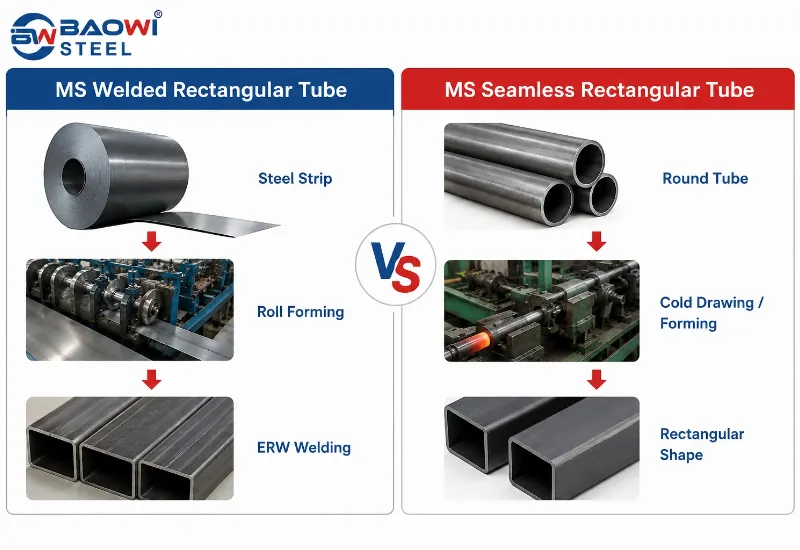
MS Welded Rectangular Tubes vs MS Seamless Rectangular Tubes
MS rectangular tubes can be classified into welded rectangular tubes and seamless rectangular tubes according to their manufacturing processes. The main differences between them are the production method, weld structure, cost, and application requirements.
MS Welded Rectangular Tubes:
MS welded rectangular tubes are produced by forming steel strips or plates into a rectangular shape and joining the edges through welding. Among them, ERW (Electric Resistance Welded) rectangular tubes are the most commonly used due to their high production efficiency, accurate dimensions, and cost-effectiveness.
Modern ERW technology provides reliable weld quality and consistent mechanical performance, making welded rectangular tubes widely used in construction, machinery frames, transportation structures, and general fabrication applications.
MS Seamless Rectangular Tubes:
MS seamless rectangular tubes are manufactured without a welded seam. They are typically produced by forming seamless round tubes into rectangular sections through cold drawing or specialized forming processes.
Because they have no weld seam, seamless rectangular tubes offer uniform structural performance and are often selected for precision applications or projects with specific mechanical requirements. However, their manufacturing process is more complex, resulting in higher costs compared with welded tubes.
FAQ
What does MS mean in rectangular tube?
MS stands for Mild Steel, which is a low-carbon steel known for good weldability, formability, and affordability. MS rectangular tube is a hollow structural section made from mild steel for construction, fabrication, and general engineering applications.
Is MS rectangular tube the same as carbon steel tube?
MS rectangular tube is a type of carbon steel tube. It specifically refers to low-carbon steel, which offers better weldability and easier fabrication compared with higher-carbon steel.
What standard is used for MS rectangular tube?
Common standards for MS rectangular tubes include ASTM A500, EN 10219, JIS G3466, and GB/T 6728. The applicable standard depends on the project requirements and application.
Is ASTM A500 suitable for MS rectangular tube?
Yes. ASTM A500 is one of the most common standards for structural MS rectangular tubes, especially in North America. ASTM A500 Grade B and Grade C are widely used for construction and structural applications.
What is the difference between MS and galvanized rectangular tube?
MS rectangular tubes are untreated mild steel products, while galvanized rectangular tubes have a zinc coating for improved corrosion resistance. Galvanized tubes are more suitable for outdoor or moisture-exposed applications.

 English
 Español
 بالعربية

 Phone :
  Whatsapp :
  Email :


