What Is the Rectangular Tube Manufacturing Process?
The
rectangular tube manufacturing process involves converting steel coils into hollow structural sections through a series of production steps, including forming, welding, sizing, straightening, and quality inspection.
Most rectangular tubes are manufactured using ERW (Electric Resistance Welding) technology. This production method offers high efficiency, stable dimensional accuracy, reliable weld quality, and consistent mechanical performance, making it widely used for structural and industrial applications.
The quality of rectangular tubes depends not only on production equipment but also on raw material selection, forming processes, welding parameters, and inspection procedures. Therefore, professional manufacturers strictly control every stage of production to ensure that their products meet international standards such as
ASTM A500,
EN 10219, and JIS G3466.
For different project requirements, customers usually select rectangular tubes based on dimensions, wall thickness, material grade, and weight. Detailed specifications are available in our rectangular tube size chart.
Compared with seamless rectangular tubes, welded rectangular tubes are more commonly used in construction, machinery, transportation, and industrial applications because they provide a practical balance between structural performance, production efficiency, and cost.
How Are Rectangular Tubes Made?
Rectangular tubes are manufactured by gradually forming flat steel strips into hollow sections and welding the edges together.
Unlike seamless tubes, which are produced from solid steel billets, welded rectangular tubes start from steel coils. The strip passes through multiple forming rollers, changes from a flat shape into a round tube, and is then welded and reshaped into the final rectangular profile.
The basic manufacturing process is:
Steel Coil → Uncoiling → Leveling → Roll Forming → ERW Welding → Sizing → Straightening → Cutting → Inspection → Packaging
Each production stage plays an important role in achieving accurate dimensions and reliable structural performance.
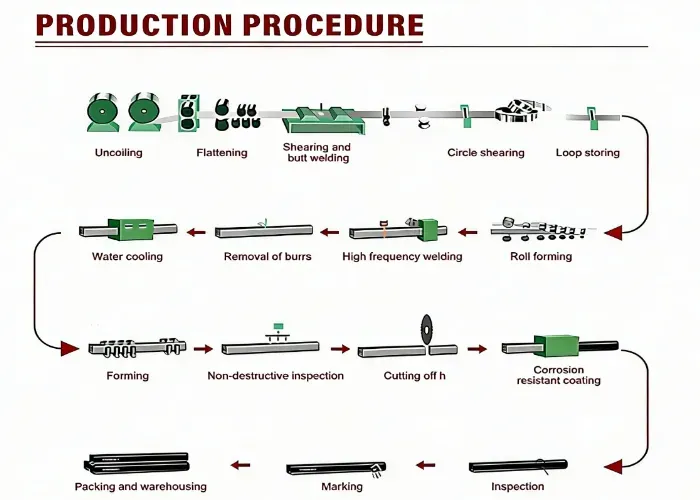
The typical production process includes:
1.Raw material preparation
2.Steel strip forming
3.High-frequency welding
4.Sizing and calibration
5.Straightening
6.Cutting
7.Quality inspection
8.Packaging
1.Raw Material Selection
High-quality raw materials are the foundation of a reliable rectangular tube. Most manufacturers use hot-rolled steel coils because they provide excellent formability, weldability, and mechanical properties. Cold-rolled steel, galvanized steel, and stainless steel coils are also selected for specific applications.
Before production begins, every steel coil undergoes strict quality inspection. Engineers verify the material certificate, chemical composition, mechanical properties, thickness tolerance, and surface condition to ensure the material meets the required specification.
Common materials include:
|
Material Standard
|
Typical Grade
|
Main Application
|
|
ASTM A500
|
Grade B / Grade C
|
Structural steel tubing
|
|
ASTM A513
|
Mechanical Tubing
|
Machinery manufacturing
|
|
EN 10219
|
S235 / S355
|
Steel structures
|
|
Q235B
|
Mild Steel
|
General fabrication
|
|
Q355B
|
High-strength Steel
|
Heavy structural projects
|
ASTM A500 is one of the most commonly used standards for structural rectangular tubes in North America. Products manufactured according to ASTM A500 requirements must meet specific chemical, mechanical, and dimensional requirements.
Learn more about ASTM A500 rectangular tube specifications and applications.
2.How Does Steel Strip Become a Rectangular Tube?
After inspection, the steel coil enters the roll forming line. First, the coil is uncoiled and leveled to eliminate residual curvature, ensuring stable feeding throughout the production line. The strip then passes through a series of precision forming rollers, where its shape changes gradually instead of bending all at once.
In most production lines, the forming sequence follows this order:
Flat Steel Strip → Round Tube → Rectangular Tube
Manufacturers prefer this method because the round section distributes forming stress more evenly, producing better corner geometry and more consistent dimensions after sizing.
Modern roll forming machines automatically control roller pressure, line speed, and alignment throughout production. This continuous forming process not only improves efficiency but also minimizes surface defects and dimensional variation.
3.ERW High-Frequency Welding
Once the steel strip forms a closed tubular shape, the open edges enter the high-frequency welding section. Here, Electric Resistance Welding (ERW) joins the edges together using high-frequency electrical current and pressure, creating a continuous longitudinal weld without additional filler metal.
Because heat is concentrated only at the joint, the surrounding material retains its mechanical properties while the weld achieves high strength and excellent consistency. This process supports continuous production at high speeds, making ERW the most widely used manufacturing method for rectangular structural tubing.
After welding, both the internal and external weld beads are removed to improve surface quality and ensure accurate dimensions before the tube enters the sizing section.
Modern production lines continuously monitor welding parameters such as current, pressure, and welding speed to maintain stable weld quality throughout the manufacturing process.
4.Sizing and Calibration
After welding, the tube enters the sizing section.After welding, rectangular tubes enter the sizing section.Multiple precision rollers adjust the tube shape and dimensions to achieve the required specifications.
The sizing process controls:
|
Parameter
|
Purpose
|
|
Outside dimensions
|
Ensures correct width and height
|
|
Wall thickness
|
Maintains material consistency
|
|
Corner radius
|
Improves structural performance
|
|
Straightness
|
Ensures installation accuracy
|
Wall thickness directly affects tube strength, weight, and load capacity. Customers can check detailed specifications through our
rectangular tube thickness chart.
5.Cutting, Inspection and Quality Control
After sizing and straightening, the rectangular tube enters the cutting and inspection stage. The continuous tube is cut into required lengths using automatic flying saws, which ensure accurate cutting without interrupting production. Standard production lengths are usually 6 meters and 12 meters, while custom lengths are also available.
Cutting Process
The cutting machine precisely cuts the tube according to customer requirements, maintaining consistent length and smooth cut edges.
Quality Inspection
After cutting, each rectangular tube undergoes strict quality inspection, including dimensional checks, mechanical testing, weld inspection, and surface inspection. The inspection process verifies the tube’s size accuracy, strength, weld quality, and surface condition to ensure it meets international standards and application requirements.
Main Equipment Used in Rectangular Tube Manufacturing
Modern production lines use specialized equipment to ensure efficiency and accuracy.
|
Equipment
|
Function
|
|
Uncoiler
|
Feeds steel coil
|
|
Leveling machine
|
Removes coil deformation
|
|
Roll forming machine
|
Shapes steel strip
|
|
HF welder
|
Creates ERW weld
|
|
Sizing machine
|
Controls dimensions
|
|
Straightening machine
|
Improves alignment
|
|
Flying saw
|
Cuts finished tubes
|
|
Testing equipment
|
Ensures quality
|
Standards for Rectangular Tube Manufacturing
Rectangular tubes are commonly produced according to international standards.
|
Standard
|
Region
|
Application
|
|
ASTM A500
|
USA
|
Structural tubing
|
|
EN 10219
|
Europe
|
Cold-formed welded hollow sections
|
|
JIS G3466
|
Japan
|
Carbon steel square and rectangular tubes
|
Conclusion
The rectangular tube manufacturing process combines precision forming, ERW welding, sizing, straightening, and quality inspection to produce reliable structural hollow sections.
Modern ERW production lines allow manufacturers to achieve high efficiency, accurate dimensions, and consistent mechanical performance.
Baowi Steel manufactures rectangular tubes according to international standards including ASTM A500 and EN 10219. With advanced production equipment and strict quality control systems, we provide reliable rectangular tube solutions for construction, machinery, and industrial applications.
Rectangular tubes are available in various sizes, wall thicknesses, and lengths according to different structural requirements. Common dimensions are specified by standards such as ASTM A500 and EN 10219. For detailed dimensions and weight information, refer to our rectangular tube size chart.
For more information, please check here.
Frequently Asked Questions
1. How are rectangular tubes manufactured?
Rectangular tubes are produced by forming steel coils, welding the edges using ERW technology, sizing the tube, cutting it into required lengths, and performing quality inspections.
2. What welding method is used for rectangular tubes?
Most structural rectangular tubes are manufactured using high-frequency ERW welding because it provides stable quality and high production efficiency.
3. Are rectangular tubes seamless or welded?
Most rectangular tubes used for structural applications are welded because they provide excellent performance and cost advantages.
4. What standards are used for rectangular tubes?
Common standards include ASTM A500, EN 10219, and JIS G3466.
5. What materials are used to manufacture rectangular tubes?
Rectangular tubes are commonly produced from carbon steel, galvanized steel, stainless steel, and low-alloy steel.

 English
 Español
 بالعربية
 Phone :
  Whatsapp :
  Email :


