Stainless steel welded pipes are widely used in water systems, food processing, construction, and chemical industries because they offer a practical balance between cost, strength, and corrosion resistance. In most real projects, the key is not just how the pipe is made, but whether it is produced with proper welding control and maintained correctly during storage, installation, and operation. Good manufacturing plus correct maintenance is what ensures long service life.
How Stainless Steel Welded Pipes Are Produced (Simple Industrial Process)
In real factories, welded stainless steel pipes are not made in a complicated academic way, but through a continuous and controlled production line. Each step affects the final weld quality, surface condition, and dimensional accuracy.
1. Material selection
Everything starts with stainless steel coils, usually
304 or 316 grade. The choice depends on where the pipe will be used. 304 is common for water and general structure, while 316 is used in more corrosive environments like coastal or chemical areas.
2. Slitting and preparation
The steel coil is cut into strips of specific width. This step determines the final pipe diameter, so accuracy here is important for later forming.
3. Forming into tube shape
The steel strip is gradually rolled into a round tube by forming rollers. At this stage, the edges must align properly. If the alignment is poor, the weld seam will be unstable later.
4. Seam welding
The open seam is welded using TIG welding, laser welding, or sometimes plasma welding. Shielding gas (usually argon) is used to protect the weld area from oxidation. This step directly determines pipe strength and appearance.
5. Cooling and sizing
After welding, the pipe is cooled and passed through sizing rollers to adjust diameter and roundness. This step ensures the pipe meets required tolerance standards.
6. Straightening and cutting
The pipe is straightened to remove bending stress and then cut into fixed lengths based on customer requirements.
7. Testing and surface finishing
Before shipment, pipes go through inspection such as hydrostatic testing, eddy current testing, and surface checking. For food-grade or sanitary use, inner and outer surfaces may also be polished to reduce contamination risk.
Why Welding Quality Matters in Real Applications?
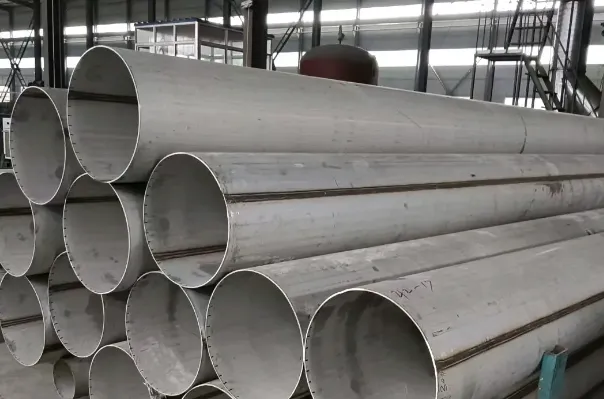
In actual engineering use, the weld seam is the most important part of a welded stainless steel pipe. If welding is unstable, problems may not appear immediately, but can develop later under pressure or corrosion conditions.
A well-controlled weld should:
Have uniform seam thickness
Show no visible cracks or porosity
Pass pressure and non-destructive testing
Maintain corrosion resistance similar to base material
Modern welding technology has made this much more reliable than in the past, which is why welded pipes are now widely accepted even in medium-pressure systems.
Maintenance of Stainless Steel Welded Pipes
Even though stainless steel has good corrosion resistance, welded pipes still need proper handling and maintenance to maintain performance over time. Many quality issues in practice are not caused by manufacturing, but by poor storage or installation.
1. Proper storage conditions
Pipes should be stored in a dry and clean environment. Mixing stainless steel with carbon steel should be avoided, because contact with carbon steel can cause surface contamination and rust spots.
2. Avoid surface contamination
During handling and installation, tools used for carbon steel should not be used on stainless steel. Even small iron particles can stick to the surface and later cause corrosion.
3. Correct welding and installation practice
On-site welding should be done with clean tools and proper shielding gas protection. Welding spatter, arc marks, or overheating should be cleaned immediately after work.
4. Regular cleaning in service
In environments such as food or chemical systems, periodic cleaning helps prevent deposits from forming inside the pipe. This is especially important for sanitary applications.
5. Surface protection during transport
During transportation and installation, pipes should be protected from scratches and impact. Damage to the surface can reduce corrosion resistance over time.
Welded vs Seamless Stainless Steel Pipes (Practical View)
In real engineering decisions, the choice is usually based on system pressure and budget rather than theory.
|
Factor
|
Welded Pipe
|
Seamless Pipe
|
|
Cost
|
Lower
|
Higher
|
|
Strength
|
Sufficient for most systems
|
Higher for extreme pressure
|
|
Availability
|
Wide range, large sizes
|
Limited in large diameters
|
|
Typical Use
|
Water, food, construction
|
High-pressure oil, gas, boilers
|
In many real projects, welded stainless steel pipes are selected not because they are “cheaper”, but because they are already fully sufficient for the working condition.
Conclusion
Stainless steel welded pipes are a mature and widely used industrial product. Their performance depends heavily on manufacturing control—especially forming accuracy and welding quality—and long-term reliability depends on proper handling and maintenance.In most non-extreme environments, they provide a stable and cost-effective solution for transporting fluids and building structures, making them one of the most commonly used stainless steel pipe types in modern engineering.

 English
 Español
 بالعربية
 Phone :
  Whatsapp :
  Email :


