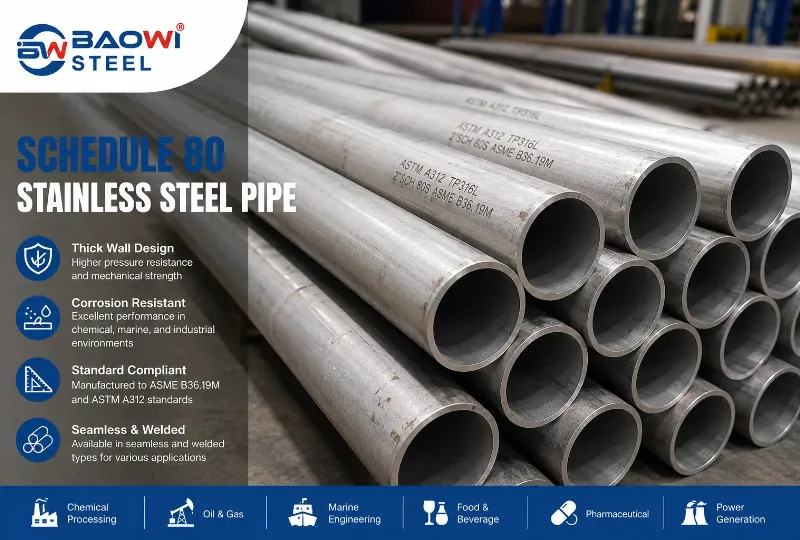
Schedule 80 stainless steel pipe is a heavy-wall stainless steel piping product designed for applications requiring higher mechanical strength, corrosion resistance, and reliable performance under demanding operating conditions. Compared with Schedule 40 stainless steel pipe, Schedule 80S pipe has a thicker wall thickness, providing improved pressure resistance and durability.
The dimensions of Schedule 80 stainless steel pipe are defined by ASME B36.19M, which specifies the outside diameter, wall thickness, and weight requirements for stainless steel pipes. Common stainless steel grades include 304, 304L, 316, and 316L, making these pipes suitable for chemical processing, oil and gas, food processing, pharmaceutical, and industrial piping systems.
For a detailed comparison between different pipe schedules, refer to our guide on Schedule 40 vs Schedule 80 Pipe: Dimensions and Applications.
What Is Schedule 80 Stainless Steel Pipe?
Schedule 80 stainless steel pipe, also known as Schedule 80S stainless steel pipe, is a thick-wall stainless steel pipe manufactured according to ASME B36.19M specifications. The “Schedule” designation indicates the relationship between the pipe size and wall thickness rather than a fixed thickness value.
Unlike carbon steel pipes manufactured according to ASME B36.10M, stainless steel pipes follow the B36.19M standard, meaning that Schedule 80S dimensions may differ from carbon steel Schedule 80 dimensions in some sizes.
The thicker wall design provides:
Higher pressure resistance
Improved mechanical strength
Better resistance to external impact
Longer service life in harsh environments
Schedule 80 stainless steel pipes are commonly supplied as seamless or welded pipes. Seamless pipes provide excellent strength and smooth internal surfaces, while welded stainless steel pipes offer cost advantages for larger diameter applications.
Schedule 80 Stainless Steel Pipe Standards and Specifications
International standards ensure that Schedule 80 stainless steel pipe meets consistent dimensional tolerances, material quality, and manufacturing requirements. Selecting products manufactured to recognized standards is essential for ensuring safety, compatibility, and long-term reliability.
The most commonly referenced standards include:
|
Standard
|
Description
|
|
ASME B36.19M
|
Stainless steel pipe dimensions and schedules
|
|
ASTM A312
|
Seamless and welded austenitic stainless steel pipe
|
|
ASTM A269
|
Seamless and welded stainless steel tubing for general service
|
|
ASTM A358
|
Electric fusion welded stainless steel pipe
|
Among these, ASME B36.19M is the primary dimensional standard. It specifies:
Nominal Pipe Size (NPS)
Outside Diameter (OD)
Wall Thickness
Pipe Schedule
Unit Weight
Meanwhile, ASTM A312 defines the manufacturing, chemical composition, mechanical properties, heat treatment requirements, and testing procedures for seamless and welded stainless steel pipe. Most industrial Schedule 80 stainless steel pipes supplied for process piping are manufactured in accordance with ASTM A312.
When purchasing stainless steel pipe, buyers should verify not only the pipe schedule but also the applicable manufacturing standard, material grade, inspection requirements, and testing certificates to ensure compliance with project specifications.
Schedule 80 Stainless Steel Pipe Dimensions
The dimensions of Schedule 80 stainless steel pipe are specified according to ASME B36.19M. Pipe size is identified by:
Nominal Pipe Size (NPS)
Outside Diameter (OD)
Wall Thickness
Schedule Designation
Weight per unit length
Unlike ordinary tubing, stainless steel pipe dimensions are based on nominal size, meaning the actual outside diameter remains fixed while the inside diameter changes according to wall thickness.
For example:
An NPS 2 Schedule 80S stainless steel pipe has an outside diameter of 2.375 inches (60.3 mm).
The wall thickness determines the internal diameter and flow capacity.
The following table provides the standard dimensions of Schedule 80S stainless steel pipe according to ASME B36.19M.
|
Nominal size [inches]
|
Outside diameter [inches]
|
Outside diameter [mm]
|
Wall thickness [inches]
|
Wall thickness [mm]
|
Weight [lb/ft]
|
Weight [kg/m]
|
|
1/2 Inches
|
0.840 Inches
|
21.3 MM
|
0.065 Inches
|
1.65 MM
|
0.54 lb/ft
|
0.80 kg/m
|
|
3/4 Inches
|
1.050 Inches
|
26.7 MM
|
0.065 Inches
|
1.65 MM
|
0.69 lb/ft
|
1.03 kg/m
|
|
1 Inches
|
1.315 Inches
|
33.4 MM
|
0.065 Inches
|
1.65 MM
|
0.87 lb/ft
|
1.30 kg/m
|
|
1 1/4 Inches
|
1.660 Inches
|
42.2 MM
|
0.065 Inches
|
1.65 MM
|
1.12 lb/ft
|
1.66 kg/m
|
|
1 1/2 Inches
|
1.900 Inches
|
48.3 MM
|
0.065 Inches
|
1.65 MM
|
1.28 lb/ft
|
1.91 kg/m
|
|
2 Inches
|
2.375 Inches
|
60.3 MM
|
0.065 Inches
|
1.65 MM
|
1.61 lb/ft
|
2.40 kg/m
|
|
2 1/2 Inches
|
2.875 Inches
|
73.0 MM
|
0.083 Inches
|
2.11 MM
|
2.49 lb/ft
|
3.71 kg/m
|
|
3 Inches
|
3.500 Inches
|
88.9 MM
|
0.083 Inches
|
2.11 MM
|
3.05 lb/ft
|
4.54 kg/m
|
|
3 1/2 Inches
|
4.000 Inches
|
101.6 MM
|
0.083 Inches
|
2.11 MM
|
3.50 lb/ft
|
5.21 kg/m
|
|
4 Inches
|
4.500 Inches
|
114.3 MM
|
0.083 Inches
|
2.11 MM
|
3.95 lb/ft
|
5.88 kg/m
|
|
5 Inches
|
5.563 Inches
|
141.3 MM
|
0.109 Inches
|
2.77 MM
|
6.40 lb/ft
|
9.52 kg/m
|
|
6 Inches
|
6.625 Inches
|
168.3 MM
|
0.109 Inches
|
2.77 MM
|
7.65 lb/ft
|
11.38 kg/m
|
|
8 Inches
|
8.625 Inches
|
219.1 MM
|
0.109 Inches
|
2.77 MM
|
9.99 lb/ft
|
14.87 kg/m
|
|
10 Inches
|
10.750 Inches
|
273.1 MM
|
0.134 Inches
|
3.4 MM
|
15.29 lb/ft
|
22.76 kg/m
|
|
12 Inches
|
12.750 Inches
|
323.9 MM
|
0.156 Inches
|
3.96 MM
|
21.13 lb/ft
|
31.44 kg/m
|
|
14 Inches
|
14.000 Inches
|
355.6 MM
|
0.156 Inches
|
3.96 MM
|
23.22 lb/ft
|
34.56 kg/m
|
|
16 Inches
|
16.000 Inches
|
406.4 MM
|
0.165 Inches
|
4.19 MM
|
28.11 lb/ft
|
41.83 kg/m
|
|
18 Inches
|
18.000 Inches
|
457.0 MM
|
0.165 Inches
|
4.19 MM
|
31.64 lb/ft
|
47.09 kg/m
|
|
20 Inches
|
20.000 Inches
|
508.0 MM
|
0.188 Inches
|
4.78 MM
|
40.12 lb/ft
|
59.70 kg/m
|
|
22 Inches
|
22.000 Inches
|
559.0 MM
|
0.188 Inches
|
4.78 MM
|
44.18 lb/ft
|
65.75 kg/m
|
|
24 Inches
|
24.000 Inches
|
610.0 MM
|
0.218 Inches
|
5.54 MM
|
55.85 lb/ft
|
83.11 kg/m
|
|
30 Inches
|
30.000 Inches
|
762.0 MM
|
0.250 Inches
|
6.35 MM
|
80.02 lb/ft
|
119.09 kg/m
|
Schedule 80 Stainless Steel Pipe Construction and Performance
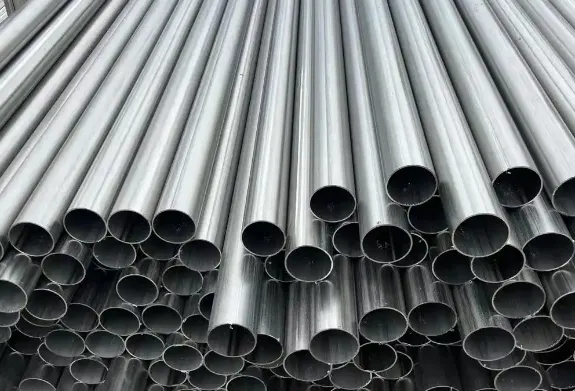
Stainless steel is widely used for industrial piping because of its excellent corrosion resistance, strength, and durability. Schedule 80 stainless steel pipe (Schedule 80S pipe) features thicker walls than lower schedule pipes, providing better pressure resistance and mechanical performance.
These pipes are available in seamless and welded types. Seamless Schedule 80S pipes offer a smooth internal surface and consistent strength, while welded pipes are suitable for larger diameter applications. Common grades include 304, 304L, 316, and 316L stainless steel.
Schedule 80 stainless steel pipes are commonly used for transporting water, air, oil, gas, chemicals, and hydraulic fluids in industries such as chemical processing, oil and gas, food processing, and pharmaceuticals.
Schedule 80 Stainless Steel Pipe Grades
Schedule 80 stainless steel pipes are commonly manufactured using austenitic stainless steel grades. The most widely used grades are 304 and 316 series stainless steel.
|
Grade
|
Characteristics
|
Common Applications
|
|
304
|
Good corrosion resistance and general durability
|
Water systems, food processing, industrial piping
|
|
304L
|
Low carbon version of 304 with improved weldability
|
Welded piping systems
|
|
316
|
Higher resistance to chlorides and chemicals
|
Marine, chemical processing
|
|
316L
|
Low carbon 316 for better corrosion resistance after welding
|
Pharmaceutical, high-purity applications
|
Among these grades, 316 and 316L stainless steel Schedule 80 pipes are preferred for more aggressive environments because of their improved resistance to corrosion caused by chlorides and chemicals.
Schedule 80 vs Schedule 80S: What's the Difference?
One of the most common questions engineers and buyers ask is whether Schedule 80 and Schedule 80S refer to the same pipe.
The short answer is not always.
The letter "S" indicates that the pipe dimensions are specified according to ASME B36.19M, the standard developed specifically for stainless steel pipe. Standard Schedule 80 pipe for carbon steel follows ASME B36.10M.
For many nominal pipe sizes, the wall thickness of Schedule 80 and Schedule 80S is identical. However, for some larger sizes, Schedule 80S may have different wall thickness values because the B36.19M standard was developed to optimize stainless steel material usage while maintaining required pressure performance.
|
Item
|
Schedule 80
|
Schedule 80S
|
|
Material
|
Carbon Steel / Alloy Steel
|
Stainless Steel
|
|
Standard
|
ASME B36.10M
|
ASME B36.19M
|
|
Outside Diameter
|
Same NPS
|
Same NPS
|
|
Wall Thickness
|
May differ on some sizes
|
Defined by B36.19M
|
|
Typical Grades
|
ASTM A106, A53, API 5L
|
ASTM A312 304, 304L, 316, 316L
|
Understanding this difference helps avoid specification errors during procurement and engineering design, particularly when replacing carbon steel piping with stainless steel systems.
How to Choose the Best Schedule 80 Stainless Steel Pipe
To select the right pipe, several factors must be considered:
1. Diameter and thickness: These depend on the pressure and type of application.
2. Stainless steel grade: 304 and 316 are the most common, depending on the required corrosion resistance.
3. Manufacturing standards: Check certifications such as ASTM A312, A269, and ASME B36.19.
4. Working conditions: Factors such as temperature, pressure, and the medium being transported influence the choice.
As per schedule 80, stainless steel pipes dimensions chart a 1-inch pipes with an outside diameter of 33.4 mm has a wall thickness of 4.55 mm and weighs 3.26 kg/m. whereas, an 8-inch pipes size with an outer diameter of 219.1 mm and wall thickness of 12.7 mm will have a weight of 65.5. A schedule 80 stainless steel pipes has thicker walls as compared to other schedule pipes. However, similar to other schedule pipes these sch 80 pipes are also used in construction work. They are mainly used in applications where the pipes have to be exposed. Since schedule 80s contain more material they are a bit expensive compared to other materials due to the higher production cost.
schedule 80 stainless steel pipes pressure rating helps it to withstand high pressure. The thickness of the wall assists in deciding the pressure rating. A 2 inch pipes is usually rated at 920 PSI for continuous service pressure and tends to burst at 7340 PSI. whereas, a 3 ½ inches pipes is said to have continuous service pressure of 990 PSI and tends to burst at 7950 PSI. stainless steel schedule 80 pipes if operated at 140 degrees F temperature the maximum operating temperature will be around 62 PSI. we have been producing and supplying these pipes to various companies in different industries. Our customers trust us due to the quality of product supplied by us.
Schedule 80 Stainless Steel Pipe Supplier
As a professional stainless steel pipe supplier,
BAOWI Steel provides Schedule 80 stainless steel pipes manufactured according to international standards, including ASME B36.19M and ASTM A312.
Compared with Schedule 40S stainless steel pipe, Schedule 80S contains a greater wall thickness, resulting in higher material consumption and increased manufacturing costs. However, the additional thickness provides improved durability, pressure resistance, and service reliability, making it suitable for critical industrial applications.
The actual dimensions of Schedule 80 stainless steel pipe depend on the nominal pipe size (NPS) and ASME B36.19M specifications. For example, an NPS 2 Schedule 80S stainless steel pipe has an outside diameter of 2.375 inches (60.3 mm), while the wall thickness determines its internal diameter, weight, and pressure performance.
Schedule 80 stainless steel pipes are widely used in industries where piping systems are exposed to challenging conditions, including:
Chemical processing
Oil and gas
Food and beverage
Pharmaceutical production
Marine engineering
High-pressure fluid transportation
With strict quality control and professional manufacturing capabilities, BAOWI Steel supplies stainless steel pipes that meet different project requirements for size, grade, and application conditions.
FAQ
1. What is Schedule 80 stainless steel pipe?
Schedule 80 stainless steel pipe is a heavy-wall stainless steel pipe manufactured according to ASME B36.19M. It provides higher pressure resistance and mechanical strength compared with Schedule 40 pipe.
2. What is the difference between Schedule 40 and Schedule 80 stainless steel pipe?
The main difference is wall thickness. Schedule 80 stainless steel pipe has a thicker wall, higher weight, and greater pressure capability.
3. What standard covers Schedule 80 stainless steel pipe dimensions?
Schedule 80S stainless steel pipe dimensions are covered by ASME B36.19M.
4. What grades are available for Schedule 80 stainless steel pipe?
Common grades include 304, 304L, 316, and 316L stainless steel.

 English
 Español
 بالعربية


 Phone :
  Whatsapp :
  Email :


