In industrial piping systems, selecting the correct pipe size is essential for ensuring safety, flow efficiency, and cost control. Among all pipe specifications, Schedule 40 steel pipe (Sch 40) is one of the most widely used standards in global construction, oil & gas, water supply, and structural applications.
However, pipe sizing is often misunderstood because terms like OD, ID, NPS, DN, and Schedule number are frequently confused. This guide explains everything clearly, including dimensions, standards, applications, and how to correctly describe pipe sizes in engineering practice.
1. Schedule 40 Pipe Definition
Schedule 40 (Sch 40) is a standardized classification that defines the wall thickness of a pipe, not its material or outer diameter.It is defined under international standards such as ASME B36.10M for carbon steel and ASME B36.19M for stainless steel piping systems.
Key meaning:
“Schedule” = wall thickness system
Higher schedule number = thicker wall
Schedule 40 = medium wall thickness (standard industrial use)
Sch 40 pipes are widely manufactured in:
Seamless steel pipe (SMLS)
Electric resistance welded pipe (ERW)
It is commonly used because it offers a balanced combination of strength, pressure capacity, and cost efficiency.
2. Sch 40 Pipe Dimensions and Specifications
The size of a pipe is usually expressed in terms of the nominal pipe size (NPS), which is the nominal value of the pipe, while the actual outside and inside diameters will be different. Schedule 40 pipe can be seamless steel pipe or electric resistance welded pipe (ERW). Schedule 40 pipe outside diameter (OD) and wall thickness vary for different NPS values according to ASME standards B36.10M and B36.19M. Here are some common examples of Schedule 40 pipe specifications:
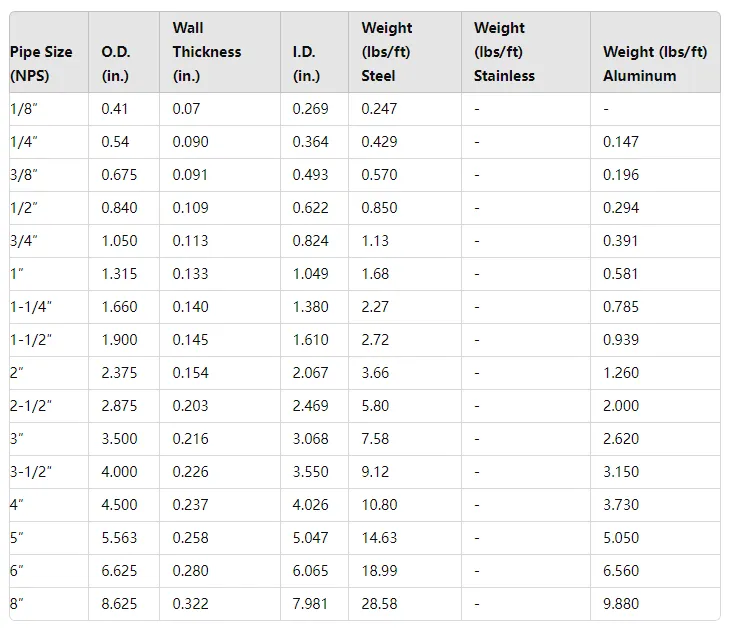
Notes:
Data is based on standard ASME B36.10M and B36.19M.
Dimensions may vary slightly between manufacturers.
The weights listed are for common materials: steel, stainless steel, and aluminum.
This table provides a detailed overview of Schedule 40 pipe sizes and weights. If you need any additional information or further assistance, feel free to ask!
3. Why Pipe Size Is Confusing (OD vs NPS vs ID)
One of the biggest misunderstandings in piping systems is that the “pipe size” does not match its real physical measurement.A pipe described as “2 inch” is not actually 2 inches in outer diameter.This is because pipe sizing follows a nominal system, not a direct measurement system.
3.1 Outside Diameter (OD) — Fixed Value
The OD is the actual physical outer width of the pipe.
Important rule:
OD is fixed for each NPS and does NOT change with schedule.
For example:
NPS 2" pipe → OD is always 2.375 inches
NPS 4" pipe → OD is always 4.500 inches
This allows fittings, flanges, and valves to remain compatible across manufacturers.
3.2 Inside Diameter (ID) — Variable Value
The ID is the internal flow area of the pipe.Unlike OD, ID changes depending on wall thickness:
Thicker wall (Sch 80) → smaller ID
Thinner wall (Sch 10) → larger ID
Schedule 40 → balanced medium ID
This directly affects:
Flow capacity
Pressure loss
Fluid velocity
3.3 Nominal Pipe Size (NPS) — Reference Number Only
NPS (Nominal Pipe Size) is not a real measurement.It is simply a standardized label used for ordering and compatibility.
Example:
NPS 2" ≠ actual 2 inches OD
It is only a size classification system
3.4 DN (Diameter Nominal) — Metric Equivalent
DN is the metric-based naming system used internationally.
Typical conversions:
NPS 2" ≈ DN 50
NPS 4" ≈ DN 100
NPS 12" ≈ DN 300
However, DN is also nominal and not an exact measurement.
4. ASME Pipe Dimension Standards
Pipe dimensions are strictly defined under engineering standards:
Carbon steel: ASME B36.10M
Stainless steel: ASME B36.19M
These standards define:
Outside diameter for each NPS
Wall thickness for each schedule
Material grouping rules
Manufacturing tolerances
They ensure global compatibility between pipes, fittings, and systems.
5. Schedule 40 Pipe Size Structure
A Schedule 40 pipe is defined by three core parameters:
1. NPS (size designation)
2. OD (fixed outer diameter)
3. Wall thickness (Sch 40 standard value)
These three together determine:
Internal diameter (flow space)
Pressure capacity
Weight per meter
Conclusion
Schedule 40 pipe is the most common and versatile pipe specification in global engineering systems. Understanding how OD, ID, NPS, and schedule thickness interact is essential for proper pipe selection and system design.By mastering these fundamentals, engineers and buyers can ensure safe operation, accurate procurement, and optimized project cost control across all industrial applications.
Read more
Schedule 40 Pipe Pressure Rating Chart and Guide

 English
 Español
 بالعربية






 Phone :
  Whatsapp :
  Email :