API 5L X65 pipe is a high-strength carbon steel line pipe specified in
API Specification 5L and ISO 3183 for oil, natural gas, water, and petroleum transportation systems. It is also referred to as ISO 3183 L450 pipe, where "X65" represents a minimum yield strength of 65,300 psi (450 MPa).
Compared with lower grades such as API 5L X52 and API 5L X60, API 5L X65 provides higher strength while maintaining good weldability and toughness. It has become one of the most widely specified pipeline materials for long-distance transmission projects, offshore pipelines, refineries, LNG terminals, and high-pressure gathering systems.
API 5L X65 pipe is available in seamless, ERW, LSAW (SAWL), and SSAW (SAWH) manufacturing processes. Depending on project requirements, it can be supplied in PSL1, PSL2, or sour service grades for corrosive environments containing hydrogen sulfide (H₂S).
What Is API 5L X65 Pipe?
API 5L X65 is a medium-to-high-strength carbon steel line pipe grade defined by API 5L for pipeline transportation systems in the petroleum and natural gas industries. It is designed to safely transport crude oil, natural gas, water, slurry, and other fluids under high-pressure operating conditions.
The designation "X65" indicates that the pipe has a minimum specified yield strength of 65,300 psi (450 MPa). The equivalent ISO designation is L450, where the number represents the minimum yield strength in megapascals.
Unlike alloy steels used for high-temperature equipment, API 5L X65 remains a carbon steel. Its excellent combination of strength, weldability, toughness, and cost efficiency makes it one of the most commonly specified grades for modern pipeline construction.
API 5L X65 Pipe Specification
The API 5L standard classifies X65 pipe into two product specification levels:
PSL1 – Standard quality for general pipeline applications.
PSL2 – Enhanced quality with stricter chemical composition, mechanical properties, impact testing, and non-destructive examination requirements.
For corrosive service environments, API 5L X65 PSL2 can also be manufactured as Sour Service Pipe, complying with NACE requirements for H₂S-containing environments.
API 5L X65 Pipe Specification Overview
|
Item
|
Specification
|
|
Standard
|
API Specification 5L / ISO 3183
|
|
Grade
|
X65 / L450
|
|
Product Specification Level
|
PSL1, PSL2
|
|
Pipe Type
|
Seamless, ERW, LSAW (SAWL), SSAW (SAWH)
|
|
Outside Diameter
|
21.3 mm – 1422 mm (depending on manufacturing method)
|
|
Wall Thickness
|
SCH 10 to SCH XXS or customized
|
|
Delivery Condition
|
As Rolled, Normalized, Thermomechanical Rolled (TMCP), Quenched & Tempered (PSL2)
|
|
Coating Options
|
Bare, FBE, 3LPE, 3LPP, Epoxy, Coal Tar Epoxy
|
|
Typical Applications
|
Oil & Gas Pipelines, Offshore Pipelines, LNG Projects, Refineries, Petrochemical Plants
|
API 5L X65 Chemical Composition
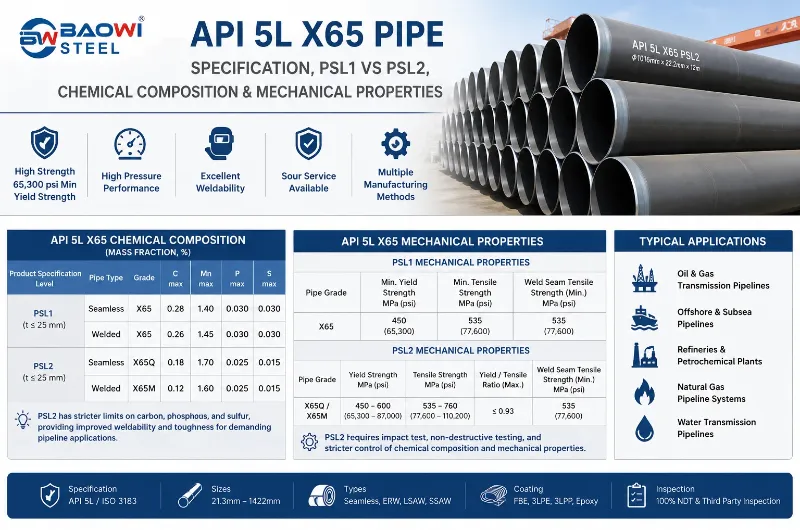
The chemical composition of API 5L X65 directly affects its weldability, toughness, and resistance to cracking. Compared with PSL1, PSL2 applies tighter limits on carbon, phosphorus, sulfur, and carbon equivalent, making it more suitable for high-pressure and critical pipeline projects.
API 5L X65 Chemical Composition (Mass Fraction, %)
|
Product Specification Level
|
Pipe Type
|
Grade
|
Carbon (C) Max
|
Manganese (Mn) Max
|
Phosphorus (P) Max
|
Sulfur (S) Max
|
|
PSL1 (t ≤ 25 mm)
|
Seamless
|
X65
|
0.28
|
1.4
|
0.03
|
0.03
|
|
PSL1 (t ≤ 25 mm)
|
Welded
|
X65
|
0.26
|
1.45
|
0.03
|
0.03
|
|
PSL2 (t ≤ 25 mm)
|
Seamless
|
X65Q
|
0.18
|
1.7
|
0.025
|
0.015
|
|
PSL2 (t ≤ 25 mm)
|
Welded
|
X65M
|
0.12
|
1.6
|
0.025
|
0.015
|
API 5L X65 Mechanical Properties
API 5L X65 provides an excellent balance between strength and weldability, making it one of the most widely used grades for oil and gas transmission pipelines. While PSL1 specifies only minimum strength requirements, PSL2 also controls maximum strength to ensure better ductility and pipeline integrity.
API 5L X65 PSL1 Mechanical Properties
|
Pipe Grade
|
Minimum Yield Strength
|
Minimum Tensile Strength
|
Weld Seam Tensile Strength (Minimum)
|
|
X65
|
450 MPa (65,300 psi)
|
535 MPa (77,600 psi)
|
535 MPa (77,600 psi)
|
API 5L X65 PSL2 Mechanical Properties
|
Pipe Grade
|
Yield Strength
|
Tensile Strength
|
Yield / Tensile Ratio
|
Weld Seam Tensile Strength
|
|
X65Q / X65M
|
450–600 MPa (65,300–87,000 psi)
|
535–760 MPa (77,600–110,200 psi)
|
≤0.93
|
≥535 MPa (77,600 psi)
|
Additional Mechanical Performance Tests for PSL2
CVN Impact Test
Drop Weight Tear Test (DWTT)
Guided Bend Test
Flattening Test
Bend Test
Hardness Test (for cold-formed welded pipe)
API 5L X65 PSL1 vs PSL2: What's the Difference?
One of the most common questions from engineers and buyers is whether to choose API 5L X65 PSL1 or PSL2. Although both grades have the same minimum yield strength of 450 MPa, PSL2 introduces stricter manufacturing, testing, and quality control requirements.
For most modern transmission pipeline projects, PSL2 has become the preferred choice because it offers improved weldability, better toughness, and enhanced reliability under demanding operating conditions.
|
Item
|
PSL1
|
PSL2
|
|
Intended Application
|
General pipeline service
|
Critical oil & gas transmission
|
|
Chemical Composition
|
Standard
|
More restrictive
|
|
Mechanical Properties
|
Minimum requirements
|
Controlled minimum and maximum values
|
|
Impact Test
|
Generally not required
|
Mandatory
|
|
Non-Destructive Testing
|
Limited
|
Required
|
|
Carbon Equivalent (CE)
|
Not specified
|
Controlled
|
|
Weldability
|
Good
|
Excellent
|
|
Recommended Service
|
Conventional pipelines
|
High-pressure, offshore and long-distance pipelines
|
API 5L X65 Manufacturing Process
API 5L X65 pipe can be manufactured using several different production methods. The appropriate process depends on pipe diameter, wall thickness, operating pressure, and project specifications.
Common Manufacturing Methods
|
Manufacturing Process
|
Typical Size Range
|
Main Advantages
|
Typical Applications
|
|
Seamless
|
Small to medium diameter
|
No weld seam, excellent pressure resistance
|
High-pressure piping, drilling, pressure vessels
|
|
ERW
|
Small to medium diameter
|
High production efficiency and competitive cost
|
Water, gas distribution, industrial pipelines
|
|
LSAW (SAWL)
|
Medium to large diameter
|
High dimensional accuracy, thick wall capability
|
Long-distance oil & gas transmission
|
|
SSAW (SAWH)
|
Large diameter
|
Cost-effective for large pipe sizes
|
Water transmission, piling, low to medium pressure pipelines
|
Among these manufacturing methods, LSAW X65 pipe is one of the most commonly specified products for high-pressure oil and natural gas pipelines due to its excellent weld quality and superior dimensional accuracy.
Why Is LSAW Pipe Preferred for High-Pressure Pipelines?
LSAW (Longitudinal Submerged Arc Welded) pipe is manufactured from a single steel plate using the UOE or JCOE forming process, followed by internal and external submerged arc welding.
Compared with spiral welded pipe, LSAW pipe provides several important advantages for demanding transmission projects:
Excellent dimensional accuracy for easier field welding.
Thick-wall capability suitable for high-pressure service.
High weld integrity with comprehensive non-destructive inspection.
Superior fracture toughness for low-temperature environments.
Consistent mechanical performance throughout the pipe body.
API 5L X60 vs API 5L X65
API 5L X60 and X65 are two of the most widely used grades in pipeline construction. The primary difference lies in their mechanical strength and suitable operating conditions.
API 5L X60 vs X65
|
Property
|
API 5L X60
|
API 5L X65
|
|
Minimum Yield Strength
|
415 MPa
|
450 MPa
|
|
Minimum Tensile Strength
|
520 MPa
|
535 MPa
|
|
Operating Pressure
|
Medium
|
Medium to High
|
|
Suitable Pipeline Length
|
Medium
|
Long-distance
|
|
Typical Applications
|
Water, oil and gas pipelines
|
High-pressure oil and gas transmission
|
While X65 offers higher strength, selecting the appropriate grade should consider factors such as operating pressure, design temperature, pipeline diameter, welding requirements, and overall project cost.
API 5L X65 vs API 5L X70
Both X65 and X70 are widely used in modern transmission pipelines. X70 provides higher strength but also requires more stringent welding procedures and quality control.
|
Property
|
API 5L X65
|
API 5L X70
|
|
Minimum Yield Strength
|
450 MPa
|
485 MPa
|
|
Minimum Tensile Strength
|
535 MPa
|
570 MPa
|
|
Weldability
|
Excellent
|
More demanding
|
|
Construction Cost
|
Lower
|
Higher
|
|
Typical Applications
|
Long-distance transmission
|
Ultra-high-pressure trunk pipelines
|
Applications of API 5L X65 Pipe
Thanks to its combination of high strength, good toughness, and excellent weldability, API 5L X65 is widely used in demanding pipeline systems worldwide.
Typical applications include:
Long-distance crude oil transmission pipelines
Natural gas transmission systems
Offshore and subsea pipelines
LNG terminals
Petrochemical plants
Refinery process piping
High-pressure water transmission
Pipeline rehabilitation and expansion projects
Frequently Asked Questions
What is API 5L X65 pipe?
API 5L X65 is a high-strength carbon steel line pipe with a minimum yield strength of 450 MPa (65,300 psi), designed for oil, gas, and water transmission pipelines.
Is API 5L X65 carbon steel?
Yes. API 5L X65 is a carbon steel line pipe rather than an alloy steel. Its chemical composition is carefully controlled to provide an excellent balance of strength, weldability, and toughness.
What is the difference between PSL1 and PSL2?
PSL2 requires stricter chemical composition limits, mandatory impact testing, non-destructive examination, and tighter quality control than PSL1, making it suitable for more demanding pipeline applications.
Is API 5L X65 available as seamless and welded pipe?
Yes. API 5L X65 can be manufactured as Seamless, ERW, LSAW (SAWL), and SSAW (SAWH) pipe depending on project requirements.
Which manufacturing method is best for large-diameter pipelines?
For high-pressure, large-diameter transmission pipelines, LSAW pipe is generally preferred because of its excellent dimensional accuracy, high weld quality, and ability to produce thick-wall pipe suitable for demanding operating conditions.
Why Choose BAOWI Steel as Your API 5L X65 Pipe Supplier?
BAOWI Steel supplies API 5L X65 line pipe in seamless and welded forms, including ERW, LSAW, and SSAW products manufactured in accordance with API 5L and ISO 3183.
Our capabilities include:
PSL1 and PSL2 supply
Sour service pipe available upon request
External coatings including FBE, 3LPE, and 3LPP
Third-party inspection support
Customized dimensions and lengths
Export experience in oil, gas, water, and infrastructure projects worldwide
Whether your project requires standard transmission pipelines or customized engineering solutions, our technical team can recommend the appropriate manufacturing process, inspection level, and material grade based on your operating conditions.

 English
 Español
 بالعربية
 Phone :
  Whatsapp :
  Email :


