Schedule 40 Pipe Meaning: What Does SCH 40 Mean?
Schedule 40 (SCH 40) is a standard pipe wall thickness designation used for a specific
Nominal Pipe Size (NPS). It does not describe the pipe's material or refer to one fixed pipe dimension. The number 40 is a schedule designation, not a measurement in millimeters or inches.For example, an NPS 2 Schedule 40 pipe has a standard outside diameter of 2.375 in and a wall thickness of 0.154 in. If the nominal pipe size changes, the Schedule 40 wall thickness changes as well. An NPS 4 SCH 40 pipe, for instance, has a different wall thickness from an NPS 2 SCH 40 pipe.This means that SCH 40 does not represent the same wall thickness for every pipe size. It is used together with NPS to identify the applicable standard pipe dimensions, including outside diameter and wall thickness.
When selecting or purchasing Schedule 40 Pipe, the NPS, outside diameter (OD), wall thickness, material grade, and applicable product standard should be confirmed separately. This ensures that the pipe dimensions and material meet the requirements of the intended application.
Pipe Schedule and NPS
A pipe schedule identifies a standardized wall-thickness series for a particular nominal pipe size. NPS, or Nominal Pipe Size, identifies the pipe size.
The two designations work together.
|
Pipe Designation
|
Meaning
|
|
NPS 2 SCH 40
|
NPS 2 pipe with Schedule 40 dimensions
|
|
NPS 4 SCH 40
|
NPS 4 pipe with Schedule 40 dimensions
|
|
NPS 4 SCH 80
|
NPS 4 pipe with Schedule 80 dimensions
|
The schedule cannot be used by itself to determine the actual pipe dimensions. NPS must be known first.
Historically, steel pipe wall thicknesses were often described as Standard, Extra Strong (XS), and Double Extra Strong (XXS). The schedule system provides a more detailed and standardized method for specifying pipe wall thickness.
For steel pipe, ASME B36.10M is the principal dimensional standard covering welded and
seamless wrought steel pipe.
NPS 4 SCH 40
NPS 4 = nominal pipe size
SCH 40 = Schedule 40 wall-thickness designation
If the NPS changes, the Schedule 40 wall thickness changes as well.
If the NPS remains the same but the schedule changes from SCH 40 to SCH 80, the wall thickness changes.
This system allows pipes, fittings, valves, and other components to be specified using standardized dimensions.
Schedule 40 Pipe Dimensions
Once you understand what SCH 40 means, the next step is to look at how the designation relates to actual pipe dimensions.
Schedule 40 does not give the pipe a single wall thickness. The wall thickness depends on the Nominal Pipe Size (NPS).
For example, NPS 2 and NPS 4 pipes can both be Schedule 40. However, their outside diameters and wall thicknesses are different.
|
NPS
|
Outside Diameter
|
SCH 40 Wall Thickness
|
|
1/2"
|
0.840 in
|
0.109 in
|
|
1"
|
1.315 in
|
0.133 in
|
|
2"
|
2.375 in
|
0.154 in
|
|
3"
|
3.500 in
|
0.216 in
|
|
4"
|
4.500 in
|
0.237 in
|
|
6"
|
6.625 in
|
0.280 in
|
|
8"
|
8.625 in
|
0.322 in
|
|
10"
|
10.750 in
|
0.365 in
|
|
12"
|
12.750 in
|
0.375 in
|
NPS 4 SCH 40 pipe has an outside diameter of 4.500 inches and a wall thickness of 0.237 inches.An NPS 2 SCH 40 pipe has an outside diameter of 2.375 inches and a wall thickness of 0.154 inches.Therefore, saying that “Schedule 40 pipe has a 0.237-inch wall” is incomplete. That value applies to NPS 4 SCH 40.For a complete dimensional reference, see the Schedule 40 Pipe Size Guide, which covers NPS, OD, ID, and wall thickness.
NPS, OD, ID, and Wall Thickness
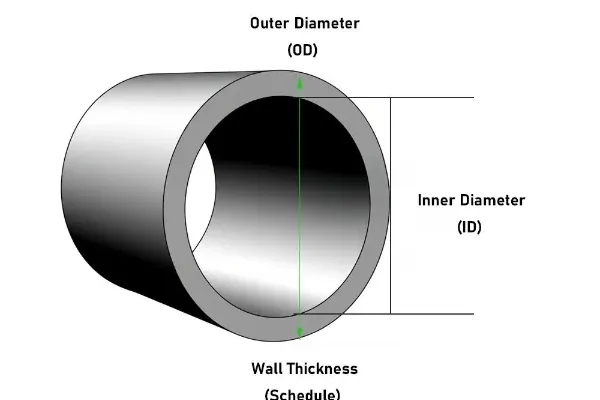
Understanding Schedule 40 requires a clear distinction between four basic pipe dimensions.
1.Nominal Pipe Size (NPS)
NPS stands for Nominal Pipe Size.
It is the standardized designation used to identify pipe size. Common NPS designations include 1, 2, 3, 4, 6, 8, and 12.
NPS is a nominal designation rather than a direct measurement of the outside diameter.
An NPS 2 pipe, for instance, has a standardized outside diameter of 2.375 inches rather than exactly 2 inches.
This standardized system allows pipes and compatible components to be specified using a consistent size designation.
2.Outside Diameter (OD)
OD is the outside diameter of the pipe.
For a given NPS, the OD is standardized. When the schedule changes while the NPS remains the same, the OD generally remains unchanged.
The wall thickness changes instead.
This is why pipes with the same NPS but different schedules can have the same outside diameter while having different inside diameters.
3.Wall Thickness
Wall thickness is the thickness of the pipe wall.
For a particular NPS, the schedule identifies the applicable standardized wall thickness.
Schedule 40 therefore does not represent one universal thickness.
The wall thickness increases or changes according to the nominal pipe size. It must be checked against the relevant dimensional standard rather than inferred from the number 40.
4.Inside Diameter (ID)
ID is the internal diameter of the pipe.
It is affected directly by the OD and wall thickness.
The basic relationship is:
ID = OD − 2 × Wall Thickness
For NPS 2 SCH 40:
OD = 2.375 in
Wall thickness = 0.154 in
ID ≈ 2.067 in
The ID is important when calculating flow area, velocity, pressure loss, and compatibility with internal components.
For the complete dimensional data, see the Schedule 40 Pipe Size Guide (OD, ID, NPS Explained).
What Does the Number 40 Mean in SCH 40?
The 40 in SCH 40 is a schedule designation rather than a physical measurement.It does not directly represent the thickness of the pipe wall.
Therefore, the following interpretations are incorrect:
SCH 40 does not mean 40 mm wall thickness.
SCH 40 does not mean 40 inches wall thickness.
SCH 40 does not mean 40 psi pressure.
SCH 40 does not mean 40 MPa pressure.
SCH 40 does not mean 40 ksi tensile strength.
SCH 40 does not identify a steel grade.
The actual wall thickness is determined by the combination of the nominal pipe size and the applicable dimensional standard.
This distinction is particularly important when reading engineering drawings and purchasing specifications. If a drawing states NPS 6 SCH 40, the number 40 cannot be used alone to determine the pipe dimensions.The NPS must be identified first
SCH 40 and SCH 40S can look similar, but they are associated with different dimensional standards.
|
Designation
|
Dimensional Reference
|
Typical Application
|
|
SCH 40
|
ASME B36.10M
|
Carbon and alloy steel pipe
|
|
SCH 40S
|
ASME B36.19M
|
Stainless steel pipe
|
The “S” does not mean stronger. It identifies the stainless steel dimensional series.
This distinction is important when comparing pipe dimensions across different materials.
A stainless steel pipe marked SCH 40S should therefore be checked against the applicable stainless steel dimensional standard rather than assuming that its dimensions are identical to a carbon steel SCH 40 pipe of the same NPS.
Chemical Composition of Schedule 40 Steel Pipe
Schedule 40 does not specify the chemical composition of a steel pipe. It only defines the pipe wall thickness for a given nominal pipe size (NPS).
The chemical composition depends on the material standard and grade. For example, Schedule 40 pipe can be manufactured to ASTM A53, ASTM A106, or other applicable standards. Each standard has its own requirements for carbon, manganese, silicon, phosphorus, sulfur, and other elements.
Common elements in carbon steel pipe include:
|
Element
|
Typical role in steel
|
|
Carbon (C)
|
Affects strength, hardness, and weldability
|
|
Manganese (Mn)
|
Improves strength and toughness
|
|
Silicon (Si)
|
Acts as a deoxidizer and contributes to strength
|
|
Phosphorus (P)
|
Controlled to maintain toughness
|
|
Sulfur (S)
|
Controlled because excessive sulfur can affect ductility and weldability
|
Some grades may also contain controlled amounts of copper, chromium, nickel, or other alloying elements.
The key point is that Schedule 40 and steel grade describe different things. Schedule 40 identifies the wall thickness, while the applicable material standard and grade determine the chemical composition and mechanical requirements.
For example, an NPS 2 Schedule 40 ASTM A53 Grade B pipe has the same Schedule 40 wall thickness designation as an NPS 2 Schedule 40 pipe made to another standard, but their material requirements may differ.
For the exact chemical composition, always check the material standard, steel grade, and manufacturer's mill test certificate (MTC).
Schedule and Material Grade
Schedule 40 does not specify the chemical composition or mechanical properties of the steel.
A complete pipe specification normally combines several characteristics.
NPS 4 SCH 40 ASTM A106 Grade B Seamless Steel Pipe
|
Specification
|
Meaning
|
|
NPS 4
|
Nominal pipe size
|
|
SCH 40
|
Wall-thickness designation
|
|
ASTM A106
|
Product specification
|
|
Grade B
|
Material grade
|
|
Seamless
|
Manufacturing method
|
This distinction matters during procurement. ASTM A53 Grade B and ASTM A106 Grade B, for example, are different product specifications even when the pipes are supplied in the same Schedule 40 dimensions.The applicable material depends on service conditions, temperature, pressure, manufacturing requirements, and project specifications.
Common Steel Grades Used for Schedule 40 Pipe
Schedule 40 steel pipe can be manufactured from different steel grades, depending on the applicable material standard and service requirements. Schedule 40 itself does not define the steel grade. Common material grades used for Schedule 40 pipe include:
ASTM A53 Grade B: A widely used carbon steel pipe grade for general mechanical and pressure applications. It is commonly used in plumbing, construction, water, air, and other industrial services. It has a minimum yield strength of 35,000 psi and a minimum tensile strength of 60,000 psi.
ASTM A106 Grade B: A seamless carbon steel pipe grade designed for high-temperature service. It is commonly used for steam, process piping, refineries, power plants, and other industrial applications. It has a minimum yield strength of 35,000 psi and a minimum tensile strength of 60,000 psi.
API 5L Grade B: A carbon steel pipe grade associated with line pipe applications in the oil and gas industry. Depending on the applicable API 5L edition and product specification, equivalent or current grade designations may differ. Schedule 40 refers to the wall thickness, while API 5L defines the material and line pipe requirements.
ASTM A333 Grade 6: A carbon steel pipe grade intended for low-temperature service. It is commonly used in applications where impact toughness at low temperatures is required, including certain process piping and LNG-related systems. It has a minimum yield strength of 35,000 psi and a minimum tensile strength of 60,000 psi.
Other steel grades can also be supplied in Schedule 40 dimensions, depending on the pipe standard, application, temperature, pressure, and project requirements. Always check the applicable material standard and manufacturer's specifications when selecting a Schedule 40 steel pipe grade.
Common Applications of Schedule 40 Pipe
Schedule 40 pipe is widely used because it provides a standardized combination of pipe dimensions and wall thickness.
Typical applications include:
Water and plumbing systems
Process piping
Compressed air systems
HVAC piping
General industrial piping
Construction and mechanical systems
Oil and gas applications
Certain low- and high-temperature piping systems
The suitability of Schedule 40 depends on more than wall thickness. Operating pressure, temperature, fluid type, corrosion conditions, material grade, pipe diameter, and applicable design codes must also be considered.
For pressure piping, the schedule should not be selected based only on the name “SCH 40.”
ASTM A53 Schedule 40 vs Schedule 80 Pipe Dimensions
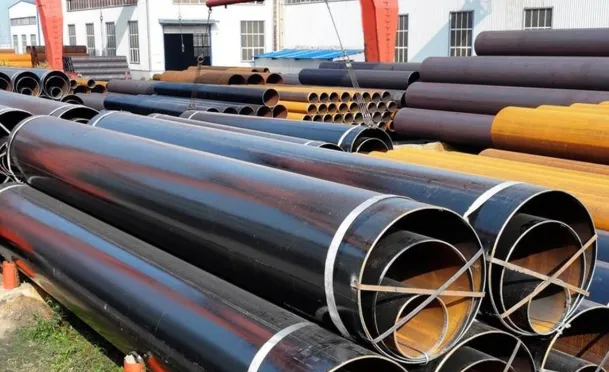
ASTM A53 steel pipe is commonly supplied in Schedule 40 and Schedule 80 wall thicknesses. For the same NPS, both schedules have the same outside diameter, while Schedule 80 has a thicker wall and smaller inside diameter.
|
NPS
|
DN
|
Outside Diameter (mm)
|
ASTM A53 Sch. 40 Wall Thickness (mm)
|
Sch. 40 Inside Diameter (mm)
|
ASTM A53 Sch. 80 Wall Thickness (mm)
|
Sch. 80 Inside Diameter (mm)
|
|
1/2"
|
15
|
21.3
|
2.77
|
15.8
|
3.73
|
13.8
|
|
3/4"
|
20
|
26.7
|
2.87
|
20.9
|
3.91
|
18.9
|
|
1"
|
25
|
33.4
|
3.38
|
26.6
|
4.55
|
24.3
|
|
1-1/4"
|
32
|
42.2
|
3.56
|
35.1
|
4.85
|
32.5
|
|
1-1/2"
|
40
|
48.3
|
3.68
|
40.9
|
5.08
|
38.1
|
|
2"
|
50
|
60.3
|
3.91
|
52.5
|
5.54
|
49.3
|
|
2-1/2"
|
65
|
73
|
5.16
|
62.7
|
7.01
|
59
|
|
3"
|
80
|
88.9
|
5.49
|
77.9
|
7.62
|
73.7
|
|
4"
|
100
|
114.3
|
6.02
|
102.3
|
8.56
|
97.2
|
|
6"
|
150
|
168.3
|
7.11
|
154.1
|
10.97
|
146.4
|
|
8"
|
200
|
219.1
|
8.18
|
202.7
|
12.7
|
193.7
|
Differences Between ASTM A53 Schedule 40 and Schedule 80
Outside diameter: The same for the same NPS.
Wall thickness: Schedule 80 is thicker than Schedule 40.
Inside diameter: Schedule 80 has a smaller inside diameter.
Weight: Schedule 80 weighs more per unit length.
Pressure capability: Schedule 80 generally supports higher working pressures, depending on material, temperature, and design conditions.
Note: Schedule 40 and Schedule 80 are dimensional designations, not material grades. ASTM A53 Grade A and Grade B pipe can be supplied in different schedules, subject to the applicable specification and size range.
For a broader dimensional and specification comparison, see Difference Between Schedule 40 And Schedule 80 Steel Pipe
Schedule 40 Pipe Selection
Selecting a Schedule 40 pipe involves more than checking the schedule number.
The main factors include:
Nominal pipe size — determines the required pipe size.
Material grade — determines material and mechanical requirements.
Schedule — establishes the applicable wall-thickness series.
Operating pressure — affects required wall thickness and design.
Operating temperature — influences allowable stress and material selection.
Fluid and service environment — affects corrosion and material compatibility.
Applicable standards — determine dimensional, material, and testing requirements.
Inspection requirements — may include hydrostatic testing, NDT, and MTC documentation.
For industrial projects, the final pipe specification should be checked against the applicable engineering code and purchase specification.
Schedule and Material Specification
Schedule and material describe different characteristics of a pipe.
Schedule defines the dimensional wall-thickness series.
Material specification defines the material requirements.
A complete steel pipe specification may contain several separate elements:
NPS 4 SCH 40 ASTM A106 Grade B Seamless Steel Pipe
|
Specification
|
Function
|
|
NPS 4
|
Nominal pipe size
|
|
SCH 40
|
Wall-thickness designation
|
|
ASTM A106
|
Product specification
|
|
Grade B
|
Material grade
|
|
Seamless
|
Manufacturing method
|
This distinction matters during procurement.SCH 40 does not tell the buyer whether the pipe is carbon steel, stainless steel, or alloy steel. It also does not define chemical composition, mechanical properties, heat treatment, or corrosion resistance.
Those requirements come from the applicable material and product standards.Baowi Steel also provides dedicated information for specific SCH 40 materials, including Schedule 40 Stainless Steel Pipe, Schedule 40 Alloy Steel Pipe, and Schedule 40 Aluminum Pipe.
How to Know If Schedule 40 Pipe Can Handle the Pressure?
To determine whether Schedule 40 pipe can handle a specific pressure, you need to consider more than the pipe schedule alone.
The key factors include:
Pipe size and outside diameter
Schedule and actual wall thickness
Pipe material and grade
Design pressure
Design temperature
Applicable piping standard
Schedule 40 indicates a standardized wall-thickness series. It does not represent a fixed pressure rating for every pipe size or material.
For example, a 2-inch Schedule 40 steel pipe has a different pressure capacity from a larger Schedule 40 pipe. The actual pressure limit should therefore be checked against the applicable design standard and material properties.
For engineering applications, do not select Schedule 40 based only on a general pressure formula. Check the pipe dimensions, material grade, design conditions, and applicable standard before determining whether SCH 40 is suitable.Specific pressure information, see our Schedule 40 Pipe Pressure Rating Chart and Guide for pressure-related data and calculation considerations.
Key Points About Schedule 40 Pipe
Schedule 40 is a dimensional designation, not a material grade or pressure class.
The number 40 does not represent a physical pipe measurement. The actual wall thickness depends on the NPS and applicable dimensional standard.
For steel pipe:
NPS identifies nominal pipe size.
SCH 40 identifies the wall-thickness series.
OD is the standardized outside diameter.
ID depends on OD and wall thickness.
Material grade is specified separately.
ASME B36.10M covers welded and seamless steel pipe dimensions.
SCH 40S is associated with stainless steel pipe under ASME B36.19M.
SCH 80 generally has a thicker wall than SCH 40 for the same NPS.
Schedule alone does not determine pressure rating.
For detailed dimensions, refer to the dedicated Schedule 40 Carbon Steel Pipe Size Chart and Dimensions.
Schedule 40 Steel Pipe Prices
The price of Schedule 40 steel pipe varies based on factors such as pipe size, steel grade, standard, length, and purchase quantity. Bulk orders often qualify for more competitive pricing; specific quotes are determined by product specifications and procurement requirements.
BAOWI Steel specializes in supplying a wide range of steel pipes and tubular products, including carbon steel, stainless steel, and alloy steel pipes manufactured via various processes. We focus on the supply and export of steel pipe products and offer services such as cutting, machining, and other custom processing.
To obtain specific pricing for Schedule 40 steel pipe, please contact us with details regarding the required pipe diameter, wall thickness, steel grade, standard, length, and purchase quantity, and we will provide a quote based on your specifications.
FAQ
What does Schedule 40 mean?
Schedule 40 is a standardized wall-thickness designation used with a specific nominal pipe size. The number 40 is a schedule designation, not a direct measurement.
Is Schedule 40 a pressure rating?
No. SCH 40 identifies pipe dimensions. It does not specify a maximum working pressure.
Is Schedule 40 the same for every pipe size?
No. The wall thickness changes with NPS. NPS 2 SCH 40 and NPS 4 SCH 40 have different actual dimensions.
Does Schedule 40 mean 40 mm?
No. The number 40 is non-dimensional and does not represent millimeters or inches.
Is Schedule 40 a steel grade?
No. Schedule and material grade are separate parts of a pipe specification.
What is the wall thickness of NPS 2 SCH 40 pipe?
NPS 2 SCH 40 has a standardized wall thickness of 0.154 inches.
What standard covers Schedule 40 steel pipe dimensions?
ASME B36.10M is the principal dimensional standard for welded and seamless wrought steel pipe. Stainless steel pipe dimensions are covered by ASME B36.19M.
Read more
Schedule 40 Pipe Pressure Rating Chart and Guide

 English
 Español
 بالعربية






 Phone :
  Whatsapp :
  Email :


