What is Schedule 40 Alloy Steel Pipe?
When searching for or learning about alloy steel pipes, you might see terms like "Schedule 40 alloy steel pipe" or "Sch alloy steel pipe." "Sch" is actually an abbreviation for "Schedule," and both have the same meaning: a parameter used to indicate the wall thickness grade and pressure resistance of steel pipes.
Schedule 40 is a key parameter identifying the wall thickness grade in piping systems, representing a standardized wall thickness specification for industrial piping. The pipe schedule number is a dimensionless value defined in
ASME B36.10, which is related to the pipe's design pressure and the allowable stress of the material using a complex formula: SCH = (1,000) × (P/S), where P represents the pipe's internal working pressure (psi), and S represents the material's allowable stress (psi) at the design temperature.
In the field of alloy steel piping, Schedule 40 standards are typically used in conjunction with a variety of material specifications. Common ones include ASTM A335 (alloy steel pipe for high-temperature service), ASTM A213 (alloy steel pipe for boilers and superheater heat exchangers), and AISI 4140, 40Cr, and other chromium-molybdenum alloy steel series.
Features of Schedule 40 Alloy Steel Pipe
Balanced wall thickness for medium-pressure systems
Excellent performance under elevated temperatures
Higher strength than carbon steel pipe
Suitable for continuous industrial operation
Compatible with standard fittings and flanges
Alloy Steel Pipe Schedule Chart (ASME B36.10 Reference)
|
NPS
|
DN
|
OD (mm)
|
SCH 40 (mm)
|
|
1/2"
|
15
|
21.3
|
2.77
|
|
3/4"
|
20
|
26.7
|
2.87
|
|
1"
|
25
|
33.4
|
3.38
|
|
1陆"
|
40
|
48.3
|
3.68
|
|
2"
|
50
|
60.3
|
3.91
|
|
3"
|
80
|
88.9
|
5.49
|
|
4"
|
100
|
114.3
|
6.02
|
|
6"
|
150
|
168.3
|
7.11
|
|
8"
|
200
|
219.1
|
8.18
|
Supporting Note:
Full schedule range (SCH 10 to SCH 80 and above) is available in our detailed
Steel Pipe Dimensions & Schedule Chart.
Alloy Steel Pipe Size & Grades
Alloy steel pipes are produced according to international dimensional and material standards to ensure consistency in engineering design and system compatibility. Depending on the application requirements, pipes can be manufactured using seamless or welded processes, with seamless types typically used in high-pressure and high-temperature environments due to their superior structural integrity.
The size range, wall thickness schedules, and material grades are standardized under ASME B36.10 and related ASTM specifications, allowing engineers to select appropriate pipe configurations based on pressure rating, temperature conditions, and service environment.
Technical Specifications
|
Item
|
Description
|
|
Processing Method
|
Seamless and Welded
|
|
Size Range
|
1/8” – 48” / DN6 – DN1200
|
|
Thickness Schedule
|
SCH 20 – SCH 160, XXS
|
|
Length
|
6m, 12m, or Random Length
|
|
Standard
|
ASME B36.10
|
|
Surface Treatment
|
Blasting & Painting, Epoxy Powder, FBE, 2PE, 3PE Coating
|
Material Grades
|
Standard
|
Grades
|
|
ASTM A335
|
P11, P12, P5, P9, P91, P92
|
|
ASTM A213
|
T5, T9, T11, T12, T22, T91, T92
|
|
EN / Alloy Grades
|
15CrMoG, 12Cr1MoVG, 12Cr5Mo, 1Cr5Mo, Cr9Mo, 10CrMo910, 12CrMo4-5
|
Applications of Schedule 40 Alloy Steel Pipe
Schedule 40 alloy steel pipes are widely used in industries requiring reliable performance under heat and pressure:
Petrochemical processing systems
Oil and gas transportation pipelines
Power generation plants (steam and boiler systems)
Heat exchangers and superheaters
Chemical processing facilities
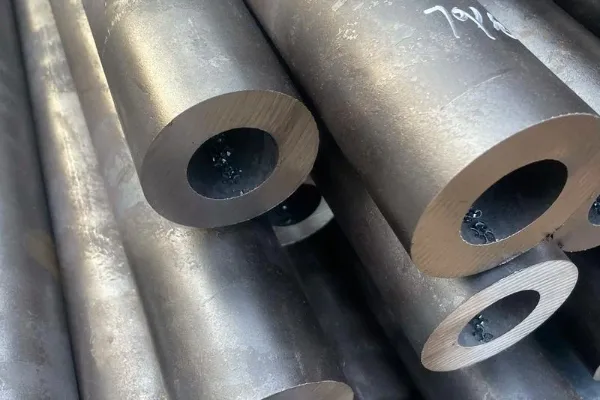
Schedule 40 Alloy Steel vs Carbon Steel
The main difference between alloy steel and carbon steel lies in their chemical composition and resulting mechanical performance.Carbon steel relies mainly on carbon content to achieve strength and hardness, while alloy steel uses a combination of multiple elements to improve overall performance.
As a result, alloy steel generally provides better resistance to heat, wear, and corrosion, while carbon steel remains more cost-effective and easier to produce for general applications.
Advantages of Schedule 40 Alloy Steel
Alloy steel is a high-performance steel made by adding specific alloying elements (such as chromium, molybdenum, nickel, vanadium, etc.) to carbon steel. These alloying elements significantly improve the material's mechanical properties and weather resistance. Compared with ordinary carbon steel, Schedule 40 alloy steel pipes exhibit significant advantages in high-temperature strength, corrosion resistance, and wear resistance. For example, common chromium-molybdenum alloy steels (such as 40Cr) contain 0.8%-1.1% chromium, and this invisible chromium oxide film gives the steel resistance to high-temperature oxidation and corrosion.
Why Choose Schedule 40 Alloy Steel Pipe?
Schedule 40 alloy steel pipe is widely used because it offers an optimal balance between cost efficiency and engineering performance.
It provides sufficient pressure capacity for most industrial applications while maintaining manageable weight and installation cost. Its compatibility with international standards ensures easy integration into global piping systems.
For many engineering projects, Schedule 40 represents the default choice unless specific operating conditions require thicker or thinner wall designs.
Conclusion
Schedule 40 alloy steel pipe is a fundamental component in modern industrial piping systems. By combining standardized ASME B36.10 dimensions with the enhanced mechanical properties of alloy steel, it delivers a reliable solution for medium to high-temperature and pressure applications.
Its balanced performance, wide availability, and compatibility with global standards make it one of the most commonly used pipe specifications in petrochemical, power generation, and industrial engineering systems worldwide.
Read more
Schedule 40 Pipe Pressure Rating Chart and Guide

 English
 Español
 بالعربية





 Phone :
  Whatsapp :
  Email :


