The production process of stainless steel pipe fittings tees is as follows: Steel pipe → Blanking → Bulging → Punching → Flattening → Welding joint (or interface) → Weld mark grinding → Finishing → Pressure testing → Surface inspection → Affixing trademarks and certificates of conformity → Packaging and warehousing. Following this workflow ensures the quality and performance of the processed materials, and adhering to specific processing methods guarantees smooth operation and use.
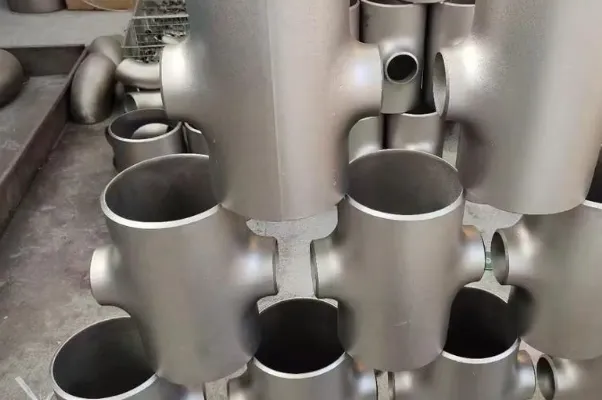
What Is a Stainless Steel Tee?
A stainless steel tee is a type of
pipe fitting used to connect three sections of pipe, allowing fluid to either combine or change direction within a pipeline system. It is widely used in industries such as oil & gas, chemical processing, water treatment, and construction.There are two main types:
Equal Tee – branch diameter is the same as the main pipe
Reducing Tee – branch diameter is smaller than the main pipe
Choosing the right type depends on flow requirements, pressure conditions, and system design.
Stainless Steel Tee Production Process
The production process of stainless steel tees is as follows:
Each of the above processes is completed by separate specialized equipment. Automatic forming machines are also available to automatically complete the filling, forming, filler melting, and shaping processes.
Material Cutting
Depending on the type of pipe, plate, or bar used, cutting methods such as sawing, gas cutting, plasma cutting, or punching/shearing are selected for material cutting.
1.Forming (Heating and Welding)
Heating is required for hot-push, hot-press, or forged tees, commonly using induction heating, electric furnaces, or flame heating. Some tees require rolling before welding, with welding methods primarily including arc welding, shielded welding, or automatic welding.
2.Heat Treatment
After forming, heat treatment is performed in an electric furnace or reverberatory furnace to relieve stress and improve the microstructure. The results are generally judged by hardness testing.
3.Surface Treatment
The surface is cleaned by sandblasting, shot blasting, grinding, or pickling to remove oxide scale and scratches.
4.Machining
The port dimensions and beveling are machined to ensure the tee meets structural dimensional requirements. Gas cutting can be used to assist in machining large parts.
5.Non-Destructive Testing
Surface and internal quality inspections are performed using PT, MT, RT, and UT, typically according to JB/T 4730 requirements.
6.Surface Protection
Acid pickling and passivation are commonly used to improve corrosion resistance; if all machined surfaces are cut surfaces, passivation is not required.
7.Marking
Products must be marked with the manufacturer's name, material, specifications, etc., using methods such as stamping, electro-etching, or inkjet printing.
Before forming, various fillers are used inside the pipe: lead, low-melting-point lead alloys, organic fillers, hydraulic oil, etc.
Stainless Steel Pipe Fittings - Tees Technical Parameters
1. Production and Processing Standards: GB/T12771-2000 "Stainless Steel Welded Pipes for Fluid Transportation" and GB/T12459—2005 "Steel Butt-Welded Seamless Pipe Fittings". Production and processing are carried out according to these two standards to ensure that the tees meet national production standards during use. 2. Stainless steel pipe fittings - tees: operating temperature -40℃~200℃. Use according to the specified temperature and strictly control the temperature.
3. Pull-out test: The pull-out force of the socket-welded argon arc welded pipe fittings is 3 times the national standard.
4. Flattening test: The pipe fitting is flattened to 1/3 of its outer diameter without cracks or splits.
5. Gas pressure test: Each pipe fitting undergoes a 1.6 MPa gas pressure test.
6. Pressure resistance test: After connecting the pipe and fitting, under 2.5 MPa pressure for 5 minutes, there is no leakage at the connection.
7. Tensile strength: Not less than 520 MPa, elongation not less than 35%. The actual measured value for this product is 733 MPa.
8. Corrosion resistance: The weld seams of the pipe fittings show no rust after a salt spray test.
The production process and technical parameters of stainless steel pipe fittings tees need to be carried out in a certain manner to ensure that they play an important role and value in use. The technical parameters of stainless steel pipe fittings tees need to be strictly controlled. Strict adherence to the parameters during use and production will result in high-quality stainless steel pipe fittings tees that play an important role and value in production.
Conclusion
The stainless steel tee manufacturing process involves multiple critical steps, from material selection and forming to testing and surface treatment. Each stage directly impacts the final product’s strength, durability, and performance.
For industrial applications, choosing the right manufacturing method and ensuring strict quality control is essential to guarantee long-term reliability.

 English
 Español
 بالعربية
 Phone :
  Whatsapp :
  Email :


