1. Introduction to the ASTM A312 Standard
ASTM A312 is a widely used specification for austenitic stainless steel pipes, covering both seamless and welded (ERW) types.The standard applies to grades 304, 304L, 316, and 316L, which are commonly used in high-temperature, high-pressure, and corrosion-resistant applications across industrial, chemical, food processing, and petrochemical sectors.In piping system design, the pressure rating (also known as allowable working pressure) is one of the most critical parameters, as it determines the pressure a pipe can safely withstand under a given temperature and wall thickness.
ASTM A312 pipe pressure depends on size, schedule, and temperature. For example, a 1-inch Schedule 40 pipe can handle around 3,000–3,200 psi at room temperature.
2. Mechanical Properties of 304 & 316 Stainless Steel (per ASTM A312)
For A312 TP316 or TP316L stainless steel pipes:
Minimum tensile strength: ≥ 515 MPa
Minimum yield strength (0.2% offset): ≥ 205 MPa
These mechanical properties ensure reliable performance in corrosive or elevated-temperature environments.
Both seamless and welded pipes produced under ASTM A312 must meet the same mechanical property requirements, ensuring structural integrity regardless of manufacturing method.
3. Factors Affecting Pressure Rating
A pipe’s pressure rating is not a fixed value. It varies depending on several major factors:
Nominal Pipe Size (NPS)
Wall thickness / Schedule (Sch 10,
Sch40, 80, 160, etc.)
Operating temperature
Material grade (304 vs 316 / 316L)
Manufacturing method (seamless vs welded)
Higher temperature results in lower allowable pressure.
Most pressure rating charts provide values at 100°F–750°F (38°C–399°C).
Because of these variables, pressure values must always be evaluated along with schedule, temperature, and material grade.
4. Typical ASTM A312 Pressure Rating Examples (304/316)
Below is a simplified reference of commonly cited values at ~100°F (38°C).
Actual design must always follow manufacturer-provided MTRs or ASME code tables.
|
Pipe Size (NPS)
|
Schedule
|
Typical Allowable Working Pressure (psig) @ 100°F
|
|
1" (304/316)
|
Sch 40
|
~3048 psig
|
|
1" (304/316)
|
Sch 80
|
~4213 psig
|
|
1" (304/316)
|
Sch 160
|
~6140 psig
|
|
1.5"
|
Sch 40
|
~2257 psig
|
|
1.5"
|
Sch 80
|
~3182 psig
|
Different sources may provide slightly different values.
This is why pressure rating must be verified using certified manufacturer data rather than relying solely on generic tables.
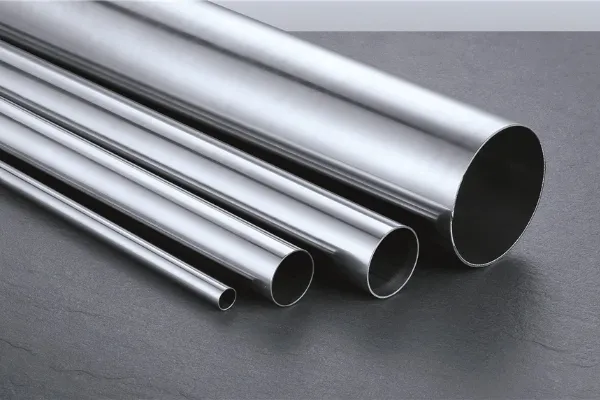
5.304 vs 316 Stainless Steel — Pressure & Application Differences
304 / 304L Stainless Steel
Most commonly used grade
Suitable for general water, low-chloride, and light chemical environments
Cost-effective and widely available
316 / 316L Stainless Steel
Significantly better corrosion resistance,Excellent for chloride, marine, chemical, and pharmaceutical environments,Better performance at elevated temperatures.
Although 316 often offers superior corrosion resistance, allowable pressures mainly depend on wall thickness, temperature, and fabrication quality, not only on material grade.
6.How to calculate the pressure that ASTM A312 stainless steel pipe can withstand?
Pressure ratings for ASTM A312 pipes are typically calculated using Barlow’s Formula. This formula relates the internal pressure of a pipe to its physical dimensions and the allowable stress of the material.
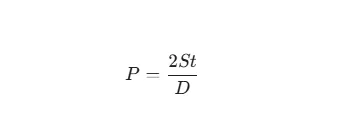
Where:
P = Internal Design Pressure (PSI)
S= Allowable Stress of the material (PSI)
t = Nominal Wall Thickness (inches)
D = Outside Diameter (inches)
Note: The "Allowable Stress" (S) varies based on the temperature. As the temperature rises, the allowable pressure rating of the pipe decreases.
A. Calculation Formula:
2 x Wall Thickness x (Tensile Strength x 40%) / Outer Diameter
B. 316, 316L, TP316, TP316L – Tensile Strength: 485 MPa
C .321, 304, 304L – Tensile Strength: 520 MPa
The tensile strength of 304 stainless steel pipe is 520 MPa.
The water pressure that stainless steel pipes can withstand varies depending on the material. The outer diameter and wall thickness are also crucial factors in calculating the pressure a stainless steel pipe can withstand. A thicker wall allows for greater pressure resistance; for example, a 10mm thick stainless steel pipe can withstand significantly higher water pressure than a 5mm thick pipe with the same outer diameter. Furthermore, the outer diameter also plays a role; a larger outer diameter results in lower pressure resistance. For example, with the same wall thickness, a larger outer diameter results in lower pressure resistance.
How to calculate the pressure that a stainless steel pipe can withstand:
Water pressure test pressure: The formula P = 2SR/D, where S refers to the wall thickness, r refers to 40% of the tensile strength, and D refers to the outer diameter. The pressure a stainless steel pipe can withstand is calculated using the following examples:
304 stainless steel pipe specification: 159*3 P = 2*520*0.4*3/159 = 7.84 MPa
316 stainless steel pipe specification: 159*3 P = 2*485*0.4*3/159 = 7.32 MPa
Conclusion
The pressure rating of ASTM A312 stainless steel pipes (304/316) is influenced by pipe size, wall thickness, temperature, and design standards. While both grades offer similar strength, selecting the right material depends largely on the operating environment.For accurate engineering design, always rely on ASME standards and detailed calculations, rather than general estimates.
FAQ
Q1: Is 316 always stronger than 304?
A: Not in terms of pressure rating. Strength is similar; corrosion resistance is the main difference.
Q2: Why do pressure ratings differ among manufacturers?
A: Variations in material, heat treatment, wall thickness tolerance, weld efficiency, and testing standards.
Q3: Can welded A312 pipes be used for high-pressure systems?
A: Yes, if welds meet efficiency and certification requirements per code.

 English
 Español
 بالعربية

 Phone :
  Whatsapp :
  Email :


