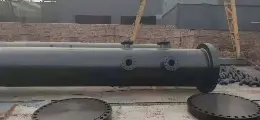
LSAW Pipe is a large-diameter, thick-walled, high-strength welded pipe manufactured using hot-rolled steel plates as raw material. The production process involves forming, double-sided submerged arc welding, diameter expansion, and rigorous inspection.
The core manufacturing characteristics of LSAW are as follows: a single steel plate → formed into a cylinder → a single longitudinal seam → submerged arc welding → diameter expansion and shaping → rigorous inspection → finished pipe. This "seam" is not a weakness, but rather a testament to the highly controllable nature of modern welding technology.
What is LSAW pipe?
LSAW Steel Pipe stands for Longitudinal Submerged Arc Welded Steel Pipe. Manufacturers produce it from steel plates using a UOE, JCOE, or HME forming process. The pipe features a straight weld seam along its length.
It is widely used in:
Oil and gas pipelines
Offshore engineering
High-pressure fluid transmission
Structural applications
Production process of LSAW steel pipe
a. Plate Inspection: After the steel plates used to manufacture large-diameter straight seam submerged arc welded steel pipes enter the production line, they first undergo full-plate ultrasonic testing;
b. Edge Milling: The two edges of the steel plate are double-sided milled using an edge milling machine to achieve the required plate width, edge parallelism, and bevel shape;
c. Pre-bending: The plate edges are pre-bent using a pre-bending machine to give the plate edges the required curvature;
d. Forming: On a JCO forming machine, one half of the pre-bent steel plate is first pressed into a "J" shape through multiple step-by-step stamping, then the other half of the steel plate is similarly bent and pressed into a "C" shape, finally forming an open "O" shape;
e. Pre-welding: The formed straight seam welded steel pipe is joined together and continuously welded using gas shielded welding (MAG);
f. Internal Welding: Welding is performed on the inside of the straight seam steel pipe using longitudinal multi-wire submerged arc welding (up to four wires);
g. External Welding: Longitudinal multi-wire submerged arc welding is used to weld on the outside of the straight seam submerged arc welded steel pipe;
h. Ultrasonic Inspection I: 100% inspection of the inner and outer welds and the base material on both sides of the welds of the straight seam welded steel pipe;
i. X-ray Inspection I: 100% X-ray industrial television inspection of the inner and outer welds, using an image processing system to ensure the sensitivity of the flaw detection;
j. Diameter Expansion: The entire length of the straight seam submerged arc welded steel pipe is expanded to improve the dimensional accuracy of the steel pipe and to improve the distribution of internal stress;
k. Hydrostatic Testing: Each expanded steel pipe is inspected on a hydrostatic testing machine to ensure that the steel pipe meets the standard test pressure requirements. This machine has automatic recording and storage functions;
l. Beveling: The pipe ends of the qualified steel pipes are processed to achieve the required pipe end bevel dimensions;
m. Ultrasonic Inspection II: Each pipe is subjected to ultrasonic testing again to check for defects that may occur in the straight seam welded steel pipe after diameter expansion and hydrostatic testing;
n. X-ray Inspection II: X-ray industrial television inspection and radiographic examination of pipe end welds are performed on steel pipes after diameter expansion and hydrostatic testing;
o. Pipe End Magnetic Particle Inspection: This inspection is performed to detect defects at the pipe ends;
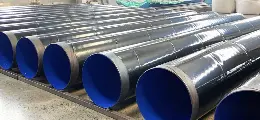
p. Corrosion Protection and Coating: Qualified steel pipes are subjected to corrosion protection and coating according to user requirements.
In addition to the above inspection items, according to API standards and other relevant standards, as well as some user-specific requirements, destructive testing and other inspections are also required for steel plates and pipes, including random sampling of the physical and chemical properties of incoming raw materials and 100% visual inspection of steel plates.
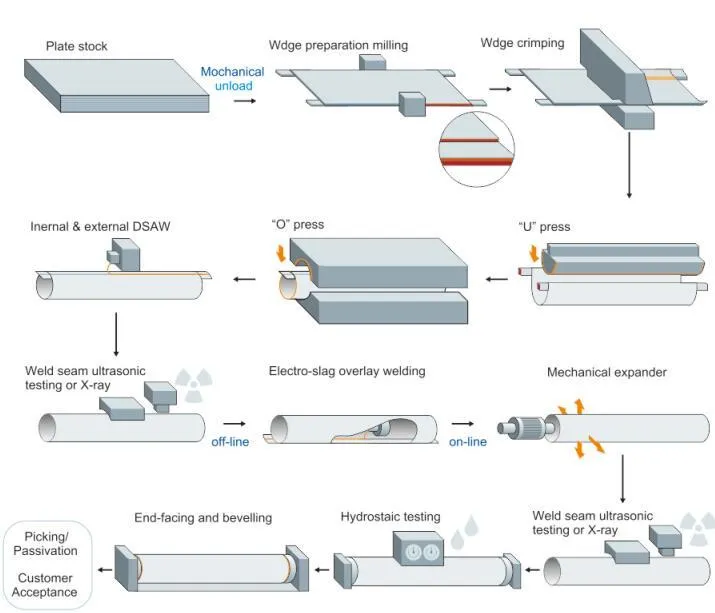
JCOE vs UOE: How to Choose?
|
Comparison Dimension
|
JCOE / JCO
|
UOE
|
|
Forming Principle
|
Progressive multi-step pressing (J → C → O)
|
Two-step heavy pressing (U → O)
|
|
Production Speed
|
~10–15 pipes/hour, suitable for small to medium batches
|
~40–50 pipes/hour, suitable for large-scale standardized production
|
|
Equipment Investment
|
Relatively low, strong mold versatility
|
Very high, requires large presses + multiple dedicated molds
|
|
Specification Flexibility
|
Can cover 16”–64”+ with many non-standard sizes
|
Requires mold change for different sizes, suitable for single-spec large projects
|
|
Dimensional Accuracy
|
High (depends on CNC control and operator precision)
|
Very high (O-forming in one press ensures best consistency)
|
|
Typical Applications
|
Most domestic projects, thick-wall pipes, multi-spec orders
|
Long-distance pipelines, offshore pipelines, mega-scale standardized projects
|
Technological Features of LSAW Pipes:
1. Uniform steel plate deformation during forming, low residual stress, and no surface scratches. Flexible pipe specifications, particularly suitable for large-diameter, thick-walled, and high-grade steel products;
2. Pre-welding plus internal and external welding processes ensure optimal welding positions, effectively reducing misalignment, weld deviation, and incomplete penetration, making quality control easier;
3. Overall mechanical diameter expansion improves dimensional accuracy, optimizes stress distribution, reduces stress corrosion risk, and facilitates on-site construction;
4. Nine 100% quality inspections are implemented, with the entire process under control to ensure stable quality of submerged arc welded steel pipes; The production line is equipped with a data acquisition system for real-time parameter transmission and centralized monitoring, comprehensively guaranteeing product quality.
FAQ
Why is submerged arc welding used in LSAW pipes?
It provides deep penetration, strong welds, and high production efficiency.
What inspection methods are used in LSAW pipe production?
Ultrasonic testing, X-ray inspection, and hydrostatic testing ensure quality.
Which forming method is better: JCOE or UOE?
Both methods work well. UOE is more efficient for mass production, while JCOE offers flexibility.
BAOWI Steel——Excellent quality, professional manufacturing. We are committed to providing high-quality LSAW steel pipes, strictly following international standards to ensure that each steel pipe has excellent strength, corrosion resistance and precise dimensions. Choosing BAOWI Steel means choosing a reliable partner to provide solid protection for your oil and gas transportation, water conservancy projects and various infrastructure projects. BAOWI Steel helps the global steel industry to create a better future!

 English
 Español
 بالعربية
 Phone :
  Whatsapp :
  Email :


