Schedule 40S (SCH 40S) is the standard wall thickness designation for stainless steel pipes defined in ASME B36.19M. Unlike Schedule 40 dimensions specified in ASME B36.10M for wrought steel pipes, SCH 40S is specifically designated for stainless steel pipe and is widely used in piping systems requiring excellent corrosion resistance, durability, and long service life.
It is important to understand that SCH 40S is not a material grade. Instead, it defines the pipe wall thickness for each Nominal Pipe Size (NPS). The actual pipe material is specified separately, with the most common grades including
ASTM A312 TP304, TP304L,
TP316, and TP316L.
Because stainless steel offers superior resistance to corrosion, oxidation, and chemical attack, SCH 40S pipes are extensively used in industries such as:
Chemical processing
Oil and gas
Food and beverage production
Pharmaceutical manufacturing
Water treatment
Marine engineering
Power generation
General industrial process piping
Compared with thinner schedules such as SCH 10S, Schedule 40S provides greater mechanical strength and higher pressure capability while maintaining the corrosion-resistant advantages of stainless steel.
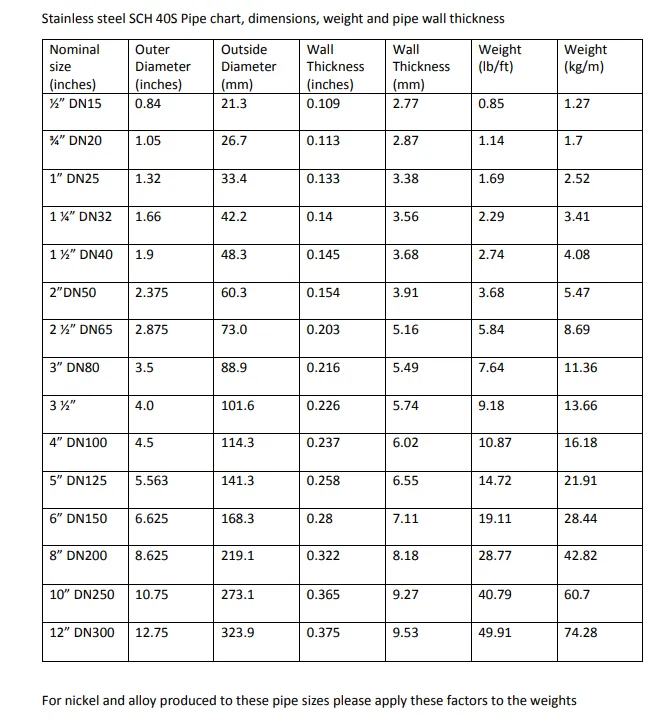
Standard Sizes – Stainless Steel SCH 40S Pipe Chart
The following table summarizes the most commonly used Nominal Pipe Sizes (NPS), Outside Diameter (OD), Wall Thickness, and Weight for Schedule 40S stainless steel pipes manufactured according to ASME B36.19M.The table below summarizes commonly used Nominal Pipe Sizes (NPS), outer diameters, wall thickness, and weight for SCH 40S stainless steel pipes.
Note:
Pipe dimensions shown above are based on ASME B36.19M.
Actual weights may vary slightly depending on manufacturing tolerances and material grade.
Some manufacturers may provide customized wall thicknesses for specific applications; always verify the product specification before purchasing.
Understanding SCH 40S Wall Thickness
One of the most common misconceptions is that Schedule 40S represents a fixed wall thickness. In reality, the wall thickness varies according to the nominal pipe size (NPS).
|
NPS
|
Outside Diameter
|
SCH 40S Wall Thickness
|
|
1/2"
|
21.3 mm
|
2.77 mm
|
|
2"
|
60.3 mm
|
3.91 mm
|
|
6"
|
168.3 mm
|
7.11 mm
|
|
12"
|
323.9 mm
|
9.53 mm
|
As pipe diameter increases, the corresponding wall thickness also increases to provide sufficient mechanical strength and pressure resistance.
Although SCH 40S and Schedule 40 share identical wall thicknesses for many smaller pipe sizes, they begin to differ for certain larger nominal diameters because ASME B36.19M uses a dedicated wall thickness series specifically optimized for stainless steel pipes.
The American MSS and ANSI standards classify pipe wall thickness into three types based on pipe weight:
(1) Standard weight pipes are represented by STD;
(2) Thickened pipes are represented by XS;
(3) Extra thick pipes are represented by XXS.
For pipes with a DN of 250mm, Sch40 is equivalent to
STD pipe.
For pipes with a DN of 200mm, Sch80 is equivalent to XS pipe.
For those interested in learning more about pipe wall thickness and pressure ratings, you can also check our article: [Schedule 40 Pipe Pressure Rating Chart and Guide], which offers detailed charts and guidance for engineers and procurement professionals.
Schedule 40S Stainless Steel Pipe Applicable Standards
Schedule 40S stainless steel pipes are manufactured in accordance with internationally recognized standards that define their dimensions, material requirements, and manufacturing quality. The two most important standards are ASME B36.19M and ASTM A312 / ASME SA312.
ASME B36.19M – Specifies the dimensions, outside diameters (OD), wall thicknesses, and weights of stainless steel pipes, including Schedule 5S, Schedule 10S, Schedule 40S, and Schedule 80S.
ASTM A312 / ASME SA312 – Covers seamless, welded, and heavily cold-worked austenitic stainless steel pipes intended for general corrosive service and high-temperature applications. It includes commonly used grades such as TP304, TP304L, TP316, and TP316L.
Together, these standards ensure consistent pipe dimensions, manufacturing quality, material properties, and compatibility across stainless steel piping systems, allowing SCH 40S pipes from different manufacturers to meet the same engineering and performance requirements.
Common Stainless Steel Grades for SCH 40S Pipe
Schedule 40S (SCH 40S) specifies the wall thickness of stainless steel pipe rather than the material itself. The most commonly supplied materials are ASTM A312 TP304, TP304L, TP316, and TP316L, all of which are widely used in industrial piping systems. Selecting the appropriate grade depends on the operating environment, corrosion conditions, temperature, and project budget.
1.TP304 Stainless Steel SCH 40S Pipe
TP304 is the most widely used stainless steel grade for Schedule 40S pipes. Containing approximately 18% chromium and 8% nickel, it offers an excellent balance of corrosion resistance, strength, and affordability. TP304 SCH 40S pipes are commonly used in freshwater systems, food processing, architectural applications, and general industrial piping.
2.TP304L Stainless Steel SCH 40S Pipe
TP304L is the low-carbon version of TP304, with a maximum carbon content of 0.03%. The reduced carbon level minimizes carbide precipitation during welding, improving resistance to intergranular corrosion. For welded piping systems, TP304L is often preferred over standard TP304.
3.TP316 Stainless Steel SCH 40S Pipe
TP316 stainless steel contains 2–3% molybdenum, providing significantly better resistance to pitting and crevice corrosion in chloride-containing environments. It is widely used where pipes are exposed to seawater, salt spray, or aggressive chemicals.
4.TP316L Stainless Steel SCH 40S Pipe
TP316L combines the corrosion resistance of TP316 with a lower carbon content, making it the preferred material for welded piping in highly corrosive environments. It is commonly specified for pharmaceutical, biotechnology, food processing, and offshore projects where both corrosion resistance and weld integrity are critical.
TP304 vs TP316 SCH 40S Pipe
The primary difference between TP304 and TP316 stainless steel is the addition of molybdenum in TP316. This alloying element greatly improves resistance to chloride-induced corrosion, making TP316 the preferred choice for marine and chemical applications.
|
Property
|
TP304
|
TP316
|
|
ASTM Specification
|
ASTM A312
|
ASTM A312
|
|
Chromium
|
18–20%
|
16–18%
|
|
Nickel
|
8–10.5%
|
10–14%
|
|
Molybdenum
|
—
|
2–3%
|
|
Corrosion Resistance
|
Excellent
|
Superior
|
|
Chloride Resistance
|
Good
|
Excellent
|
|
Marine Applications
|
Limited
|
Recommended
|
|
Typical Industries
|
Food processing, water supply, architecture
|
Chemical processing, marine, pharmaceutical
|
|
Relative Cost
|
Lower
|
Higher
|
SCH 40 vs SCH 40S
Although their names are similar, Schedule 40 and Schedule 40S are defined by different standards and are intended for different piping materials.
|
Item
|
Schedule 40
|
Schedule 40S
|
|
Applicable Standard
|
ASME B36.10M
|
ASME B36.19M
|
|
Primary Material
|
Carbon steel and alloy steel
|
Stainless steel
|
|
Common Grades
|
ASTM A53, ASTM A106
|
ASTM A312 TP304, TP316
|
|
Typical Applications
|
Water transmission, oil & gas, structural piping
|
Chemical processing, food, pharmaceutical, marine
|
|
Corrosion Resistance
|
Depends on coating or alloy
|
Excellent
|
For many small and medium nominal pipe sizes, SCH 40 and SCH 40S have identical outside diameters and similar wall thicknesses. However, SCH 40S is specifically standardized for stainless steel pipes under ASME B36.19M, and certain larger sizes may have different wall thickness values. Therefore, engineers should always verify dimensions using the applicable standard.
Typical Applications of SCH 40S Stainless Steel Pipe
SCH 40S stainless steel pipe is suitable for a wide range of industrial piping systems. Depending on the material grade, it can be used for chemical processing, food and beverage production, pharmaceutical manufacturing, water treatment, marine engineering, offshore platforms, petrochemical plants, and general process piping.
TP304 and TP304L are commonly selected for water supply, food processing, and general industrial applications, while TP316 and TP316L are better suited for marine environments and chemical processing where higher resistance to chloride corrosion is required.
Read more related content
Schedule 40 Pipe Pressure Rating Chart and Guide
Schedule 40 Galvanized Pipe
Sch 40 Pipe Dimensions

 English
 Español
 بالعربية



 Phone :
  Whatsapp :
  Email :


