The right galvanized pipe wall thickness depends on the pipe size, applicable dimensional standard, design pressure, mechanical loads, and service environment. For the same nominal pipe size (NPS), different schedules can have different nominal wall thicknesses. Schedule 40 is a common option for general-purpose piping, while Schedule 80 has a thicker wall for the same NPS. However, the correct choice must meet the project's engineering requirements; a schedule number alone does not determine the allowable working pressure.
When selecting galvanized steel pipes, check four key factors: nominal pipe size, required wall thickness or schedule, operating conditions, and galvanizing requirements. Steel wall thickness refers to the thickness of the base metal, whereas zinc coating thickness refers to the protective layer applied to the steel surface. These are separate specifications and should be verified independently.
The following guide explains how to compare galvanized pipe wall thicknesses, understand schedule designations, and specify the right pipe for your application.
What Determines Galvanized Pipe Wall Thickness?
The wall thickness of a galvanized steel pipe is the thickness of its steel base material, excluding the zinc coating. It is normally specified in millimeters or inches.
Several factors determine the required wall thickness.
Pipe size: Nominal pipe size (NPS) and DN identify a standardized pipe size rather than its exact inside diameter. The outside diameter and nominal wall thickness must be checked against the applicable dimensional standard.
Design pressure and temperature: Pipes carrying pressurized fluids must meet the applicable design requirements.
The required wall thickness depends on factors such as operating pressure, temperature, material properties, joint efficiency where applicable, and corrosion allowance.
Mechanical loads: Buried pipelines, structural applications, and pipes exposed to external forces may require additional consideration of soil loads, impact, bending, support spacing, and other mechanical conditions.
Corrosion and service environment: Galvanizing provides a zinc coating that helps protect the steel from corrosion.
However, the required steel wall thickness and the required coating thickness are separate considerations. The service environment determines whether additional corrosion protection or a corrosion allowance is necessary.
Applicable standards: The product specification and dimensional standard determine which sizes, wall thicknesses, tolerances, and material requirements apply.
Common references include ASTM A53/A53M for certain black and hot-dipped galvanized steel pipes and ASME B36.10M for welded and seamless wrought steel pipe dimensions.
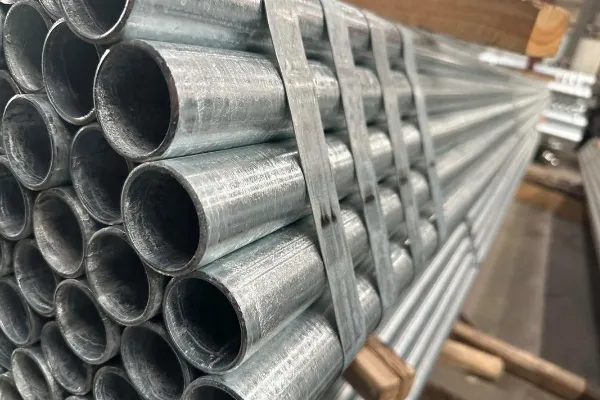
What Does “Wall Thickness” / “Schedule” Mean for Galvanized Pipes
For galvanized steel pipes, wall thickness is often expressed via a “Schedule” (SCH) number — e.g. SCH 40, SCH 80, SCH 160. Higher schedule → thicker wall at the same nominal outside diameter (OD).
The schedule number helps standardize and compare pipes’ wall thickness across different diameters, materials, and manufacturers.
For example: an ERW galvanized pipe with NPS (nominal pipe size) 2″ in SCH 40 might have a wall thickness around 0.154 inches (≈ 3.91 mm), while in SCH 80 it might be 0.218 inches (≈ 5.54 mm) for the same OD.
Thus, choosing the right “schedule” — or wall thickness — is a first essential step before drilling down into exact dimensions.
Galvanized Pipe Wall Thickness Chart
The table below provides representative Schedule 40 steel pipe dimensions commonly used as a reference when specifying galvanized pipe.
Confirm that the selected product can be supplied to the required dimensional and galvanizing specifications.
|
Nominal Pipe Size (NPS)
|
DN
|
Outside Diameter (mm)
|
Schedule 40 Wall Thickness (mm)
|
|
1/2"
|
15
|
21.3
|
2.77
|
|
3/4"
|
20
|
26.7
|
2.87
|
|
1"
|
25
|
33.4
|
3.38
|
|
1 1/2"
|
40
|
48.3
|
3.68
|
|
2"
|
50
|
60.3
|
3.91
|
|
3"
|
80
|
88.9
|
5.49
|
|
4"
|
100
|
114.3
|
6.02
|
|
6"
|
150
|
168.3
|
7.11
|
|
8"
|
200
|
219.1
|
8.18
|
Note: Values are representative nominal dimensions for Schedule 40 steel pipe based on ASME B36.10M dimensional data. They are not universal requirements for every galvanized pipe product. NPS and DN are nominal designations, and actual dimensions may be subject to the specified manufacturing tolerances.
For a detailed comparison of a particular size, refer to the Schedule 40 Galvanized Pipe guide. Buyers who need thicker-wall options can also review the Schedule 80 Galvanized Steel Pipe page.
How Schedule Numbers Affect Pipe Wall Thickness
Pipe schedule is a standardized designation used to identify nominal wall thickness for a given nominal pipe size.
Common designations include Schedule 10, Schedule 40, Schedule 80, and Schedule 160, where applicable to the selected pipe size and dimensional standard.
For the same NPS, a higher schedule generally means a thicker wall. Because the outside diameter normally remains the same across schedules for that NPS, increasing wall thickness reduces the available inside diameter.
For example, an NPS 2 steel pipe has an outside diameter of approximately 60.3 mm. Under ASME B36.10M dimensional conventions:
|
NPS
|
Schedule
|
Nominal Wall Thickness
|
|
2"
|
Schedule 40
|
3.91 mm
|
|
2"
|
Schedule 80
|
5.54 mm
|
These values illustrate the dimensional difference between the two schedules. They do not establish a universal allowable working pressure for every galvanized pipe.
A thicker wall may improve resistance to certain mechanical loads and may be appropriate for more demanding service conditions.
However, pressure suitability must be determined using the applicable design code, material properties, operating conditions, and other relevant requirements.
Schedule 40 is commonly considered for general-purpose piping, while Schedule 80 may be specified when a thicker wall is needed.
Neither designation should be selected solely by assuming that a higher schedule automatically makes a pipe suitable for every demanding application.
Standard Nominal Diameters for Galvanized Pipes
Galvanized pipes are available in a wide range of sizes to accommodate different applications. The nominal diameter, often referred to as the nominal pipe size (NPS), is a standardized measurement used to describe the size of a pipe. It's important to note that the nominal diameter is not always the exact measurement of the pipe's inner or outer diameter.
Common nominal diameters for galvanized steel tubing include:
1/8 inch (3.2 mm)
1/4 inch (6.4 mm)
3/8 inch (9.5 mm)
1/2 inch (12.7 mm)
3/4 inch (19.1 mm)
1 inch (25.4 mm)
1 1/4 inch (31.8 mm)
1 1/2 inch (38.1 mm)
2 inch (50.8 mm)
2 1/2 inch (63.5 mm)
3 inch (76.2 mm)
4 inch (101.6 mm)
6 inch (152.4 mm)
8 inch (203.2 mm)
These sizes are commonly used in both residential and commercial applications. Smaller diameters (1/8 inch to 2 inches) are frequently found in household plumbing systems, while larger diameters are often utilized in industrial settings or large-scale water distribution systems.
Common Thickness Standards for Stainless Steel Galvanized Pipes
The thickness standards for stainless steel galvanized pipes are usually specified by national or industry standards. Below are some common thickness standards for stainless steel galvanized pipes:
Standard Wall Thickness: According to national or industry standards, the standard wall thickness of stainless steel galvanized pipes is generally between 0.8mm and 4.0mm. This standard wall thickness is suitable for most conventional applications, such as water supply pipelines and petrochemical pipelines.
Thin Wall Pipe: Thin-walled stainless steel galvanized pipes are generally less than 0.8mm thick and are mainly used in applications with lower weight requirements, such as furniture manufacturing and decoration.
Thick Wall Pipe: Thick-walled stainless steel galvanized pipes are generally greater than 4.0mm thick and are suitable for applications subjected to high temperatures, high pressures, or special working conditions, such as chemical equipment and oil drilling.
Pipe Wall Thickness vs. Zinc Coating Thickness
Steel wall thickness and zinc coating thickness describe two different properties of a galvanized pipe.
|
Property
|
Steel Wall Thickness
|
Zinc Coating Thickness
|
|
What it measures
|
Thickness of the steel base material
|
Thickness of the protective zinc layer
|
|
Typical unit
|
mm or inches
|
um or another unit specified by the standard
|
|
Main purpose
|
Structural capacity and dimensional requirements
|
Corrosion protection
|
|
Specified by
|
Pipe product and dimensional requirements
|
Applicable galvanizing specification
|
|
How it is checked
|
Suitable dimensional or ultrasonic measurement methods
|
Appropriate coating-thickness measurement methods
|
Hot-dip galvanizing applies a zinc coating to the steel surface. The coating does not replace the need to specify the correct steel wall thickness.
When preparing a purchase order, state the required pipe wall thickness and galvanizing requirements separately. The applicable coating standard and acceptance criteria should be agreed upon before production.
Frequently Asked Questions
What is the standard wall thickness of galvanized steel pipe?
There is no single standard wall thickness for all galvanized steel pipes. The required thickness depends on the nominal pipe size, dimensional standard, selected schedule or specified dimension, and intended application.
Is Schedule 40 galvanized pipe thick enough for water supply?
Schedule 40 may be suitable for some water supply systems, but suitability depends on the design pressure, temperature, material specification, connections, and applicable plumbing requirements. Confirm the project's requirements before selecting a pipe.
What is the difference between Schedule 40 and Schedule 80 galvanized pipe?
For the same nominal pipe size, Schedule 80 generally has a thicker nominal wall than Schedule 40. This usually reduces the inside diameter and increases the pipe's weight. The appropriate choice depends on the design requirements rather than schedule number alone.
Does a thicker galvanized pipe always have a higher pressure rating?
No. Pressure capacity depends on more than wall thickness, including the material grade, outside diameter, temperature, design code, manufacturing requirements, and applicable tolerances. The allowable working pressure must be established using the relevant engineering criteria.
More related content
HDG vs GI Steel Pipe: Understanding the Key Differences
Galvanized Iron vs Galvanized Steel Comparison Guide
Pipe Schedule Dimensions Chart

 English
 Español
 بالعربية




 Phone :
 Whatsapp :
 Email :