When it comes to selecting stainless steel pipes for construction, manufacturing, or fluid transportation, one of the most important factors to consider is the ASTM A312 steel pipe size tolerance. This standard specifies the dimensions, materials, and testing requirements for seamless and welded stainless steel pipes used in high-temperature and pressure environments. Understanding the tolerance range and how it affects the performance and compatibility of pipes in various applications can help ensure the right fit for your project. In this article, we will explore the essential details of ASTM A312 steel pipe size tolerance, including its significance, standards, and how it impacts overall pipe quality.
1.What is ASTM A312?
ASTM A312 is a specification developed by
ASTM International (formerly known as the American Society for Testing and Materials) for stainless steel pipes. It covers both seamless and welded pipes made from austenitic stainless steel grades, specifically designed for high-temperature applications. Common grades include
304, 304L, 316, and 316L. These pipes are primarily used in industries such as chemical processing, power generation, and petroleum refining due to their excellent resistance to corrosion and heat.
2.ASTM A312 Stainless Steel Tube Tolerances
Wall Thickness Tolerance
Permitted Variations in Wall Thickness (%)
|
NPS Designator
|
Tolerance (% from Nominal)
|
Over (%)
|
Under (%)
|
|
1/8 to 2 1/2, all t/D ratios
|
20
|
12.5
|
|
|
3 to 18 incl., t/D up to 5% incl.
|
22.5
|
12.5
|
|
|
3 to 18 incl., t/D > 5%
|
15
|
12.5
|
|
|
20 and larger, welded, all t/D ratios
|
17.5
|
12.5
|
|
|
20 and larger, seamless, t/D up to 5% incl.
|
22.5
|
12.5
|
|
|
20 and larger, seamless, t/D > 5%
|
15
|
12.5
|
|
Where:
t = Nominal Wall Thickness
D = Ordered Outside Diameter
Outside Diameter Tolerance
Permitted Variation in Outside Diameter (mm)
|
Outside Diameter (OD)
|
Tolerance (mm)
|
|
10.29 - 48.26
|
-0.5
|
|
48.26 - 114.30
|
-1
|
|
114.30 - 219.08
|
-2
|
|
219.08 - 457.20
|
-3
|
Length Tolerance (mm)
+6.0 / -0
Lenth Variations
a. Unless otherwise specified, all size from NPS 1/8 to NPS 8 are available in a maximum length of 24 ft. And a length
range from 15 to 24 ft. Short length are acceptable, but the number and minimum length are agreed upon by the purchaser
and the manufacturer.
b. If a certain cut length is required, the required length should be specified in the order. The pipe shall not be longer than the
specified length and the pipe length shall not exceed 1/4 inch [6 mm].
c. Unless otherwise specified, Joints are not allowed to have .
3.A312 pipe Manufacturing Types
ASTM A312 stainless steel pipe and tube covers following manufacturing types (Including hot finished or cold finished):
a. Seamless Pipe (SMLS): It covers stainless steel seamless pipe or tube in hot rolling or cold drawn.
b. Welded Pipe (WLD): Welded by an automatic welding process that does not add filler metal when welding.
c. Cold Worked Pipe (HCW pipe): The heavy cold-worked pipe that apply cold working of not less than 35% reduction in thickness
of both wall, and welded to the welded pipe prior to final annealing. Do not use fillers during welding.
d. Welded and HCW pipe: Welded pipe and HCW pipe of 14 and smaller than NPS 14 shall have a single longitudinal weld.
After approval by the purchaser, the welded pipe and HCW pipe with an NPS greater than NPS 14 shall have a single longitudinal weld
or shall be manufactured by forming and welding two longitudinal sections of flat stock.
So each welds are to be tested, inspected, inspected or treated.
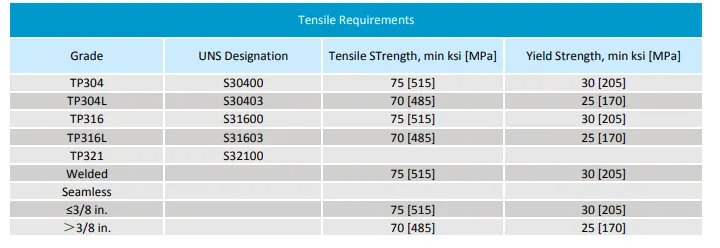
4.Mechanical Properties of ASTM A312 Pipe
5.ASTM A312: Quick FAQs
1. What is the standard wall thickness tolerance?
The most critical rule is the -12.5% mill tolerance. The pipe wall must never be thinner than 87.5% of the specified nominal thickness.The "over" tolerance is more generous, typically ranging from +15% to +22.5% depending on the pipe size and $t/D$ ratio.
2. Does A312 allow for "Out-of-Round" pipes?
Yes, this is called ovality. While the Outside Diameter (OD) must stay within fixed limits (e.g., $\pm$ 0.4 mm for small sizes), thin-walled pipes are allowed additional ovality—up to 1.5% of the OD—because they can easily be pulled back into a circle during installation or welding.
3. Can I use ASTM A312 for food or pharma?
While A312 grades like 304L and 316L are corrosion-resistant enough for these industries, A312 is an industrial pipe standard. For high-purity applications requiring specific internal surface finishes (RA values), ASTM A270 (Sanitary Tubing) is usually preferred over A312 pipe.
4. How does Schedule 40S differ from Schedule 40?
In ASTM A312, the "S" stands for Stainless. Stainless schedules (defined in ASME B36.19) are often thinner than carbon steel schedules (ASME B36.10) to save on material costs, as stainless steel is significantly more expensive and has higher strength-to-weight efficiency.

 English
 Español
 بالعربية
 Phone :
  Whatsapp :
  Email :


