ASTM A105 Material Specification
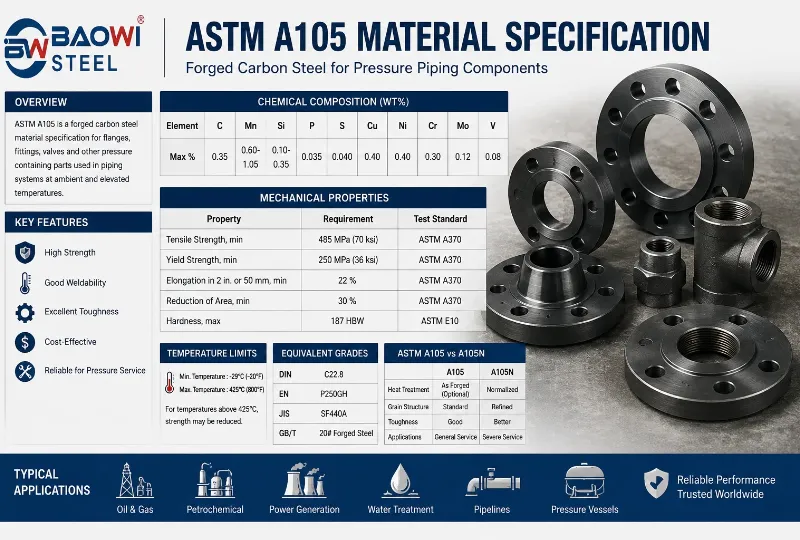
ASTM A105 is one of the most widely used forged carbon steel materials in pressure piping systems. Engineers, procurement specialists, and project contractors frequently specify ASTM A105 for
flanges, forged fittings, valves, and other pressure-containing components because it offers an excellent balance of strength, weldability, availability, and cost.This guide explains the ASTM A105 material specification in detail, including its chemical composition, mechanical properties, manufacturing requirements, equivalent grades, temperature limitations, and industrial applications.
What Is ASTM A105 Material?
ASTM A105 is a standard specification developed by
ASTM International for forged carbon steel piping components used in pressure systems at ambient and elevated temperatures.
The specification applies to:
Forged flanges
Forged fittings
Valves
Pressure-containing forged parts
Unlike
ASTM A106 or
ASTM A53, ASTM A105 is not divided into multiple grades. When engineers refer to "ASTM A105 material," they are referring to a specific forged carbon steel specification rather than a family of grades.
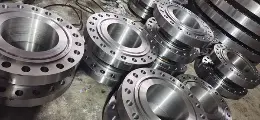
Specification Format of SA105N Flange
|
Material:
|
Corbon steel:ASTM A105/105N;A694 F42-F70;A350LF1/LF2;
|
|
Stainless steel:ASTM A182 F304/304L;F316/316L;F321;F51;
|
|
Alloy steel:ASTM A182 F11/F12/F22;
|
|
Pressure:
|
150# 300# 600# 900# 1500# 2500#
|
|
Surface preparation:
|
Anti-rust black paint, anti-rust varnish, transparent anti-rust oil, hot galvanized, sandblasting.
|
|
FF RF MFM TG RJ
|
|
Packing detail
|
Free fumigation wooden cases, trays can be according to customer requirements for special packaging
|
|
Product delivery time
|
20days for bulk, 7-10 working days for inventory.
|
|
Minimum Order Quantity
|
According to customer's requirement
|
|
Application Range
|
It is widely used in petroleum, chemical industry, nuclear power plant, food manufacturing, construction, shipbuilding,
|
|
|
|
papermaking, medicine and other industries.
|
Chemical Composition of ASTM A105 Material
The chemical composition of ASTM A105 carbon steel ensures a balance between strength, weldability, and corrosion resistance. The typical chemical composition is as follows:
|
Element
|
Composition (%)
|
|
Carbon (C)
|
≤ 0.35
|
|
Manganese (Mn)
|
0.60 – 1.05
|
|
Phosphorus (P)
|
≤ 0.035
|
|
Sulfur (S)
|
≤ 0.040
|
|
Silicon (Si)
|
0.10 – 0.35
|
|
Copper (Cu)
|
≤ 0.40
|
|
Nickel (Ni)
|
≤ 0.40
|
|
Chromium (Cr)
|
≤ 0.30
|
|
Molybdenum (Mo)
|
≤ 0.12
|
|
Vanadium (V)
|
≤ 0.08
|
These elements provide the necessary mechanical strength and machinability for high-pressure applications.
Mechanical Properties of ASTM A105 Flange
ASTM A105 flanges are valued for their excellent mechanical performance under pressure and high-temperature environments. The mechanical properties are defined as:
|
Property
|
Value
|
|
Tensile Strength
|
≥ 485 MPa (70 ksi)
|
|
Yield Strength
|
≥ 250 MPa (36 ksi)
|
|
Elongation
|
≥ 22%
|
|
Hardness
|
≤ 187 HB (Brinell Hardness)
|
ASTM A105 Heat Treatment Requirements
ASTM A105 components are commonly supplied in the as-forged condition. However, heat treatment may be required depending on component size, wall thickness, and project specifications.
Common Heat Treatment Methods
Normalizing
Normalizing refines grain structure and improves toughness.
Annealing
Annealing reduces hardness and improves machinability.
Stress Relieving
Stress relieving minimizes residual stresses generated during forging and machining.
Benefits of Heat Treatment
Improved toughness
Enhanced dimensional stability
More uniform mechanical properties
Better performance under cyclic loading
ASTM A105N Material Explained
Many buyers encounter ASTM A105N and wonder how it differs from standard ASTM A105.
The letter "N" stands for Normalized.
ASTM A105N undergoes a normalizing heat treatment after forging, creating a finer and more uniform grain structure.
|
Property
|
ASTM A105
|
ASTM A105N
|
|
Heat Treatment
|
Not Mandatory
|
Normalized
|
|
Grain Structure
|
Standard
|
Refined
|
|
Toughness
|
Good
|
Better
|
|
Impact Resistance
|
Good
|
Improved
|
|
Critical Service
|
General Applications
|
Severe Applications
|
For offshore platforms, pressure vessels, and low-temperature piping systems, ASTM A105N is often preferred.
ASTM A105 Equivalent Material Grades
International projects frequently require cross-reference materials.
|
Standard
|
Equivalent Grade
|
|
ASTM
|
A105
|
|
DIN
|
C22.8
|
|
EN
|
P250GH
|
|
JIS
|
SF440A
|
|
GB/T
|
20# Forged Steel
|
Although these materials share similar characteristics, engineers should always verify chemical composition and mechanical requirements before substitution.
ASTM Standards:
A266/A266M Specification for Carbon Steel Forgings for Pressure Vessel Components.
A675/A675M Specification for Carbon Steel Bars, Hot-Rolled, Special Quality and Mechanical Properties.
A696 Specification for Carbon Steel Bars, Hot-Rolled or Cold-Worked, Special Quality, for Pressure Piping Components.
A788/A788M Specification for Steel Forgings, General Requirements.
A961/961M General Requirements for Steel Flanges, Forged Fittings, Valves, and Parts for Piping Applications.
Frequently Asked Questions (FAQ)
Is ASTM A105 a Grade or a Specification?
ASTM A105 is a material specification for forged carbon steel components rather than a multi-grade steel standard.
What Is ASTM A105 Used For?
ASTM A105 is used for forged flanges, valves, fittings, and pressure-containing piping components.
Can ASTM A105 Be Welded?
Yes. ASTM A105 offers excellent weldability and supports common industrial welding procedures.
What Is the Difference Between ASTM A105 and ASTM A105N?
ASTM A105N undergoes normalizing heat treatment, resulting in improved toughness and more consistent mechanical properties.
What Is the Difference Between ASTM A105 and ASME SA105?
ASTM A105 and ASME SA105 generally refer to the same forged carbon steel material requirements, but they are designated under different standards. ASTM A105 is the ASTM material specification, while ASME SA105 is the ASME designation used for pressure-containing components. The material requirements are essentially aligned, so the difference is mainly in the standard designation and code context rather than the steel itself.

 English
 Español
 بالعربية
 Phone :
  Whatsapp :
  Email :


