OCTG stands for Oil Country Tubular Goods, a group of steel tubular products used in oil and gas drilling, well construction, and production. The three main OCTG product types are drill pipe, casing pipe, and tubing. Each serves a different purpose: drill pipe transmits torque and drilling fluid during drilling, casing supports the wellbore and isolates geological formations, and tubing carries produced oil or gas to the surface.
OCTG products are selected according to well depth, operating pressure, temperature, fluid composition, mechanical loads, and applicable technical specifications. Common considerations include steel grade, outside diameter, wall thickness, connection type, length range, and inspection requirements.
For oil and gas operators, drilling contractors, and procurement teams, understanding OCTG types and specifications helps ensure that the supplied tubular products match the intended well design and operating conditions.
What Are the Main Types of OCTG?
OCTG includes several types of tubular products and associated components used throughout the well construction and production process.
The three principal product categories are drill pipe, casing, and tubing. Pup joints, couplings, and other connection components are also important parts of an OCTG supply package.
|
OCTG product
|
Primary function
|
Typical application
|
Relevant standard
|
|
Drill pipe
|
Transmits torque and circulates drilling fluid
|
Drilling operations
|
API Spec 5DP
|
|
Casing pipe
|
Supports the wellbore and isolates formations
|
Well construction
|
API Spec 5CT
|
|
Tubing pipe
|
Carries produced oil and gas to the surface
|
Well production
|
API Spec 5CT
|
|
Pup joint
|
Adjusts the length of a tubular string
|
Drilling, completion, and production assemblies
|
Depends on product type and specification
|
|
Coupling
|
Connects compatible threaded pipe joints
|
Casing and tubing strings
|
Applicable product and connection specifications
|
API Spec 5CT covers casing, tubing, pup joints, coupling stock, coupling materials, and specified accessory materials. API Spec 5DP covers steel drill pipe with upset pipe-body ends and welded tool joints.
The applicable requirements should always be checked against the relevant standard edition and purchase specification.
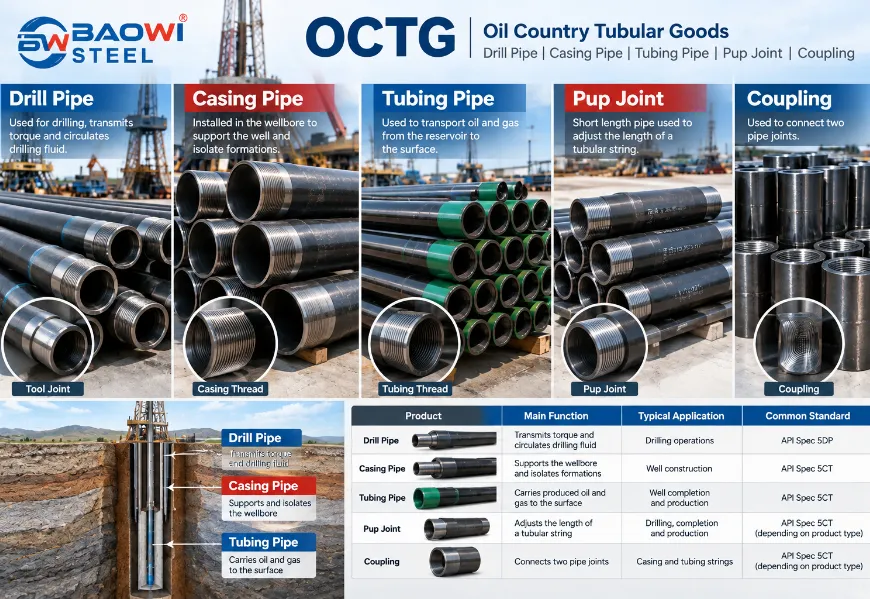
OCTG Drill Pipe: Pipe Used for Drilling
Drill pipe is a high-strength tubular component used to connect the surface drilling equipment to the bottom-hole assembly. During drilling, it transmits rotational torque to the drill bit and provides a flow path for drilling fluid.
Drilling fluid travels down the inside of the drill pipe, exits through the drill bit, and returns toward the surface through the annular space between the drill string and the surrounding wellbore or casing.
Drill pipe must withstand several demanding operating loads:
Tensile load: The pipe supports the weight of the suspended drill string.
Torsional load: Rotation transmits torque to the drill bit.
Internal pressure: Drilling fluid flows through the pipe under pressure.
Cyclic loading: Repeated rotation, bending, and changes in operating conditions can contribute to fatigue.
Drill pipe is commonly supplied with tool joints welded to the pipe body. The connection design, pipe grade, wall thickness, and inspection requirements affect its performance and service life.
Relevant standard: API Spec 5DP establishes technical delivery requirements for steel drill pipe. It includes grades such as E and higher-strength grades including G, S, X, and V, as well as grade SS for applicable sour-service requirements. The correct grade depends on the specified product and operating conditions.
Steel Casing Pipe: Supporting and Protecting the Wellbore
Steel casing pipe is installed in a drilled wellbore to provide structural support, isolate formations, and establish a controlled passage for subsequent drilling and production operations.
Casing is typically run into the well and cemented in place where required by the well design. Different casing strings may be installed at different depths as drilling progresses.
Casing performs several essential functions.
1. Wellbore stability
Casing helps prevent unstable formations from collapsing into the well and provides structural support for the well construction.
2. Formation isolation
Together with the cement sheath and appropriate well barriers, casing helps isolate geological formations and limit unwanted fluid migration between zones.
3. Pressure containment
Casing is selected to withstand the expected loads associated with the well design, including external pressure, internal pressure, axial load, and potential collapse conditions.
4. Support for completion equipment
Casing provides the structural passage in which production tubing and other downhole equipment can be installed.
Casing specifications depend on well depth, formation conditions, pressure differentials, temperature, fluid chemistry, and the required safety margins. Outside diameter alone is not enough to determine whether a casing pipe is suitable for a particular well.
OCTG Casing Pipe Grades and Connections
API Spec 5CT covers casing grades such as J55, K55, N80, L80, C90, T95, C110, and P110, as applicable to the relevant product and specification edition. These grades have different mechanical properties and suitability for particular service conditions.
Common casing connection options include:
STC (Short Thread and Coupling): A short-round-thread connection.
LTC (Long Thread and Coupling): A long-round-thread connection.
BTC (Buttress Thread and Coupling): A buttress-thread connection.
Premium connections: Specialized connection designs selected where specified performance requirements call for additional sealing or mechanical capabilities.
Not every connection is interchangeable. Connection selection should consider the casing size, grade, pressure requirements, make-up procedure, and well design.
OCTG Tubing Pipe: Transporting Oil and Gas to the Surface
Tubing is the conduit used to transport produced oil, natural gas, and associated fluids from the producing interval toward the surface. It is generally installed inside the casing as part of the well completion.
Unlike casing, which commonly provides long-term structural support for the well, tubing is designed primarily for production flow and may be retrieved or replaced during workover operations, depending on the completion design.
Tubing has several important functions:
Fluid transportation: Provides a controlled flow path from the producing formation to the surface.
Pressure containment: Withstands the internal and external pressure conditions specified for the production system.
Intervention and maintenance: Can often be retrieved for inspection, replacement, or well servicing.
Production management: Supports completion designs involving artificial lift, gas lift, or chemical injection where applicable.
Tubing is available in different outside diameters, wall thicknesses, grades, and connection configurations. The appropriate selection depends on production rate, pressure, temperature, fluid composition, corrosion risks, and compatibility with downhole equipment.
OCTG Tubing Grades, Sizes and Connections
Common API 5CT tubing grades include J55, K55, N80, L80, and P110, subject to the applicable product requirements.
The correct grade should be selected based on mechanical loads and service conditions rather than grade designation alone.
Common tubing connection types include:
NUE (Non-Upset End): A connection configuration without an externally upset pipe end.
EUE (External-Upset End): A configuration with an externally upset pipe end.
Premium connections: Specialized connections selected for specified sealing, load, or service requirements.
Tubing is commonly supplied in nominal joint lengths specified by the purchaser. Approximately 30 ft is a familiar nominal length in the industry, but actual length ranges and tolerances must be confirmed against the applicable specification and order.
What Is an OCTG Pup Joint?
A pup joint is a short length of pipe used to adjust the overall length of a tubular string when a standard-length joint would not provide the required fit.
Pup joints are used in drilling, completion, and production assemblies, depending on the product type. Casing and tubing pup joints are covered within the scope of API Spec 5CT, while other pup joint applications must be evaluated against the applicable product specification.
When ordering a pup joint, confirm the following:
Product type and applicable standard
Outside diameter and wall thickness or specified weight
Steel grade and material requirements
Overall length and length tolerance
Connection type and thread specification
Inspection and documentation requirements
The connection ends must be compatible with the adjoining tubular components. A pup joint should not be selected by length alone.
OCTG vs. Casing vs. Tubing vs. Drill Pipe
OCTG is the collective term for oilfield tubular products, while casing, tubing, and drill pipe refer to individual product types with different functions.
|
Comparison
|
Drill pipe
|
Casing pipe
|
Tubing pipe
|
|
Main purpose
|
Drilling and fluid circulation
|
Wellbore support and formation isolation
|
Production fluid transportation
|
|
Typical operating stage
|
Drilling
|
Well construction and production
|
Well completion and production
|
|
Typical position
|
Drill string
|
Installed in the wellbore
|
Usually inside production casing
|
|
Main loads
|
Torsion, tension, pressure, fatigue
|
Axial load, collapse, burst, external pressure
|
Internal pressure, axial load, external pressure
|
|
Common product standard
|
API Spec 5DP
|
API Spec 5CT
|
API Spec 5CT
|
|
Connection considerations
|
Tool joints and drilling connections
|
Casing threads and couplings
|
Tubing threads and couplings
|
These categories are not interchangeable. A pipe suitable for carrying production fluids may not be suitable for transmitting drilling torque, and a casing grade selected for one well may not meet the requirements of another well.
How Do Casing and Tubing Work Together?
Casing and tubing perform complementary roles in a completed oil or gas well.
Casing forms a structural and zonal-isolation system around the wellbore. Tubing is installed inside the appropriate casing string to provide a controlled path for produced fluids.
A simplified arrangement is:
1.The well is drilled to the planned depth.
2.A casing string is installed and cemented where required.
3.Additional casing strings may be installed as the well is drilled deeper.
4.Production tubing is installed inside the selected casing string as part of the completion.
5.Oil or gas flows through the tubing to the surface facilities.
The exact arrangement varies by well design, production method, pressure conditions, and completion equipment.
Suggested diagram: A labeled oil well cross-section showing the formation, cement sheath, casing strings, production tubing, and flow direction.
OCTG Standards, Steel Grades and Specifications
OCTG specifications define the technical requirements that determine whether a tubular product is suitable for its intended application. Buyers should identify the applicable standard, grade, dimensions, connection, and inspection requirements before placing an order.
API 5CT vs. API 5DP vs. API 5L
These standards serve different product categories.
|
Standard
|
Main scope
|
Typical products
|
|
API Spec 5CT
|
Casing and tubing
|
Casing, tubing, applicable pup joints and related materials
|
|
API Spec 5DP
|
Drill pipe
|
Steel drill pipe with upset ends and welded tool joints
|
|
API Spec 5L
|
Line pipe
|
Steel pipe for pipeline transportation systems
|
API Spec 5CT is the relevant starting point for conventional casing and tubing procurement. API Spec 5DP addresses drill pipe, while API Spec 5L addresses line pipe. The precise scope and any permitted exceptions must be checked against the applicable editions.
API's published standards information identifies the 11th edition of API Spec 5CT, issued in December 2023, and its subsequent addenda and errata. The applicable edition and amendments should be confirmed when preparing a technical specification or purchase order.
Common OCTG Steel Grades
Steel grade selection affects the strength and service suitability of OCTG products. However, a higher grade designation does not automatically mean that the product is better for every well.
|
Product category
|
Examples of grades
|
Important selection factors
|
|
Casing and tubing
|
J55, K55, N80, L80, C90, T95, C110, P110, where applicable
|
Strength, pressure, corrosion environment, hardness and specification requirements
|
|
Drill pipe
|
E, G, S, X, V and SS, where applicable under API Spec 5DP
|
Strength, drilling loads, fatigue, connection design and service conditions
|
The grade lists are examples, not a complete ordering specification. Availability, permitted dimensions, testing requirements, and grade-specific limitations depend on the applicable standard and purchase requirements.
For wells exposed to hydrogen sulfide, the purchaser should identify sour-service requirements and verify material suitability.
Sulfide stress cracking resistance cannot be guaranteed by a grade name or alloy addition alone; it depends on the material condition, hardness, manufacturing controls, and actual operating environment.
OCTG Sizes, Wall Thickness and Length
OCTG dimensions should be specified according to the selected product type and the applicable dimensional tables.
The main parameters include:
Outside diameter (OD): The nominal outside size used to identify the pipe.
Wall thickness: Affects internal diameter, weight, and pressure-related performance.
Weight per unit length: Used for handling, string weight calculations, and ordering.
Length range: Determines the supplied joint lengths and affects handling and connection count.
Connection type: Determines compatibility with other joints and completion equipment.
For casing and tubing, API Spec 5CT includes applicable dimensional, mass, grade, and end-finish requirements. Drill pipe dimensions and product requirements should instead be checked against the applicable API Spec 5DP documentation.
Do not calculate a casing or tubing string from nominal outside diameter alone. Internal clearance, connection dimensions, pressure ratings, and other mechanical limits must be checked against the relevant tables and engineering design.
OCTG Manufacturing and Quality Control
OCTG manufacturing and inspection requirements depend on the product type, grade, manufacturing route, and applicable specification.
For casing and tubing, production may involve steelmaking, pipe forming or seamless pipe production, heat treatment where required, dimensional finishing, threading, inspection, and marking.
Drill pipe manufacturing involves additional requirements associated with upset pipe ends and tool joints.
Quality assurance may include the following activities, where required by the applicable specification and purchase order:
Chemical composition verification
Tensile and other specified mechanical tests
Dimensional and straightness checks
Nondestructive examination
Thread and connection inspection
Hardness testing for applicable grades and requirements
Product marking, traceability, and inspection documentation
Not every test applies to every OCTG product or grade. The actual inspection plan should be based on the governing standard, service conditions, and contractual requirements.
When evaluating an OCTG supplier, buyers should confirm the product's traceability, applicable certifications, inspection scope, and ability to meet the specified grade, dimensions, and connection requirements.
OCTG Pipe Applications in the Oil and Gas Industry
OCTG products are used throughout drilling, well construction, completion, and production.
Onshore drilling: Drill pipe supports drilling operations, while casing and tubing support well construction and production.
Offshore drilling: Tubular products must meet the well design and environmental requirements associated with offshore operations.
Oil production: Casing and tubing provide structural support and controlled fluid flow.
Natural gas production: Material and connection selection must account for the specified pressure, temperature, and gas composition.
Challenging service environments: Additional material, corrosion, or sour-service requirements may apply depending on the actual operating conditions.
The correct OCTG configuration is determined by engineering requirements rather than by a single universal product grade or size.
BAOWI Steel OCTG Products and Supply Capabilities
BAOWI Steel supplies steel pipe products for industrial and oilfield applications, including casing and tubing and drill pipe.
For an OCTG inquiry, provide the required product type, governing standard, grade, outside diameter, wall thickness or weight designation, length range, connection, quantity, and any special service or inspection requirements.
These details help establish whether the requested product matches the intended application and clarify the technical requirements for quotation.
Contact BAOWI Steel with your OCTG specifications to discuss product availability and supply requirements.
Frequently Asked Questions About OCTG
What does OCTG stand for?
OCTG stands for Oil Country Tubular Goods. It refers to tubular steel products used in oil and gas drilling, well construction, and production, including drill pipe, casing, and tubing.
What are the three main types of OCTG?
The three main types are drill pipe, casing pipe, and tubing. Drill pipe is used for drilling, casing supports and isolates the wellbore, and tubing carries produced fluids to the surface.
What is the difference between OCTG and line pipe?
OCTG products are used primarily in drilling, well construction, and production operations. Line pipe is designed for pipeline transportation of oil, gas, and other fluids. API Spec 5CT covers casing and tubing, API Spec 5DP covers drill pipe, and API Spec 5L covers line pipe, subject to each standard's scope and applicable exceptions.
What standard applies to OCTG casing and tubing?
API Spec 5CT is the principal API specification for casing and tubing. Buyers should confirm the applicable edition, amendments, grade, dimensions, connection, and any additional purchase requirements.
What is the difference between casing and tubing?
Casing is installed in the wellbore to provide structural support and help isolate formations. Tubing is generally installed inside the casing to carry produced oil or gas to the surface and may be retrieved for maintenance or replacement.
Which steel grades are commonly used for OCTG?
Common casing and tubing grades include J55, K55, N80, L80, and P110, along with other grades applicable to specific products and service conditions. Drill pipe uses a different grade system under API Spec 5DP. The correct grade depends on the product specification and operating environment.
Is all OCTG pipe seamless?
No. OCTG manufacturing routes depend on the product and applicable specification. Many conventional casing and tubing products are supplied as seamless pipe, while other permitted manufacturing routes may apply to specific products. Buyers should verify the manufacturing method required for the ordered product.
What should buyers check before ordering OCTG?
Buyers should confirm the product type, governing standard and edition, steel grade, outside diameter, wall thickness or weight, length range, connection type, operating environment, inspection requirements, and material documentation.
What is an OCTG pup joint?
An OCTG pup joint is a short length of tubular product used to adjust the length of a pipe string. It must match the required product type, grade, dimensions, connection, and applicable specification.
Related Articles
BSP Thread Dimensions Chart & Tap Drill Size Table (BSPP & BSPT)
Steel Casing Pipe Size Chart
Nominal Pipe Size (NPS) Chart

 English
 Español
 بالعربية
 Phone :
 Whatsapp :
 Email :