ASTM A105 is one of the most widely used forged carbon steel materials for flanges, fittings, valves, and other pressure-containing components. While its mechanical properties often receive the most attention, the chemical composition plays an equally important role in determining strength, weldability, toughness, and long-term service performance.Each element specified in the ASTM A105 standard serves a specific purpose. Carbon improves strength, manganese increases hardenability, silicon enhances deoxidation, while phosphorus and sulfur are carefully limited to maintain toughness and weldability.
This guide explains the ASTM A105 chemical composition in detail, describes how each element influences material performance, and provides practical information for engineers, manufacturers, and buyers.
1.ASTM A105 Chemical Composition Table
The ASTM A105 standard specifies the maximum or allowable percentage of each chemical element to ensure consistent material quality.
For each reduction of 0.01 % below the specified carbon maxinnim (0.35 %), an increase of 0.06 % manganese above the specified maximum (1.05 %) will be permitted up to a maximum of 1.65 %.
|
Element
|
Composition, %
|
|
Carbon
|
0.35 max
|
|
Manganese
|
0.60-1.05
|
|
Phosphorus
|
0.035 max
|
|
Sulfur
|
0.040 max
|
|
Silicon
|
0.10-0.35
|
|
Copper
|
0.40 maxA
|
|
Nickel
|
0.40 maxA
|
|
Chromium
|
0.30 maxA,B
|
|
Molybdenum
|
0.12 maxA,8
|
|
Vanadium
|
0.08 max
|
A; The sum of copper, nickel, chromium, molybdenum and vanadium shall not exceed 1.00 %.
B: The sum of chromium and molybdenum shall not exceed 0.32 %.
*Residual elements unless otherwise specified.
These composition limits help ASTM A105 maintain an excellent balance of strength, ductility, machinability, and weldability for high-pressure piping systems.
2.ASTM A105 Chemical Composition Technical Notes
(1) Standard Reference
This composition chart follows the ASTM A105 standard for forged carbon steel components used in pressure piping systems.
(2) Residual Elements
Copper, Nickel, Chromium, Molybdenum, and Vanadium are residual alloying elements that may remain from steelmaking. Their content is controlled to maintain consistent material properties.
(3) Heat Analysis
Chemical composition is typically verified by heat analysis before forging. Finished products are supplied with a Material Test Certificate (MTC) confirming compliance with ASTM A105 requirements.
3.ASTM A105 Chemical Element Requirements
3.1Carbon (C)
Maximum content: 0.35%
Carbon is the primary strengthening element in ASTM A105.
Higher carbon content increases hardness and tensile strength, but excessive carbon can reduce weldability and increase the risk of cracking.
Main effects:
Improves strength
Increases hardness
Reduces ductility when excessive
Affects weldability
3.2Manganese (Mn)
Specified range: 0.60–1.05%
Manganese improves both strength and toughness while reducing the harmful effects of sulfur.
Benefits:
Improves tensile strength
Enhances toughness
Increases hardenability
Reduces hot cracking
3.3Silicon (Si)
Specified range: 0.10–0.35%
Silicon primarily acts as a deoxidizer during steelmaking.
Benefits:
Removes oxygen during steel production
Improves strength
Enhances steel cleanliness
Supports better forging quality
3.4Phosphorus (P)
Maximum content: 0.035%
Phosphorus is considered an undesirable impurity in forged carbon steel.
Excessive phosphorus can increase brittleness, particularly at lower temperatures.
3.5Sulfur (S)
Maximum content: 0.040%
Sulfur is tightly controlled because excessive sulfur reduces ductility and may increase the risk of welding defects.
3.6Residual Alloying Elements
ASTM A105 also limits several residual alloying elements, including Copper, Nickel, Chromium, Molybdenum, and Vanadium.
These elements help maintain consistent forging characteristics and predictable mechanical performance.
4.How Chemical Composition Affects Mechanical Properties
Chemical composition directly influences the mechanical properties of ASTM A105.
Higher carbon generally increases tensile strength but decreases weldability.
Manganese improves both strength and toughness.
Low phosphorus and sulfur help prevent brittle failure.
Silicon supports clean steel production and consistent forging quality.
Together, these elements enable ASTM A105 to achieve:
Minimum Tensile Strength: 485 MPa (70 ksi)
Minimum Yield Strength: 250 MPa (36 ksi)
Minimum Elongation: 22%
These properties make ASTM A105 suitable for high-pressure piping systems operating at ambient and elevated temperatures.
5.ASTM A105 Chemical Composition vs Other Materials
ASTM A105 vs ASTM A105N
|
Property
|
ASTM A105
|
ASTM A105N
|
|
Chemical Composition
|
Same
|
Same
|
|
Heat Treatment
|
Optional
|
Normalized
|
|
Grain Structure
|
Standard
|
Refined
|
|
Mechanical Uniformity
|
Standard
|
Improved
|
ASTM A105 vs ASTM A350 LF2
|
Property
|
ASTM A105
|
ASTM A350 LF2
|
|
Service Temperature
|
Ambient to elevated
|
Low temperature
|
|
Carbon Content
|
Higher allowable
|
Lower for toughness
|
|
Heat Treatment
|
Optional
|
Required
|
|
Impact Testing
|
Usually not required
|
Required
|
LF2 is optimized for cryogenic and low-temperature applications, while ASTM A105 is intended for general pressure piping service.
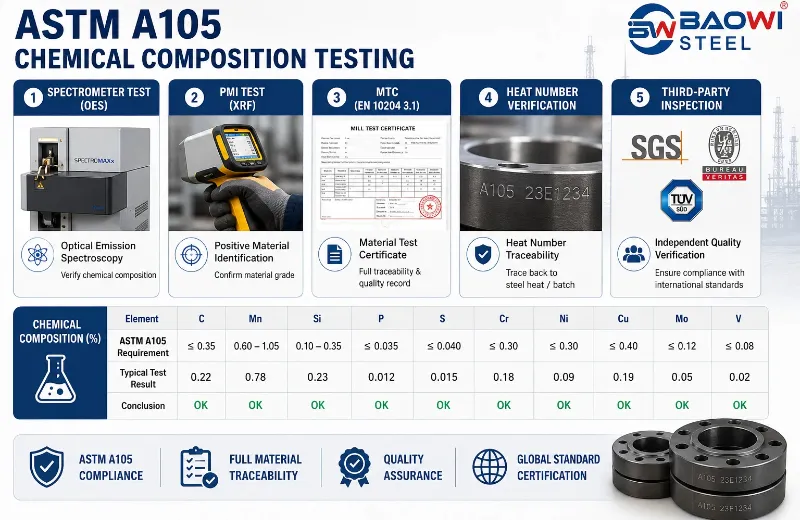
6.ASTM A105 Chemical Composition Testing
Spectrometer Test
Optical Emission Spectroscopy (OES) is commonly used to verify chemical composition.
PMI Test
Positive Material Identification (PMI) helps confirm material grade before installation.
Material Test Certificate
A typical MTC includes heat number, chemical analysis, mechanical properties, heat treatment condition, and inspection results.
7.Applications of ASTM A105
Because of its balanced chemical composition and reliable mechanical properties, ASTM A105 is widely used in:
Oil and gas pipelines
Petrochemical plants
Power generation facilities
Water treatment systems
Steam distribution systems
Industrial processing plants
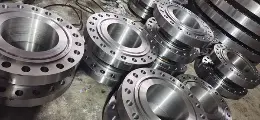
Typical products include forged flanges, threaded fittings, socket weld fittings, valves, and custom pressure components.
8.Frequently Asked Questions
What is the maximum carbon content of ASTM A105?
0.35% maximum.
Is ASTM A105 low carbon steel?
It is a forged carbon steel with moderate carbon content and good weldability.
Does ASTM A105 contain chromium?
Yes, residual chromium is limited to a maximum of 0.30%.
Is ASTM A105 suitable for welding?
Yes. Its controlled carbon content provides good weldability for most industrial applications.
How is ASTM A105 chemical composition verified?
Through heat analysis, spectrometer testing, and material test certificates.
9.Conclusion
ASTM A105 achieves its excellent balance of strength, weldability, and durability through carefully controlled chemical composition.Carbon, manganese, silicon, phosphorus, sulfur, and residual alloying elements each play a specific role in ensuring consistent forging quality and reliable service performance.
Read more
What Is ASTM A105?
ASTM A105 Flange Ultimate Guide

 English
 Español
 بالعربية

 Phone :
  Whatsapp :
  Email :


