If you've searched for
ASTM A105 vs A105N, you've probably noticed that many websites provide conflicting explanations. Some claim A105N is a different material, while others describe ASTM A105 as simply "as-forged" steel. In reality, neither statement fully reflects the
ASTM specification.
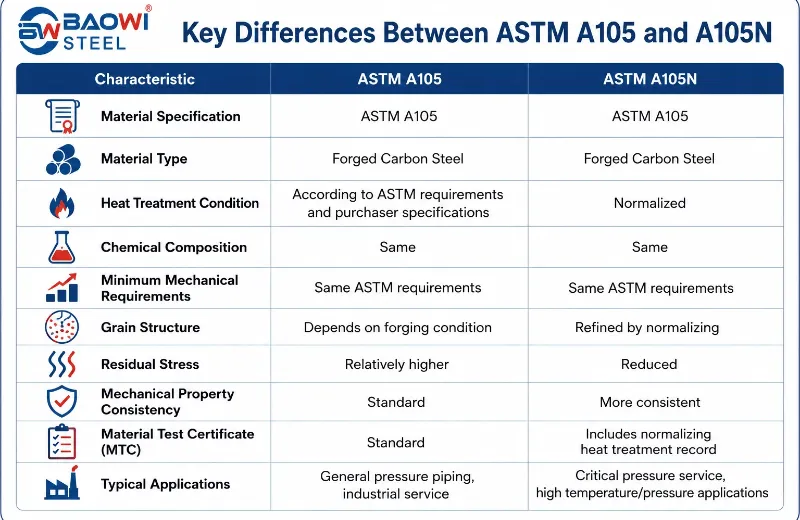
The truth is much simpler. ASTM A105 and ASTM A105N share the same material specification and chemical composition. The primary distinction lies in the heat treatment condition. The suffix "N" indicates that the forging has been normalized after manufacture, producing a more uniform grain structure and improving the consistency of its mechanical properties.
This difference does not create a new steel grade, nor does it change the ASTM chemical composition requirements. Instead, it identifies the manufacturing condition of the forged component.Whether you are purchasing
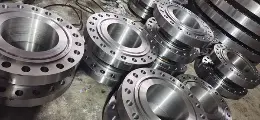
flanges, fittings,
valves, or other forged piping components, understanding the difference between ASTM A105 and A105N helps you select the correct material, comply with project specifications, and avoid unnecessary costs.
ASTM A105 vs A105N at a Glance
Before exploring each topic in detail, the following comparison table summarizes the key differences between ASTM A105 and A105N.
|
Feature
|
ASTM A105
|
ASTM A105N
|
|
ASTM Specification
|
ASTM A105
|
ASTM A105
|
|
Material Type
|
Forged Carbon Steel
|
Forged Carbon Steel
|
|
Steel Grade
|
Same
|
Same
|
|
Heat Treatment
|
According to ASTM requirements and purchaser specifications
|
Normalized
|
|
Chemical Composition
|
Same
|
Same
|
|
Minimum Mechanical Requirements
|
Same ASTM requirements
|
Same ASTM requirements
|
|
Grain Structure
|
Depends on forging condition
|
Refined by normalizing
|
|
Residual Stress
|
Relatively higher
|
Reduced
|
|
Mechanical Property Consistency
|
Standard
|
More consistent
|
|
Typical Applications
|
General pressure piping
|
Critical pressure service
|
Quick Answer:
A105N is not a different steel grade. It is ASTM A105 supplied in the normalized condition. The chemical composition remains unchanged, while the heat treatment refines the grain structure and improves consistency in mechanical performance.
ASTM A105N Mneaning
ASTM A105N is not a separate material specification.
Instead, it refers to ASTM A105 that has undergone a normalizing heat treatment after forging.
The suffix "N" stands for Normalized.
Normalizing is one of the most widely used heat treatment processes for forged carbon steel. It refines the internal grain structure, reduces residual stress, and promotes more consistent mechanical properties throughout the forging.
Importantly, normalizing does not change the steel's chemical composition.
Therefore:
ASTM A105 = Material specification
ASTM A105N = ASTM A105 supplied in the normalized condition
This distinction is frequently misunderstood in purchasing documents and engineering drawings.
Why Does A105N Include the Letter "N"?
The letter "N" indicates that the material has been normalized.
Normalizing involves heating the forging above its critical transformation temperature, maintaining the required temperature for an appropriate period, and then allowing the material to cool naturally in still air.
Compared with an untreated forging, this process produces:
A finer ferrite-pearlite structure
Improved grain uniformity
Reduced internal stress
Better dimensional stability
More consistent mechanical properties
These improvements explain why many EPC contractors and engineering companies specify A105N for critical pressure piping applications.
However, it is important to understand that the ASTM specification does not define A105N as a higher-strength steel. Instead, the heat treatment improves consistency while maintaining compliance with the same ASTM mechanical property requirements.
ASTM A105 Heat Treatment Requirements
One of the most common misconceptions is that ASTM A105 always means "as-forged."
The ASTM A105 specification does not define the material in this way.
Instead, forgings may be supplied in different heat treatment conditions depending on:
Purchaser requirements
Manufacturing practice
Forging size
Applicable project specifications
Supplementary requirements
Possible manufacturing conditions include:
|
Heat Treatment Condition
|
Typical Application
|
|
As-Forged (when permitted)
|
General industrial applications
|
|
Annealed
|
Improved machinability
|
|
Normalized
|
Improved grain uniformity
|
|
Normalized and Tempered (when specified)
|
Special engineering requirements
|
Therefore, ASTM A105 should not be interpreted as meaning "untreated steel."
If a project specification explicitly requires ASTM A105N, the forging must undergo normalizing and the heat treatment should appear on the Material Test Certificate (MTC).
If you're comparing the ASTM and ASME designation systems instead of heat treatment conditions, read: ASTM A105 vs ASME SA105.
ASTM A105 vs A105N Chemical Composition
Another frequently asked question is whether ASTM A105N contains different alloying elements.
The answer is No.
Both ASTM A105 and ASTM A105N follow exactly the same chemical composition limits specified in ASTM A105.
Heat treatment changes the internal grain structure but does not alter the chemical composition.
Chemical Composition Comparison
|
Element
|
ASTM A105
|
ASTM A105N
|
|
Carbon (C)
|
≤ 0.35%
|
≤ 0.35%
|
|
Manganese (Mn)
|
0.60–1.05%
|
0.60–1.05%
|
|
Silicon (Si)
|
0.10–0.35%
|
0.10–0.35%
|
|
Phosphorus (P)
|
≤ 0.035%
|
≤ 0.035%
|
|
Sulfur (S)
|
≤ 0.040%
|
≤ 0.040%
|
|
Copper (Cu)
|
≤ 0.40%
|
≤ 0.40%
|
|
Nickel (Ni)
|
≤ 0.40%
|
≤ 0.40%
|
|
Chromium (Cr)
|
≤ 0.30%
|
≤ 0.30%
|
|
Molybdenum (Mo)
|
≤ 0.12%
|
≤ 0.12%
|
|
Vanadium (V)
|
≤ 0.08%
|
≤ 0.08%
|
ASTM A105N Normalizing Process: Step-by-Step Heat Treatment
The normalizing process gives ASTM A105N its refined grain structure and balanced mechanical properties. During heat treatment, the forged flange is heated above its critical temperature, held long enough to form a uniform austenitic structure, and then cooled naturally in still air. This process refines the ferrite-pearlite microstructure, reduces residual stress, and improves toughness, strength, and dimensional stability.
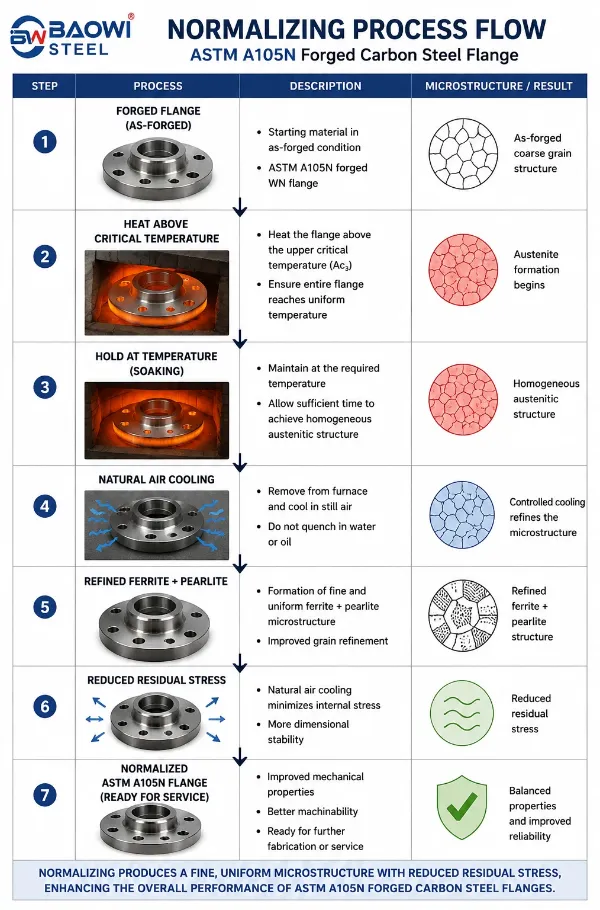
A105N is often preferred for elevated-temperature pressure service because normalizing improves microstructural uniformity and mechanical consistency.This statement reflects common engineering practice without implying that ASTM assigns a higher temperature rating to A105N.
Applications of ASTM A105 and A105N
Both ASTM A105 and A105N are widely used in high-pressure piping systems across the oil and gas, petrochemical, power generation, and industrial processing industries. They are commonly forged into a wide range of piping components, including
flanges, pipe fittings,
valves,
elbows,
tees, and
reducers, depending on the requirements of the piping system.
Common ASTM A105 Applications
ASTM A105 is widely used for:
Welding Neck Flanges
Slip-On Flanges
Blind Flanges
Threaded Flanges
Socket Weld Flanges
Forged Fittings
Valve Bodies
Pressure Piping Components
Typical industries include:
Water Treatment
HVAC
Fire Protection
General Manufacturing
Oil & Gas
Chemical Plants
Common ASTM A105N Applications
A105N is commonly specified for projects requiring documented heat treatment and more consistent mechanical properties.
Typical applications include:
Refineries
Petrochemical Plants
Steam Distribution Systems
LNG Facilities
Offshore Platforms
Power Stations
High-Pressure Process Pipelines
EPC Projects
Frequently Asked Questions (FAQ)
Is ASTM A105N a different material?
No. ASTM A105N is ASTM A105 supplied in the normalized heat treatment condition. It uses the same material specification and chemical composition.
Does the "N" mean normalized?
Yes. The suffix "N" indicates that the forging has undergone a normalizing heat treatment.
Are the chemical compositions different?
No. ASTM A105 and A105N have identical chemical composition limits. Heat treatment changes the microstructure, not the chemistry.
Does A105N have higher strength?
The ASTM specification requires the same minimum mechanical properties for both materials. However, normalized forgings often exhibit more consistent production test results because of their refined grain structure.
Which material is better for elevated-temperature service?
Many engineering specifications prefer A105N for elevated-temperature pressure service because normalizing improves microstructural uniformity and mechanical consistency.
9.Conclusion
Although ASTM A105 and ASTM A105N share the same chemical composition and mechanical property requirements, the key difference lies in the heat treatment condition. ASTM A105 is supplied in the as-forged condition unless otherwise specified, while ASTM A105N is normalized after forging to refine the grain structure and improve toughness, ductility, and mechanical consistency. As a result, A105N is often preferred for critical piping systems, low-temperature service, and applications that require enhanced reliability. If no normalizing treatment is specified, ASTM A105 generally provides a more economical solution for standard pressure-temperature applications.
Read more
What Is ASTM A105?
ASTM A105 Flange Ultimate Guide

 English
 Español
 بالعربية
 Phone :
  Whatsapp :
  Email :


