ASTM A105 is a carbon steel forging material widely used in pressure piping systems. It delivers reliable mechanical strength with a minimum tensile strength of 485 MPa (70 ksi), a yield strength of 250 MPa (36 ksi), and hardness ranging between 137–187 HBW. In addition, it operates safely in a temperature range from -29°C to 425°C (-20°F to 800°F), making it ideal for flanges, fittings, and valves in oil & gas, petrochemical, and power generation industries. Because of its stable chemical composition and controlled forging process, ASTM A105 ensures consistent performance under pressure and moderate high-temperature service conditions.
1.ASTM A105 Material & Standard Scope
ASTM A105 (ASME SA105) is a forged carbon steel standard for pressure piping components such as flanges, fittings, and valves. It is designed for service temperatures from -29°C to 425°C (-20°F to 800°F) with minimum mechanical properties of 485 MPa tensile strength, 250 MPa yield strength, and 137–187 HBW hardness. It is widely used in oil & gas, petrochemical, and power piping systems where strength and reliability are required.
Engineers search “ASTM A105 material properties” to confirm pressure rating compatibility, machining suitability, and material selection for industrial piping design.
2.ASTM A105 Mechanical Properties (Per ASTM A105 Standard)
Mechanical properties define how ASTM A105 performs under load, pressure, and deformation. These values ensure safe use in high-pressure systems.
Tensile and Yield Strength
Tensile Strength: ≥ 485 MPa (70 ksi)
Yield Strength: ≥ 250 MPa (36 ksi)
Ductility Performance
Elongation: ≥ 22% (standard condition)
Elongation: up to 30% (thicker sections)
Reduction of Area: ≥ 30%
Hardness
Hardness Range: 137 – 187 HBW
Maximum Limit: 197 HBW
Transition: As a result, ASTM A105 provides an ideal combination of strength and flexibility for forged components.
|
Category
|
Property
|
Requirement
|
Unit
|
Engineering Notes
|
|
Strength
|
Tensile Strength
|
≥ 70 (485)
|
ksi (MPa)
|
Minimum strength for pressure-retaining forged components
|
|
Strength
|
Yield Strength
|
≥ 36 (250)
|
ksi (MPa)
|
Defined by 0.2% offset or extension-under-load method
|
|
Toughness
|
Reduction of Area
|
≥ 30
|
%
|
Indicates forging integrity and ductility level
|
|
Hardness
|
Brinell Hardness
|
≤ 187
|
HBW
|
Typical working range 137–187 HBW
|
Elongation Requirements
|
Test Condition
|
Requirement
|
Unit
|
Description
|
|
Standard Round Specimen (2 in / 50 mm or 4D proportional)
|
≥ 22
|
%
|
Basic tensile test condition
|
|
Strip Test (Wall thickness ≥ 7.9 mm / 5/16 in.)
|
≥ 30
|
%
|
Base elongation requirement for thicker sections
|
|
Strip Test Adjustment Rule
|
−1.5% per 0.8 mm reduction
|
%
|
Applied for thickness below 7.9 mm
|
|
Special Small Forgings
|
Per ASTM Section 8.3.4
|
Variable
|
Applies to limited-size forgings
|
Mechanical Testing & Definition Notes
|
Item
|
Description
|
|
Tensile Test
|
Measures maximum load-bearing capacity before fracture
|
|
Yield Strength
|
Stress point where permanent deformation begins
|
|
Hardness Test
|
Ensures machinability and wear resistance balance
|
|
Reduction of Area
|
Evaluates forging quality and internal soundness
|
|
Elongation Variation
|
Depends on specimen type and wall thickness
|
ASTM A105 Heat Treatment and Material Condition
ASTM A105 forgings may undergo different heat treatment processes depending on application requirements.
Common conditions include:
Normalizing (A105N)
Annealing
Quenching and tempering (special applications)
Heat treatment improves:
Grain structure refinement
Mechanical uniformity
Impact toughness
Internal stress reduction
ASTM A105 Sub-Grades and Conditions
Although ASTM A105 is a single specification, different conditions are widely used in engineering practice.
|
Grade
|
Condition
|
Key Feature
|
Application
|
|
A105
|
As-forged
|
Standard condition
|
General service
|
|
A105N
|
Normalized
|
Improved toughness
|
High-pressure pipelines
|
|
A105QT
|
Quenched & tempered
|
Higher strength
|
Severe service conditions
|
|
A105 Modified
|
Customized
|
Project-specific
|
OEM applications
|
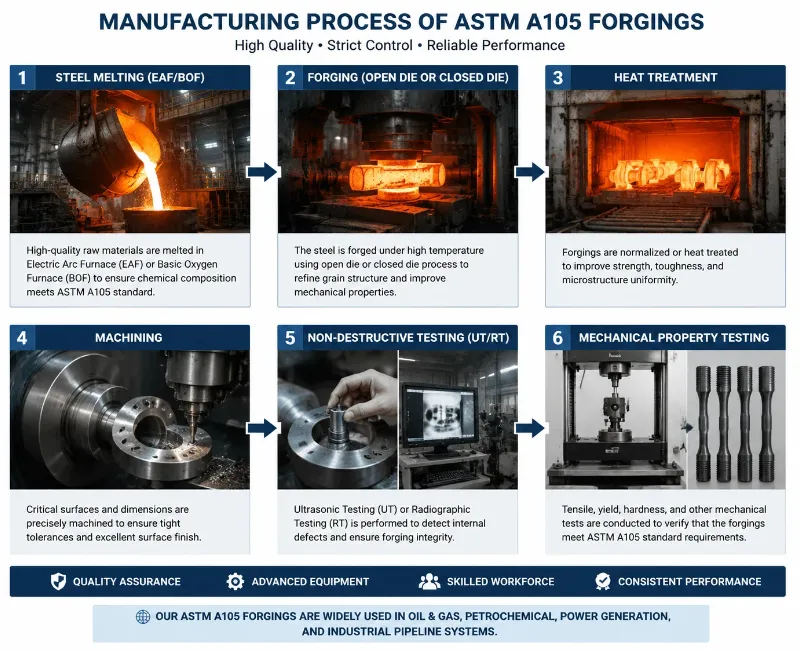
3.Manufacturing Process of ASTM A105 Forgings
ASTM A105 components are manufactured through a controlled industrial process:
Steel melting (EAF/BOF)
Forging (open die or closed die)
Heat treatment
Machining
Non-destructive testing (UT/RT)
Mechanical property testing
This process ensures dense microstructure and consistent mechanical performance.
Frequently Asked Questions (FAQ)
1. What is ASTM A105 used for?
ASTM A105 is used for forged carbon steel piping components such as flanges, fittings, and valves in pressure systems.
2. What is the tensile strength of ASTM A105?
The minimum tensile strength is 485 MPa (70 ksi).
3. What is the hardness of ASTM A105?
The hardness range is typically 137–187 HBW.
4. What is the temperature range of ASTM A105?
ASTM A105 is suitable for service temperatures from -29°C to 425°C.
5. What is the difference between A105 and A105N?
A105N is normalized, which improves grain structure and toughness compared to standard A105.
Read more
ASTM A105 vs. ASME SA105
ASTM A105 Material Specification

 English
 Español
 بالعربية
 Phone :
  Whatsapp :
  Email :


