1. Quick Answer
If your project requires forged pressure piping components such as flanges and fittings → choose
ASTM A105
If your application involves valve bodies, pump housings, or complex-shaped pressure components → choose ASTM A216 WCB
For pressure systems: ASTM A105 is widely used in oil & gas, petrochemical, and power generation industries due to its forged structure, higher strength consistency, and reliable pressure performance.
For cast components: ASTM A216 WCB is commonly used in valve manufacturing and industrial equipment where complex geometry and cost efficiency are more important than maximum mechanical performance.
Note: The most critical distinction is not only chemical composition or strength level, but the fundamental difference between forging and casting, which directly affects density, toughness, and long-term service behavior.
2. Comparison Table: ASTM A105 vs ASTM A216 WCB
The table below summarizes the key technical differences between forged ASTM A105 and cast ASTM A216 WCB. It helps engineers and procurement teams quickly determine the correct material based on manufacturing method, mechanical performance, cost, and application environment.
|
Feature
|
ASTM A105
|
ASTM A216 WCB
|
Typical Project
|
Recommended For
|
|
Material Type
|
Forged carbon steel
|
Cast carbon steel
|
Forging vs casting selection
|
Structural decision factor
|
|
Manufacturing Process
|
Hot forging
|
Sand/precision casting
|
Density vs shape complexity
|
Performance vs geometry
|
|
Mechanical Strength
|
High and consistent
|
Medium
|
Pressure resistance comparison
|
A105 for high reliability
|
|
Toughness
|
Good
|
Moderate
|
Crack resistance behavior
|
Forged steel advantage
|
|
Density / Structure
|
Dense, refined grain
|
Casting structure with potential porosity
|
Internal structure quality
|
A105 for critical service
|
|
Machinability
|
Good
|
Excellent
|
Manufacturing efficiency
|
WCB for complex parts
|
|
Temperature Service
|
Moderate to high
|
Moderate
|
Industrial piping vs valves
|
Depends on system
|
|
Cost Level
|
Medium
|
Lower
|
Budget vs performance balance
|
WCB for cost-sensitive projects
|
|
Typical Applications
|
Flanges, fittings, pressure parts
|
Valve bodies, pump housings
|
Real-world usage
|
System-based selection
|
3. ASTM A105
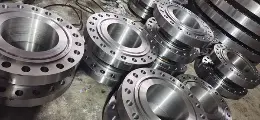
ASTM A105 is a forged carbon steel material widely used for pressure-containing piping components such as
flanges, fittings, and
valves.It is produced through a forging process that improves internal grain structure, which enhances mechanical strength and pressure resistance.
4. What Is ASTM A216 WCB?
ASTM A216 WCB is a cast carbon steel material used primarily for pressure-containing cast components, especially in valve and pump manufacturing.Unlike forging, casting allows complex geometries but results in a different internal microstructure.
ASTM A216 WCB is a standard specification for cast carbon steel used in pressure-containing components. It is widely applied in the oil, gas, and power generation industries, especially for valve bodies, flanges, and fittings operating under moderate to high-temperature service conditions.
5. Key Differences Explained (Engineering Perspective)
The comparison between ASTM A105 and ASTM A216 WCB is not only a material comparison—it is a comparison between two different engineering manufacturing philosophies.
5.1 It’s Not Just About Chemical Composition
A common mistake in material selection is assuming that materials with similar carbon steel composition can be directly substituted.
In real engineering systems, performance is influenced by:
Long-term pressure cycles
Temperature variation
Mechanical vibration
Corrosion environment
Stress concentration points
These factors expose the fundamental difference between forged and cast structures.
5.2 Forged Steel vs Cast Steel: Two Different Logic Systems
ASTM A105 is a forged material. During forging, the steel is plastically deformed, which refines grain structure and improves density.
ASTM A216 WCB is a cast material. Molten steel is poured into molds, allowing complex shapes but producing a different internal structure.
The engineering logic can be summarized as:
Forged steel (A105): focuses on strength, reliability, and pressure safety
Cast steel (WCB): focuses on shape complexity and manufacturing efficiency
This is why A105 is preferred in high-pressure piping systems, while WCB dominates valve bodies.
5.3 Structural Integrity Matters More Than Strength Numbers
Even if strength values appear similar on paper, real service performance can differ significantly.
ASTM A105 provides:
More uniform internal structure
Better fatigue resistance
Higher reliability under cyclic pressure
ASTM A216 WCB provides:
Efficient production for complex shapes
Lower cost for large components
Acceptable performance in controlled environments
5.4 Real Engineering Risk Perspective
ASTM A105 performs reliably in piping systems where pressure and temperature fluctuate over time.
ASTM A216 WCB performs well in static or semi-static components such as valve bodies, where flow control and shape complexity are more important than dynamic loading.
The real difference is not only “what material it is,” but how it behaves under long-term operational risk conditions.
6.Chemical Composition, Physical and Mechanical Properties of ASTM A105 and ASTM A350 LF2
|
Item
|
ASTM A105
|
ASTM A350 LF2
|
|
Chemical Composition
|
|
C (Carbon)
|
≤ 0.35%
|
≤ 0.26%
|
|
Mn (Manganese)
|
0.60% – 1.05%
|
0.60% – 1.35%
|
|
P (Phosphorus)
|
≤ 0.04%
|
≤ 0.035%
|
|
S (Sulfur)
|
≤ 0.05%
|
≤ 0.035%
|
|
Si (Silicon)
|
0.10% – 0.35%
|
0.15% – 0.40%
|
|
Cr (Chromium)
|
–
|
–
|
|
Ni (Nickel)
|
–
|
–
|
|
Cu (Copper)
|
–
|
Max 0.20%
|
|
Fe (Iron)
|
Balance
|
Balance
|
|
Mechanical Properties
|
|
Yield Strength
|
Min 250 MPa (36 ksi)
|
Min 205 MPa (30 ksi)
|
|
Tensile Strength
|
485-620 MPa (70-90 ksi)
|
485-620 MPa (70-90 ksi)
|
|
Elongation
|
≥ 20% (over 8 inches or 200mm)
|
≥ 20% (over 8 inches or 200mm)
|
|
Hardness
|
Max 187 HB
|
–
|
|
Impact Toughness
|
–
|
Min 27 Joules (20 ft-lb) at -50°C
|
|
Physical Properties
|
|
Density
|
7.85 g/cm³
|
7.85 g/cm³
|
|
Thermal Expansion
|
11.0 × 10⁻⁶ /°C
|
11.0 × 10⁻⁶ /°C
|
|
Melting Point
|
1425°C – 1538°C (2597°F – 2800°F)
|
1450°C – 1550°C (2642°F – 2822°F)
|
|
Applications
|
General environment flanges, suitable for oil, gas, and chemical industries
|
Low-temperature pipeline systems, suitable for low-temperature liquid and gas pipelines
|
7.Conclusion
ASTM A105 and ASTM A216 WCB are widely used carbon steel materials in pressure piping and industrial equipment systems, but they serve different engineering purposes. ASTM A105 is a forged carbon steel that provides higher strength consistency, better toughness, and superior performance in high-pressure piping systems such as flanges and fittings. In contrast, ASTM A216 WCB is a cast carbon steel designed for complex-shaped components like valve bodies and pump housings, where manufacturing flexibility and cost efficiency are more important than maximum forged strength.
The fundamental difference lies in the manufacturing process—forging vs casting—which directly affects internal structure, mechanical reliability, and long-term service behavior. Therefore, material selection should always be based on operating conditions, pressure requirements, and component design rather than chemical composition alone.
Read more
ASTM A105 Material Specification

 English
 Español
 بالعربية

 Phone :
  Whatsapp :
  Email :


