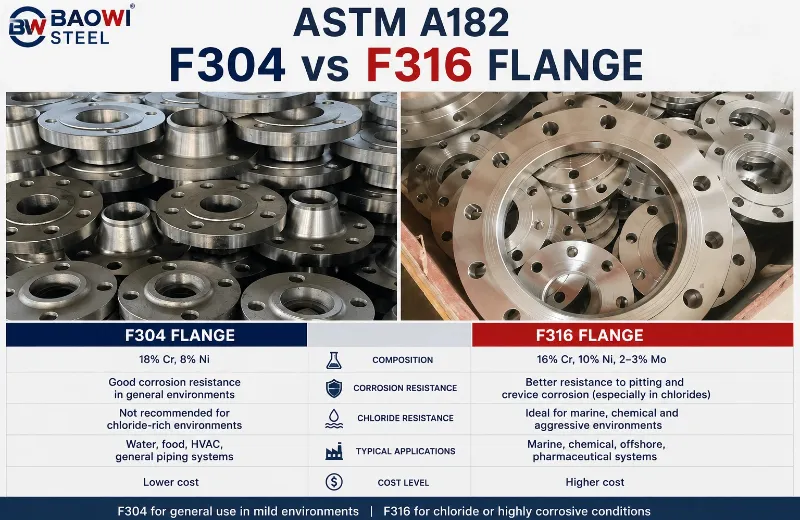
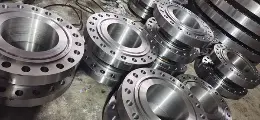
ASTM A182 F304 and F316 are widely used forged stainless steel flange materials in industrial piping systems, especially in oil & gas, chemical, marine, and power applications.The main difference is that F316 contains molybdenum (Mo), which significantly improves resistance to pitting and crevice corrosion in chloride environments. This makes F316 more suitable for seawater and highly corrosive conditions, while F304 is typically used in less aggressive environments.Both grades are austenitic stainless steels with similar chromium-nickel content, but the addition of 2%–3% molybdenum gives F316 better corrosion resistance and longer service life in harsh service conditions.
ASTM A182 is a standard specification covering forged or rolled alloy and stainless steel pipe flanges, fittings, valves, and pressure retaining components used in high temperature and high pressure service.ASTM A182 is the standard specification for forged stainless steel and alloy steel flanges, fittings, and
valves; F304 and F316 represent the forged counterparts to the familiar Type
304 (18Cr-8Ni) and Type
316 (16Cr-10Ni-2Mo) grades found in plate products, and both possess an austenitic microstructure."F" stands for "Forged," distinguishing it from stainless steel standards for products such as A240 plate and
A312 seamless pipe.
It includes:
Alloy steel grades: F1, F5, F9, F11, F22, F91, F92
Stainless steel grades: F304, F304L, F316, F316L, F321, F347
These materials are widely used in refineries, offshore platforms, chemical plants, and industrial piping systems.
What Is ASTM A182 F304 Flange?
ASTM A182 F304 is an austenitic stainless steel forging grade based on 18% chromium and 8% nickel composition (UNS S30400). It is widely used due to its balanced corrosion resistance, good mechanical properties, and cost efficiency.
F304 performs well in:
Fresh water systems
Steam lines
Mild organic acids
Food processing equipment
General industrial piping
However, F304 has limited resistance in chloride-containing environments. Under long-term exposure, pitting corrosion and crevice corrosion may occur.
What Is ASTM A182 F316 Flange?
ASTM A182 F316 is an upgraded austenitic stainless steel grade with molybdenum addition (2–3%), typically referred to as UNS S31600.The addition of molybdenum significantly improves resistance to localized corrosion, especially in chloride-rich environments.
ASTM A182 F304 vs F316 Flange: Key Differences
|
Property
|
F304
|
F316
|
|
Type
|
Austenitic stainless steel
|
Austenitic stainless steel
|
|
Chromium (Cr)
|
18–20%
|
16–18%
|
|
Nickel (Ni)
|
8–11%
|
10–14%
|
|
Molybdenum (Mo)
|
None
|
2–3%
|
|
Pitting resistance
|
Medium
|
High
|
|
Crevice corrosion resistance
|
Medium
|
High
|
|
Chloride resistance
|
Limited
|
Improved
|
|
Cost
|
Lower
|
Higher
|
1. Chemical Composition Difference
F304 is an 18Cr-8Ni stainless steel grade without molybdenum.
F316 is a 16Cr-10Ni stainless steel grade containing 2 to 3 percent molybdenum.
The key difference is the addition of molybdenum in F316, which improves resistance to chloride corrosion.
|
Element
|
F304
|
F316
|
|
Carbon (C)
|
≤0.08%
|
≤0.08%
|
|
Chromium (Cr)
|
18–20%
|
16–18%
|
|
Nickel (Ni)
|
8–11%
|
10–14%
|
|
Molybdenum (Mo)
|
0
|
2–3%
|
|
Manganese (Mn)
|
≤2.0%
|
≤2.0%
|
|
Phosphorus (P)
|
≤0.045%
|
≤0.045%
|
|
Sulfur (S)
|
≤0.03%
|
≤0.03%
|
2. Corrosion Resistance Difference
F304 provides general corrosion resistance in mild environments. It performs well in indoor piping systems, water systems, and non-aggressive media.
F316 offers improved resistance to pitting corrosion, crevice corrosion, and chloride stress corrosion cracking.
F316 is more suitable for marine, chemical, and chloride-containing environments.
3. Mechanical Property Difference
F304 and F316 have very similar mechanical strength.
Both grades typically have:
Tensile strength: 515 MPa minimum
Yield strength: 205 MPa minimum
Elongation: around 30 percent or higher
The difference in selection is not based on strength but on corrosion resistance.
|
Property
|
F304
|
F316
|
|
Tensile strength
|
≥515 MPa
|
≥515 MPa
|
|
Yield strength
|
≥205 MPa
|
≥205 MPa
|
|
Elongation
|
≥30%
|
≥30%
|
|
Hardness
|
≤183 HBW
|
≤183 HBW
|
4. Application Difference
F304 is commonly used in:
Indoor piping systems
Water and steam lines
General industrial equipment
Low corrosion environments
F316 is commonly used in:
Marine and offshore systems
Chemical processing plants
Oil and gas refineries
Chloride exposure environments
5. Cost and Selection Difference
F304 is more cost-effective and widely used in general industrial applications.
F316 has a higher cost due to molybdenum content but provides longer service life in corrosive environments.
Selection should be based on service conditions, especially chloride exposure, temperature, and corrosion risk level.
6. Pitting Resistance Equivalent Number (PREN)
PREN is used to evaluate localized corrosion resistance.
Formula: PREN equals chromium plus 3.3 multiplied by molybdenum plus 16 multiplied by nitrogen.
F304 has a PREN value of approximately 18 to 20.
F316 has a PREN value of approximately 24 to 28.
Higher PREN indicates better resistance to pitting corrosion in chloride environments.
For more severe conditions, duplex stainless steels such as ASTM A182 F51 or super duplex F53 provide higher corrosion resistance.
7. Ductility and Temperature Resistance
Ductility refers to the ability of the material to deform under stress without cracking. Both F304 and F316 have good ductility due to their austenitic structure, making them suitable for flanged joint systems.
Temperature resistance should be understood in two aspects. Oxidation resistance refers to surface stability at high temperature, while pressure-containing capability depends on design codes and allowable stress.
Both F304 and F316 have good oxidation resistance at elevated temperatures. However, in chloride environments, both grades may experience stress corrosion cracking when temperature exceeds approximately 60 degrees Celsius under tensile stress.
F304H and F316H may be used for higher temperature strength applications, while F304L and F316L are preferred for welded systems to reduce sensitization risk.
Pressure Ratings and ASME B16.5 Classes
ASTM A182 flanges are commonly manufactured according to ASME B16.5 pressure class standards, which define the pressure-temperature ratings of flanges based on material grade and operating temperature.
The standard pressure classes include Class 150, 300, 600, 900, 1500, and 2500. As the class increases, the flange wall thickness, bolt strength, and pressure capacity also increase significantly.
However, pressure rating is not independent of material grade. For example, F304 and F316 stainless steel flanges generally maintain better corrosion stability under elevated temperature conditions compared to alloy steel grades, while F11 and F22 alloy steel flanges provide superior high-temperature creep strength in steam and power generation systems.
Stainless Steel ASME Flanges: Grades And Performance
The most common stainless steel grades used for ASME flanges include F304, F304L, F316, and F316L. These austenitic stainless steels are widely applied in industrial piping systems due to their excellent toughness, weldability, and corrosion resistance.
|
ASTM Material
|
UNS Number
|
Common Name
|
Key Characteristics
|
|
A182 F304
|
S30400
|
304 SS
|
Standard austenitic, 18% Cr, 8% Ni
|
|
A182 F304L
|
S30403
|
304L SS
|
Low-carbon version (≤0.03% C)
|
|
A182 F316
|
S31600
|
316 SS
|
2-3% Mo for improved corrosion resistance
|
|
A182 F316L
|
S31603
|
316L SS
|
Low-carbon with Mo
|
|
A182 F321
|
S32100
|
321 SS
|
Ti-stabilized for weldability
|
|
A182 F347
|
S34700
|
347 SS
|
Nb-stabilized for high-temp
|
|
A182 F904L
|
N08904
|
904L SS
|
High Mo (4-5%), Cu-added
|
|
A182 F6a (Duplex)
|
S31803
|
2205 Duplex
|
22% Cr, 5% Ni, 3% Mo
|
Comparison of Procurement Costs and Project Lifecycle for ASTM A182 F304 vs. F316 Flanges
1. Initial Procurement Cost: For flanges of the same pressure rating and specifications, the raw material cost for F316 is 30%–50% higher than that of F304; the price difference is primarily driven by the cost of nickel and molybdenum.
2. Short-term Projects (3–5 years; indoor, dry environments): Selecting F304 significantly reduces the initial procurement budget, while its performance fully meets operational requirements.
3. Long-term Projects (8+ years; coastal or corrosive chemical environments): Although F304 offers a lower initial price, corrosion-induced leakage typically occurs within 2–3 years. The costs associated with flange replacement, maintenance downtime, and production losses far exceed the price difference compared to F316, making F316 more cost-effective over the full lifecycle.
4.F304L/F316L Low-Carbon Derivative Grades
F304L and F316L flanges are frequently encountered in engineering applications; they are low-carbon modified versions of the standard grades, featuring a carbon content of ≤0.03%. This composition eliminates the risk of post-welding intergranular corrosion, making them suitable for thick-walled flanges, applications requiring frequent welding, and continuous high-temperature operation. The selection logic mirrors that of the base grades: choose F304L for lower-corrosion environments and F316L for harsh corrosive conditions.
Conclusion
ASTM A182 F304 and F316 flanges do not represent a simple "entry-level vs. high-end" distinction; rather, they are differentiated materials suited to specific operating conditions:
F304 flanges offer a cost-effective, general-purpose solution, delivering excellent value for indoor applications involving clean media and environments free of chloride ions;
F316 flanges utilize molybdenum alloying to enhance corrosion resistance, making them essential for harsh environments involving chlorides, acids, alkalis, or marine conditions;
The core logic for selection involves balancing costs against performance requirements—avoiding unnecessary expense on high-end materials while preventing the risks of corrosion and leakage caused by choosing the wrong material to save money. Decisions should be based on three key criteria: the chloride ion content of the pipeline medium, the operating environment, and the project's intended service life.
In high-end piping projects—such as those in petrochemicals, marine engineering, and pharmaceuticals—errors in material selection can directly lead to safety incidents. Strictly distinguishing between A182 F304 and F316 flanges during the design and procurement phases is fundamental to ensuring the long-term, stable operation of the entire piping system.
FAQ
What is the main difference between ASTM A182 F304 and F316?
The main difference is that F316 contains molybdenum, which improves resistance to pitting and crevice corrosion in chloride environments.
Which is better, F304 or F316 flange?
F316 is better in corrosive environments, while F304 is more cost-effective for general use.
Is F316 suitable for seawater?
F316 has improved resistance but is not fully resistant to seawater, especially in stagnant or warm conditions.
Why is molybdenum important in F316?
Molybdenum increases resistance to localized corrosion such as pitting and crevice corrosion.
Can F304 and F316 be welded?
Yes, both grades are weldable, but low carbon versions F304L and F316L are preferred for welding applications.

 English
 Español
 بالعربية

 Phone :
  Whatsapp :
  Email :