What is ASTM A182?
ASTM A182 is a material standard established by the American Society for Testing and Materials (ASTM), specifically designated for forged or rolled alloy steel and stainless steel piping components intended for high-temperature and high-pressure service conditions. It covers a wide range of pressure-retaining components, including flanges, fittings, and valves.
The purpose of ASTM A182 is to provide a foundation for the API technical standards encountered in piping engineering by defining the materials involved, establishing the required performance criteria, and specifying the documentation necessary for installation, testing, and quality control.
Commonly used materials include F304/L, F316/L, F11, F22, and duplex stainless steels, all of which possess a combination of high-temperature resistance and corrosion resistance. Consequently, ASTM A182 materials are widely utilized in industries such as petroleum, chemical processing, and power generation—making them particularly well-suited for operating environments where stringent requirements for safety and stability are paramount.
Scope of ASTM A182
1.This specification covers forged low alloy and stainless steel piping components for pressure systems, including flanges, fittings, valves, and similar parts meeting specified dimensions or referenced ASME standards.
2.Products machined directly from bars (not directly covered here) should follow ASTM A479/A479M or A739. Components under this specification are limited to 10,000 lb (4540 kg); for larger or specialized items, see A336/A336M or A965/A965M.
3.Multiple grades are included: low alloy steels, ferritic, martensitic, austenitic, and duplex stainless steels. Selection depends on design and service requirements; some duplex grades also appear in A1049/A1049M.
4.Supplementary requirements are optional and apply only if specified by the purchaser.
5.The standard uses both inch‑pound and SI units; unless the “M” (SI) designation is requested, materials are provided in inch‑pound units.
6.Values in each unit system are independent; combining them may lead to non-conformance.
The product types covered by the ASTM A182/A182M standard include:
Pipe flanges
Forged or rolled fittings (elbows, tees, reducers, etc.)
Valves and critical components
These components must comply with the dimensional requirements specified in the standard, or satisfy referenced dimensional standards—such as the dimensions prescribed in ASME standards. The standard explicitly stipulates that the maximum weight for applicable products is 10,000 lb (approximately 4,540 kg). For components of larger dimensions or those intended for special applications, reference may be made to similar grades provided in the ASTM A336/A336M and A965/A965M standards.Furthermore, for products machined directly from steel bars or hollow steel bars (which are not directly covered by this standard), reference may be made to the corresponding grades provided in the ASTM A479/A479M, A739, or A511/A511M standards.
ASTM A182 Flange Sepcification
Standard Specification for Forged or Rolled Alloy and Stainless Steel Pipe Flanges,Forged Fittings, and Valves and Parts for High-Temperature Service
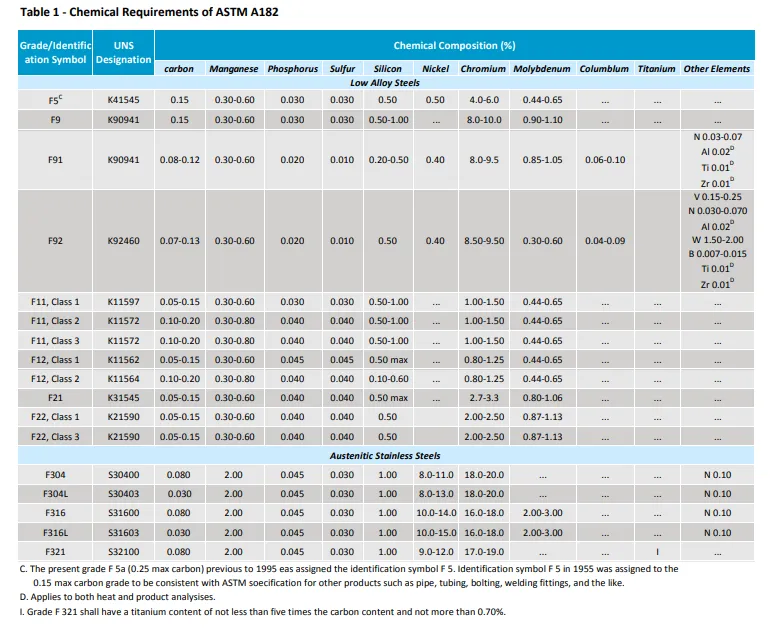
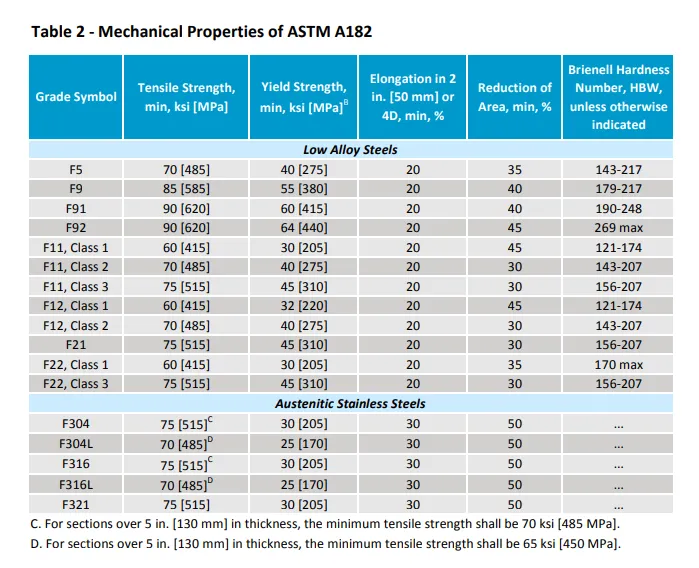
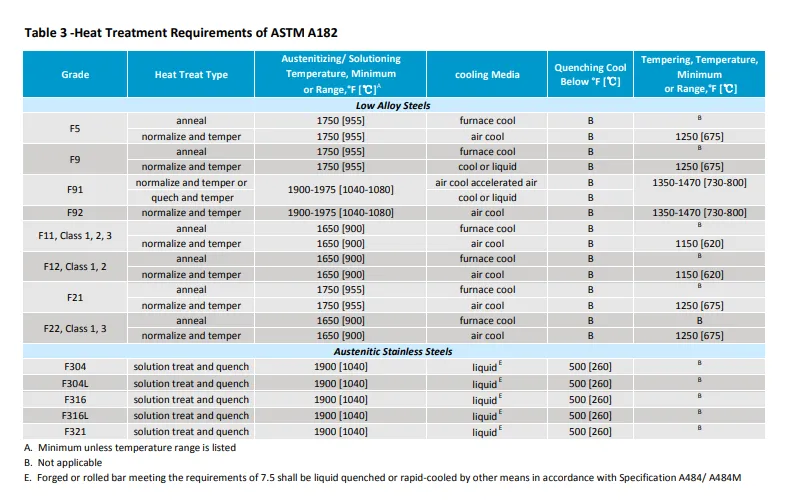
ASTM A182: Common Material Grades and Classifications
ASTM A182 encompasses a wide variety of alloy steel and stainless steel grades, allowing for the selection of the most suitable material based on specific operating conditions:
Low-Alloy Steel Materials
Low-alloy steels are primarily utilized in high-temperature and high-pressure steam and hot oil systems; they are characterized by excellent high-temperature strength and creep resistance. Common grades include:
F5, F9: Suitable for applications involving moderate temperatures and pressures.
F11, F22: The most widely used grades in the petroleum, thermal power generation, and heat treatment equipment sectors.
F91, F92 (and similar high-chromium, high-molybdenum steels): Employed in boiler piping and cracking units operating at even higher temperatures.
Stainless Steel Materials
Due to their superior corrosion resistance, stainless steels are well-suited for piping systems conveying corrosive media and for use in chemical processing systems. Common grades include:
F304, F304L:General-purpose austenitic stainless steels, resistant to common corrosive media.
F316, F316L:Molybdenum-bearing grades offering enhanced corrosion resistance; frequently used in petrochemical and marine environments.
The standard also includes certain specialized materials—such as——Duplex stainless steels—which are designated for use in environments characterized by extreme corrosion and high pressure.
Depending on their specific chemical composition and mechanical properties, these materials exhibit varying levels of resistance to high-temperature oxidation, corrosive attack, and high-pressure impact. Consequently, material selection during the design phase requires careful consideration of operating parameters, including the working medium, temperature, and pressure, to identify the optimal material solution.
ASTM A182 Material Grades
The ASTM A182 standard covers a variety of alloy steel and stainless steel grades used for forged or rolled pipe flanges, forged fittings, and valves. These grades are designated by a combination of letters and numbers; commonly used grades include:
ASTM A182-F1: A low-alloy steel, typically used for low-temperature service.
ASTM A182-F5: A chromium-molybdenum alloy steel featuring enhanced high-temperature strength, suitable for high-temperature applications.
ASTM A182-F9: A chromium-molybdenum alloy steel offering improved creep resistance and high-temperature stability; frequently used in refineries and power plants.
ASTM A182-F11: A low-alloy steel featuring enhanced creep resistance, classified into three grades: Class 1, Class 2, and Class 3.
ASTM A182-F22: A chromium-molybdenum alloy steel exhibiting good creep strength as well as resistance to oxidation and corrosion.
ASTM A182-F91: A high-strength, low-alloy steel possessing good toughness and high-temperature strength, suitable for power generation and petrochemical applications.
ASTM A182-F304: An austenitic stainless steel containing 18% chromium and 8% nickel; it is the most widely used stainless steel grade.
ASTM A182-F316: An austenitic stainless steel containing 16–18% chromium, 10–14% nickel, and 2–3% molybdenum; it offers superior corrosion resistance compared to F304.
ASTM A182-F321: A titanium-stabilized austenitic stainless steel with a composition similar to F304, but with the addition of titanium to enhance resistance to intergranular corrosion.
ASTM A182-F347: A stabilized austenitic stainless steel offering improved resistance to sensitization and intergranular corrosion.
ASTM A182-F51 (Duplex Stainless Steel): A duplex stainless steel characterized by a balanced combination of ferrite and austenite phases. It provides high strength and improved resistance to stress corrosion cracking. ASTM A182-F53 (Duplex Stainless Steel): A high-alloy stainless steel featuring excellent corrosion resistance and high strength.
ASTM A182-F55 (Super Duplex Stainless Steel): A super duplex stainless steel grade characterized by enhanced corrosion resistance and high mechanical strength.
Frequently Asked Questions (FAQ) – ASTM A182 Forged Steel Fittings
Q1: What is ASTM A182?
A: ASTM A182 is a standard specification for forged or rolled low alloy and stainless steel piping components, including flanges, fittings, valves, and other pressure-retaining parts used in high-pressure and high-temperature systems.
Q2: Which materials are included in ASTM A182?
A: The standard covers multiple grades, including low alloy steels, ferritic, martensitic, austenitic stainless steels, and duplex (ferritic-austenitic) stainless steels. Material selection depends on design requirements and service conditions.
Q3: What are typical applications of ASTM A182 forged fittings?
A: They are widely used in oil and gas pipelines, chemical plants, power generation systems, and high-pressure steam systems where both mechanical strength and corrosion resistance are critical.
Q4: Can ASTM A182 components be supplied in metric units?
A: Yes. ASTM A182 is provided in both inch-pound and SI units. Unless the order specifies the “M” designation, materials are supplied in inch-pound units. Each unit system must be used independently.
Read more
Materials and advantages of ASTM A182 butt welding flange

 English
 Español
 بالعربية
 Phone :
  Whatsapp :
  Email :