Square tube sizes are defined by the outside width, outside height, wall thickness, and tube length. Common square steel tubing sizes include 1 × 1, 1.5 × 1.5, 2 × 2, 3 × 3, and 4 × 4 inches, with different wall thicknesses available depending on the product specification.
A square tube size chart helps buyers compare dimensions, estimate weight, and identify suitable tubing for fabrication or structural applications. Actual availability, dimensional tolerances, and load capacity depend on the applicable standard, material grade, and design requirements.
Square Tube Size Chart
Square steel tubing is available in a wide range of outside dimensions and wall thicknesses. Imperial sizes are common in North American projects, while metric sizes are widely used in Europe, Asia, and international construction and manufacturing.
The following tables provide representative dimensions for preliminary selection. Actual size availability depends on the product standard, manufacturing process, material grade, and supplier's production range.
Imperial Square Steel Tube Sizes and Weights
|
Outside Dimensions (in)
|
Wall Thickness (in)
|
Approx. Weight (lb/ft)
|
|
1 × 1
|
0.065
|
0.83
|
|
1 × 1
|
0.12
|
1.44
|
|
1.5 × 1.5
|
0.065
|
1.27
|
|
1.5 × 1.5
|
0.12
|
2.25
|
|
1.5 × 1.5
|
0.188
|
3.36
|
|
2 × 2
|
0.065
|
1.71
|
|
2 × 2
|
0.12
|
3.07
|
|
2 × 2
|
0.188
|
4.64
|
|
2 × 2
|
0.25
|
5.96
|
|
3 × 3
|
0.12
|
4.7
|
|
3 × 3
|
0.188
|
7.2
|
|
3 × 3
|
0.25
|
9.36
|
|
3 × 3
|
0.375
|
13.4
|
|
4 × 4
|
0.128
|
6.75
|
|
4 × 4
|
0.188
|
9.76
|
|
4 × 4
|
0.25
|
12.76
|
|
4 × 4
|
0.375
|
18.5
|
|
4 × 4
|
0.5
|
23.82
|
|
6 × 6
|
0.188
|
14.87
|
|
6 × 6
|
0.25
|
19.57
|
|
6 × 6
|
0.375
|
28.71
|
|
6 × 6
|
0.5
|
37.44
|
|
8 × 8
|
0.25
|
26.37
|
|
8 × 8
|
0.375
|
38.92
|
|
8 × 8
|
0.5
|
51.05
|
|
10 × 10
|
0.25
|
33.18
|
|
10 × 10
|
0.375
|
49.13
|
|
10 × 10
|
0.5
|
64.66
|
|
12 × 12
|
0.25
|
39.99
|
|
12 × 12
|
0.375
|
59.34
|
|
12 × 12
|
0.5
|
78.27
|
|
12 × 12
|
0.625
|
96.78
|
|
16 × 16
|
0.375
|
79.76
|
|
16 × 16
|
0.5
|
105.5
|
|
16 × 16
|
0.625
|
130.81
|
|
22 × 22
|
0.5
|
146.34
|
|
22 × 22
|
0.75
|
216.95
|
|
22 × 22
|
1
|
285.87
|
Square steel tubing is specified by its outside dimensions and wall thickness. Common sizes include 1 × 1, 2 × 2, 3 × 3, and 4 × 4 inches, while larger sections are used for heavier structural applications. The weights above are calculated using a simplified sharp-corner model and a carbon steel density of approximately 0.2836 lb/in³. Actual weights may differ because of corner radii, dimensional tolerances, and manufacturing specifications.
Metric Square Tube Size Chart
Representative metric sizes. Confirm the applicable product standard and availability for each size and thickness combination.
|
Outside Dimensions (mm)
|
Wall Thickness (mm)
|
Approx. Weight (kg/m)
|
|
20 × 20
|
1.6
|
0.92
|
|
20 × 20
|
2
|
1.13
|
|
40 × 40
|
1.6
|
1.93
|
|
40 × 40
|
2
|
2.39
|
|
40 × 40
|
3
|
3.49
|
|
50 × 50
|
2
|
3.01
|
|
50 × 50
|
3
|
4.43
|
|
50 × 50
|
4
|
5.78
|
|
75 × 75
|
3
|
6.78
|
|
75 × 75
|
4
|
8.92
|
|
75 × 75
|
5
|
10.99
|
|
75 × 75
|
6
|
13
|
|
100 × 100
|
3
|
9.14
|
|
100 × 100
|
4
|
12.06
|
|
100 × 100
|
5
|
14.91
|
|
100 × 100
|
6
|
17.71
|
|
100 × 100
|
8
|
23.11
|
|
150 × 150
|
4
|
18.34
|
|
150 × 150
|
5
|
22.76
|
|
150 × 150
|
6
|
27.13
|
|
150 × 150
|
8
|
35.67
|
|
150 × 150
|
10
|
43.96
|
|
200 × 200
|
5
|
30.61
|
|
200 × 200
|
6
|
36.55
|
|
200 × 200
|
8
|
48.23
|
|
200 × 200
|
10
|
59.66
|
|
200 × 200
|
12.5
|
73.59
|
|
300 × 300
|
6
|
55.39
|
|
300 × 300
|
8
|
73.35
|
|
300 × 300
|
10
|
91.06
|
|
300 × 300
|
12.5
|
112.84
|
|
300 × 300
|
16
|
142.68
|
|
400 × 400
|
10
|
122.46
|
|
400 × 400
|
12.5
|
152.09
|
|
400 × 400
|
16
|
192.92
|
|
400 × 400
|
20
|
238.64
|
|
500 × 500
|
12.5
|
191.34
|
|
500 × 500
|
16
|
243.16
|
|
500 × 500
|
22
|
330.2
|
|
500 × 500
|
25
|
372.87
|
Weight note: Values are approximate theoretical estimates calculated using a steel density of 7,850 kg/m³ and a simplified sharp-corner cross-section. Actual section weights depend on corner geometry, manufacturing tolerances, and the applicable product specification.
These charts are intended for initial size comparison. Not every combination listed is necessarily manufactured or available in every market. Confirm the applicable standard, grade, dimensional tolerances, and mill availability before specifying a product.
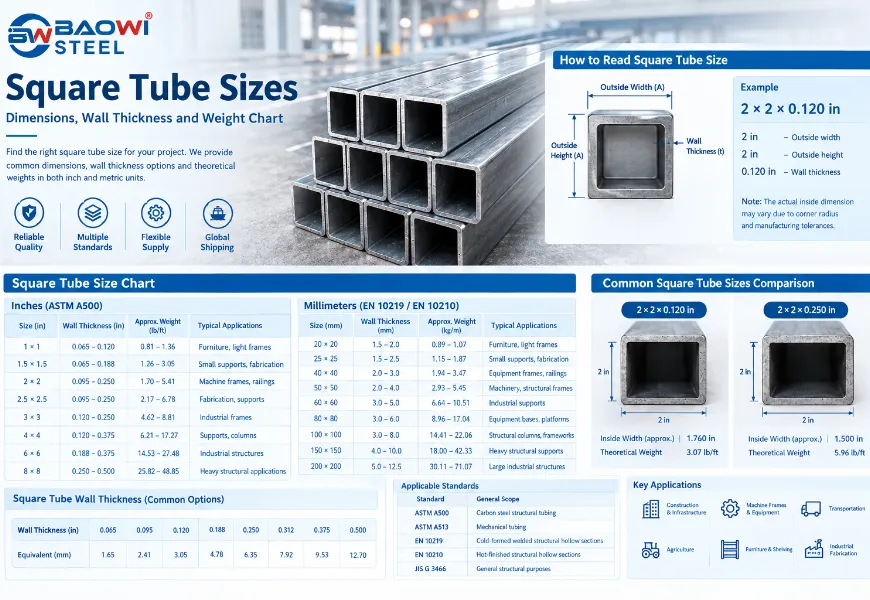
How to Read a Square Tube Size Chart ?
A square tube size chart usually lists outside dimensions, wall thickness, and weight. Understanding these measurements helps buyers compare products and prepare accurate purchase specifications.
Outside dimensions: The external width and height of the square section, such as 50 × 50 mm or 2 × 2 inches.
Wall thickness: The thickness of the steel wall, such as 3 mm or 0.120 inches.
Weight per unit length: The estimated mass per meter or foot. This is useful for freight calculations, material estimates, and comparing options.
Length: The ordered tube length. Standard and cut lengths vary by manufacturer, product size, and order requirements.
Steel grade and standard: The material and product requirements that determine mechanical properties, dimensional tolerances, testing, and suitability for the intended application.
Square Tube Wall Thickness and Weight
For the same outside dimensions, increasing wall thickness generally increases the steel cross-sectional area and the weight per unit length. It also changes the section's structural properties, but the correct thickness cannot be selected by weight alone.
|
Square Tube Size
|
Wall Thickness
|
Approx. Weight
|
|
1 × 1 in
|
0.065 in
|
0.83 lb/ft
|
|
1 × 1 in
|
0.120 in
|
1.44 lb/ft
|
|
2 × 2 in
|
0.120 in
|
3.07 lb/ft
|
|
2 × 2 in
|
0.250 in
|
5.96 lb/ft
|
|
4 × 4 in
|
0.188 in
|
9.76 lb/ft
|
|
4 × 4 in
|
0.375 in
|
18.50 lb/ft
|
|
100 × 100 mm
|
3 mm
|
9.14 kg/m
|
|
100 × 100 mm
|
6 mm
|
17.71 kg/m
|
How to Calculate Square Tube Size and Weight?
For a simplified square tube with equal outside dimensions and uniform wall thickness, the theoretical cross-sectional area can be estimated as:
Cross-sectional area (in²) = B² − (B − 2t)²
Where:
B = outside width in inches
t = wall thickness in inches
The approximate theoretical weight per foot is:
Weight (lb/ft) = Cross-sectional area (in²) × 12 × 0.2836
For example, consider a 2 × 2-inch square tube with a nominal wall thickness of 0.120 inch.
Outside width: 2 inches.
Simplified cross-sectional area: 2² − (2 − 2 × 0.120)² = 0.9024 in².
Estimated weight: 0.9024 × 12 × 0.2836 ≈ 3.07 lb/ft.
To estimate the weight of a length of tubing, multiply the weight per foot by the total length in feet. For example, a theoretical 20-foot length at 3.07 lb/ft weighs approximately 61.4 lb.
This calculation is useful for preliminary estimates, but it does not replace published product weights when corner geometry, dimensional tolerances, or a specific standard must be considered.
Common Square Tubing Sizes and Applications
The most suitable square tubing size depends on the finished product's geometry, the required stiffness, the applied loads, and the fabrication method.
1 × 1 Square Tubing
1 × 1 square tubing is a compact profile commonly used for furniture frames, display structures, small equipment supports, and light fabrication.
When selecting this size, compare the wall thickness and material grade instead of relying on the outside dimensions alone. Thin-wall tubing may be appropriate for lightweight assemblies, while more demanding applications may require a thicker wall or a different section size.
2 × 2 Square Tubing
2 × 2 square tubing is commonly used in equipment frames, racks, fabricated supports, and general industrial assemblies.
Its suitability depends on the unsupported length, applied load, connection design, and acceptable deflection. A 2 × 2 tube with a 0.120-inch wall has a different weight and section properties from a tube with a 0.083-inch wall.
For load-bearing applications, verify the relevant section properties and structural design requirements before finalizing the specification.
3 × 3 and 4 × 4 Square Tubing
3 × 3 and 4 × 4 square tubing may be used for larger equipment frames, support assemblies, platforms, and structural fabrication.
Larger outside dimensions can improve section stiffness, but the final performance depends on the material grade, wall thickness, loading conditions, and connection details. A larger tube is not automatically the most economical or appropriate choice for every project.
Large Square Tubing for Structural Projects
Larger square hollow sections may be specified for industrial facilities, building frames, and infrastructure applications. Their suitability depends on the governing structural design standard, required section properties, fabrication details, and available product sizes.
Do not select a large square tube based solely on its outside dimensions. Structural members must be checked for strength, stability, and serviceability by a qualified engineer.
Dimensional Tolerances for Square Steel Tubing
Dimensional tolerances determine the permissible variation between specified and measured product dimensions. They are important when square tubing must fit accurately into welded frames, bolted assemblies, or other fabricated structures.
Relevant dimensional requirements may include:
Outside width and height
Wall thickness
Corner geometry
Straightness
Squareness and twist
Length tolerance
The applicable tolerance depends on the product standard, specified dimensions, and manufacturing requirements. For example,
ASTM A500 has dimensional requirements for structural tubing, while EN 10219 includes dimensional and sectional tolerances for cold-formed welded structural hollow sections.
Do not apply a single tolerance value to all sizes and standards. For precision fabrication or critical structural applications, confirm the required tolerances in the applicable standard and purchase specification before ordering.

 English
 Español
 بالعربية



 Phone :
 Whatsapp :
 Email :