API 5CT casing pipe inspection is essential for verifying whether oilfield casing meets the specified material, dimensional, mechanical, and connection requirements before delivery. For buyers, the inspection process should cover more than a review of test reports. It should also confirm product identification, dimensional accuracy, applicable non-destructive testing (NDT), thread quality, and traceability.
The exact inspection requirements depend on the applicable edition of API Specification 5CT, casing grade, dimensions, manufacturing route, end finish, and purchase order. Buyers should establish these requirements before production or shipment rather than applying one inspection checklist to every casing pipe.
What Should Buyers Verify Before Accepting API 5CT Casing?
Before arranging inspection, buyers should establish the acceptance criteria for the order. This helps prevent disputes caused by differences between the purchase specification and the actual products supplied.
The following information should be confirmed first:
Applicable standard: API Specification 5CT edition and any applicable addenda or errata.
Casing grade: For example,
J55,
K55,
N80, L80, P110, or another specified grade.
Product dimensions: Nominal outside diameter, wall thickness, length range, and specified mass.
Connection type: Plain end, threaded and coupled, or another specified end finish.
Supplementary requirements: Any additional testing, inspection, documentation, or third-party witness points stated in the contract.
A practical inspection plan should identify which characteristics require measurement, which tests require laboratory results, and which activities must be witnessed by the buyer or an independent inspection company.
API 5CT Casing Pipe Inspection and Testing Requirements
1. Visual Inspection
Visual inspection checks the external and accessible internal surfaces of casing pipes for visible imperfections.
Inspectors look for conditions such as cracks, seams, laps, excessive corrosion, handling damage, and other potentially harmful surface defects.
Surface imperfections must be evaluated according to the applicable acceptance criteria.
Where permitted by the specification, grinding or other approved corrective actions may be used. Any repaired area must meet the relevant requirements.
Visual inspection alone cannot detect every internal or subsurface defect. Additional examination may be necessary.
2. Dimensional Inspection
Dimensional inspection verifies that casing pipes meet the specified dimensions and tolerances.
Common inspection items include:
|
Inspection Item
|
Purpose
|
|
Outside diameter (OD)
|
Confirms pipe size
|
|
Wall thickness
|
Checks compliance with specified thickness requirements
|
|
Length
|
Verifies the ordered length range
|
|
Straightness
|
Checks pipe alignment
|
|
End dimensions
|
Verifies preparation for the specified connection
|
|
Thread dimensions
|
Checks compliance with connection requirements
|
Inspectors use suitable measuring instruments and applicable inspection procedures. Acceptance limits depend on the specified size, product requirements, and applicable API 5CT provisions.
3. Chemical Composition Analysis
Chemical analysis verifies that the steel chemistry complies with the requirements for the specified casing grade.
Depending on the grade and applicable requirements, analysis may cover carbon, manganese, phosphorus, sulfur, and alloying elements.
Chemical composition affects hardenability, strength, toughness, and other material properties. Manufacturers generally verify the heat chemistry and maintain material traceability through production records.
Buyers should review the material test certificate (MTC) to confirm that the reported results correspond to the ordered product and grade.
4. Mechanical Property Testing
Mechanical testing evaluates whether the casing material meets the specified mechanical property requirements.
Common tests include:
Tensile testing: Measures properties such as yield strength, tensile strength, and elongation.
Hardness testing: Checks hardness where required for the specified grade and product.
Impact testing: Applies when required by the product specification, grade, supplementary requirements, or purchase order.
API 5CT grades have different mechanical property requirements. Therefore, acceptance values must be checked against the correct grade and applicable specification rather than a general casing pipe table.
Test frequency and specimen requirements also depend on the applicable provisions.
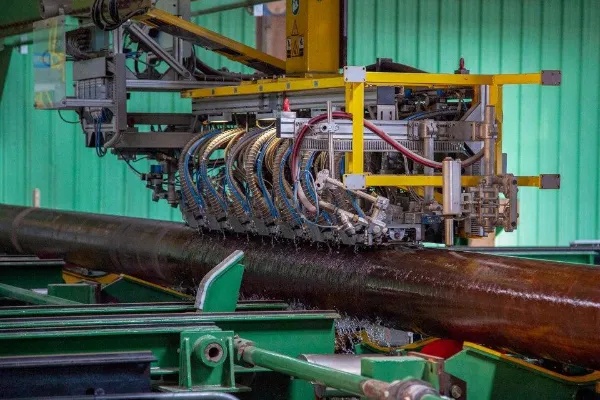
5. Nondestructive Examination (NDE)
Nondestructive examination helps identify defects without destroying the pipe.
Depending on the product, manufacturing route, and applicable requirements, inspection methods may include ultrasonic testing, electromagnetic examination, or other specified techniques.
NDE can help detect discontinuities that visual inspection may miss. The required coverage, method, calibration, and acceptance criteria must follow the applicable specification and purchase order.
Inspection records should identify the examination performed and document the results required for acceptance.
6. Thread and Coupling Inspection
Thread inspection is essential for casing supplied with threaded connections. Incorrect thread geometry or damaged surfaces can affect make-up, sealing performance, and connection integrity.
Inspection may cover:
Thread form and dimensions
Thread taper and lead
Thread surface condition
Coupling dimensions and condition
Connection gauges and applicable tolerances
Thread protectors and handling condition
The specific requirements depend on the connection type, such as the applicable API casing connection or a separately specified premium connection.
Premium connections may require additional inspection procedures and acceptance criteria established by the connection manufacturer or project specification.
7. Hydrostatic Testing
Hydrostatic testing checks a pipe's ability to withstand a specified internal pressure without unacceptable leakage.
Where required, the pipe is filled with liquid and pressurized under controlled conditions. Inspectors monitor the pipe for leakage or other unacceptable indications during the test.
The required test pressure, holding conditions, and acceptance criteria depend on the applicable API 5CT provisions and product requirements. Buyers should not assume that one pressure value applies to all casing sizes and grades.
Hydrostatic testing does not replace dimensional inspection, material testing, or required nondestructive examination.
API 5CT Casing Pipe Inspection Checklist
Before accepting a casing pipe shipment, buyers can use the following checklist to review the key inspection items.
|
nspection Item
|
What to Verify
|
|
Product identification
|
Grade, size, wall thickness, and connection
|
|
Visual condition
|
No unacceptable surface defects
|
|
Dimensions
|
Compliance with applicable tolerances
|
|
Chemical analysis
|
Results meet grade requirements
|
|
Mechanical properties
|
Required test results meet acceptance limits
|
|
NDE
|
Required examination completed and accepted
|
|
Hydrostatic test
|
Results meet applicable requirements, where required
|
|
Threads and couplings
|
Dimensions, condition, and connection compliance
|
|
Marking and traceability
|
Identification matches inspection records
|
|
Documentation
|
Test certificates and inspection records are complete
|
This checklist is a practical purchasing aid, not a substitute for the complete specification or a project-specific inspection and test plan.
How to Ensure API 5CT Casing Pipe Quality ?
Reliable casing pipe quality control starts with clearly defined purchasing requirements. Buyers should specify the grade, size, wall thickness, length, connection, applicable API 5CT edition, and any supplementary testing or inspection requirements.
Before shipment, review the inspection records and confirm that the product markings match the order. For critical oil and gas projects, buyers may also arrange third-party inspection according to the agreed inspection plan.
At Baowi Steel, buyers can specify their required casing dimensions, grades, connections, and inspection documentation when requesting a quotation. Clear technical requirements help reduce acceptance issues and support reliable project procurement.
What Should Buyers Do If Casing Pipe Fails Inspection?
A failed inspection should trigger a controlled review rather than an immediate assumption that the entire shipment is acceptable or rejectable.
The buyer and supplier should follow the applicable standard, purchase order, and agreed nonconformity procedure.
A practical response includes:
1.Identify and segregate the affected products. Prevent unverified or nonconforming pipes from being mixed with accepted material.
2.Record the inspection findings. Include pipe identification, measured values, test results, equipment details where relevant, and the applicable acceptance criterion.
3.Review the result. Confirm the measurement method, calibration status, test procedure, and whether the correct requirement was applied.
4.Determine the permitted next step. Additional examination, retesting, repair, or rejection should be considered only where allowed by the applicable requirements and contract.
5.Document the final disposition. Maintain records of accepted, rejected, or otherwise dispositioned material and confirm the status before shipment.
Retesting should not be used to disregard an initial failure. It must follow the applicable retest provisions and be properly documented.
Should Buyers Arrange Third-Party Inspection?
Third-party inspection may be useful for large orders, critical well projects, unfamiliar suppliers, or contracts that require independent verification. It can also help buyers document compliance before shipment.
The scope should be agreed upon before production or final inspection. Depending on the order, it may include:
Review of the purchase specification and inspection plan.
Witnessing or verification of specified tests.
Dimensional and visual inspection.
NDT and thread inspection record review.
Product marking and traceability verification.
Final inspection reporting and confirmation of outstanding nonconformities.
Third-party inspection does not automatically replace the manufacturer's quality-control responsibilities or the buyer's contractual acceptance process. Its value depends on the agreed scope, inspector competence, and applicable acceptance criteria.
Before appointing an inspector, buyers should clarify whether inspection is for review, witnessing, hold-point release, or final acceptance. The inspection arrangement should also specify how nonconformities will be reported and resolved.
Frequently Asked Questions
1. What tests are required for API 5CT casing pipe?
The required tests depend on the applicable API 5CT edition, grade, dimensions, product type, manufacturing route, and purchase order. They may include chemical analysis, mechanical testing, dimensional inspection, hydrostatic testing, NDT, and connection inspection where applicable.
2. Is 100% non-destructive testing mandatory for all casing grades?
No. NDT requirements and coverage depend on the relevant product and applicable provisions. Buyers should verify the exact requirements rather than assume that every grade and product configuration requires the same inspection method or coverage.
3. Which standard covers casing pipe thread inspection?
API 5B addresses applicable thread gauging and inspection requirements, while API 5CT establishes the broader product requirements. The specific connection designation and applicable provisions should be confirmed for each order.
4. Does hydrostatic testing alone prove that casing pipe meets API 5CT?
No. Hydrostatic testing evaluates a particular aspect of pipe performance. It does not replace applicable material, mechanical, dimensional, NDT, connection, marking, or traceability checks.
5. What should buyers check during pre-shipment inspection?
Buyers should confirm the ordered grade and dimensions, review required test results, examine applicable NDT and thread inspection records, verify product markings and traceability, and resolve outstanding nonconformities before shipment.
6. Can a third-party inspector reject casing pipe?
A third-party inspector can document nonconformities and issue findings within the agreed inspection scope. Formal acceptance, rejection, and disposition should follow the purchase contract, applicable standards, and the parties' agreed procedures.
Related Articles
Steel Casing Pipe Size Chart

 English
 Español
 بالعربية
 Phone :
 Whatsapp :
 Email :