What Is a Steel Pipe Mill Test Certificate (MTC)?
A steel pipe mill test certificate (MTC), also called a material test certificate or mill test report (MTR), is a quality document that records material identification and relevant test results for a steel product. Depending on the applicable product standard and certificate type, it may include chemical composition, mechanical properties, heat treatment condition, dimensional information, and inspection results.
For steel pipe buyers, an MTC helps verify whether the supplied material meets the requirements specified in the purchase order. It also supports traceability by linking documented test results to an identified heat or production batch.
An MTC is particularly important when purchasing seamless steel pipes, welded steel pipes, line pipes, oil and gas casing, tubing, and stainless steel pipes for industrial applications.
However, receiving a certificate does not automatically prove that the delivered pipes comply with every requirement. Buyers must check the certificate against the purchase order, applicable material standard, physical pipe markings, and any additional inspection requirements.
What Information Does a Steel Pipe MTC Contain?
The exact format varies by manufacturer, product type, and applicable standard. A typical steel pipe mill test certificate contains several sections that buyers should review before accepting a shipment.
|
Manufacturer information
|
Name of the producing mill
|
Whether the issuing organization is correctly identified
|
|
Certificate number
|
Unique document reference
|
Whether the certificate can be traced or verified
|
|
Product description
|
Pipe type, dimensions, and quantity or batch details
|
Whether the description matches the purchase order
|
|
Material grade and standard
|
Steel grade and governing specification
|
Whether the grade and standard are exactly as ordered
|
|
Heat number
|
Identification of the steelmaking heat
|
Whether the number matches the physical material markings
|
|
Chemical composition
|
Measured elemental composition
|
Whether each reported value complies with the applicable limits
|
|
Mechanical properties
|
Strength, elongation, and other required results
|
Whether results meet the applicable acceptance criteria
|
|
Heat treatment condition
|
Recorded treatment condition, where applicable
|
Whether it matches the material specification and order
|
|
Inspection and testing
|
Required test results and inspection information
|
Whether all contractually required tests are documented
|
|
Certificate type and authorization
|
Inspection document category and responsible personnel
|
Whether the document type and authorization meet the order requirements
|
Not every MTC includes every field listed above.
For example, impact test results, hardness, hydrostatic testing, nondestructive examination, and dimensional inspection may be documented separately or included when required by the applicable product standard or purchase order.
Buyers should therefore evaluate the certificate against the actual order requirements rather than assume that every MTC follows an identical format.
How to Read a Steel Pipe Mill Test Certificate?
1. Confirm the Material Grade and Product Standard
Start by comparing the material grade and product standard on the MTC with the purchase order.
For example, a purchase order may specify ASTM A106 Grade B seamless carbon steel pipe or API 5L X52 line pipe. These designations are not interchangeable simply because both products are steel pipes.
2. Check the Heat Number and Material Traceability
The heat number is one of the most important fields on a steel pipe MTC. It identifies a particular steelmaking heat and helps connect the material to its recorded chemical analysis and associated production or inspection records.
Depending on the production and identification system, the heat number may appear on pipe markings, labels, bundle tags, or related traceability documents.
3. Review the Chemical Composition
The chemical composition section reports the content of elements in the steel, usually expressed as a percentage by mass.
Depending on the grade, the MTC may list carbon (C), manganese (Mn), silicon (Si), phosphorus (P), sulfur (S), chromium (Cr), nickel (Ni), molybdenum (Mo), and other relevant elements.
|
Element
|
Symbol
|
Why it matters
|
|
Carbon
|
C
|
Influences strength, hardness, and weldability
|
|
Manganese
|
Mn
|
Contributes to strength and hardenability
|
|
Silicon
|
Si
|
Acts as a deoxidizer and affects mechanical properties
|
|
Phosphorus
|
P
|
Is generally subject to specified maximum limits
|
|
Sulfur
|
S
|
Is generally controlled because of its effects on toughness and processing
|
|
Chromium
|
Cr
|
Contributes to corrosion resistance and hardenability, depending on the grade
|
|
Nickel
|
Ni
|
Can improve toughness and contributes to corrosion resistance in suitable alloys
|
|
Molybdenum
|
Mo
|
Can improve hardenability and certain high-temperature or corrosion-related properties
|
Not all elements apply to every steel grade. Carbon steel, low-alloy steel, and stainless steel have different compositional requirements.
4. Verify the Mechanical Properties
The mechanical properties section shows how the tested material performs under specified test conditions.
Common parameters include:
Yield strength: The stress at which the material begins to deform plastically, as defined by the applicable test method.
Tensile strength: The maximum engineering stress recorded during a tensile test.
Elongation: A measure of deformation before fracture under the specified tensile test conditions.
Impact energy: The energy absorbed during an impact test, when required.
Hardness: A measure of resistance to indentation, where testing is specified.
|
Property
|
Common abbreviation
|
What to check
|
|
Yield strength
|
YS, ReH, or Rp0.2
|
Applicable minimum or permitted range
|
|
Tensile strength
|
TS or Rm
|
Applicable minimum and maximum, where specified
|
|
Elongation
|
A or related notation
|
Required minimum and relevant test conditions
|
|
Impact energy
|
KV or other standard-specific notation
|
Required energy, test temperature, and specimen conditions
|
|
Hardness
|
HBW, HRC, or HV
|
Specified limits and applicable test method
|
5. Check Heat Treatment and Supplementary Testing
Certain steel pipes require a specified heat treatment condition, such as normalized, quenched and tempered, or solution treated, depending on the material and product standard.
Check whether the recorded condition agrees with the order and whether the required test results correspond to that condition.
For projects involving pressure service, oil and gas applications, corrosive environments, or other demanding operating conditions, the purchase order may also require supplementary tests.
These may include:
Hydrostatic testing.
Ultrasonic or other nondestructive examination.
Impact testing.
Hardness testing.
Dimensional inspection.
Additional chemical analysis or product analysis.
Other project-specific inspections.
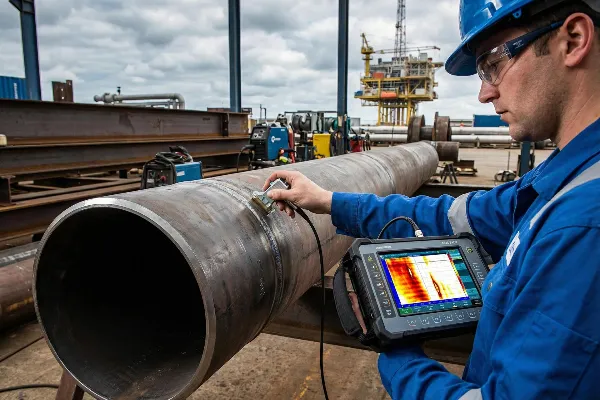
An MTC may document some of these tests, while other reports are supplied separately. Before approving a shipment, verify that all required documents are available and cover the relevant material.
EN 10204 3.1 vs. 3.2 Mill Test Certificates
EN 10204 specifies types of inspection documents for metallic products. It defines the nature of the documents; it does not independently establish the chemical composition or mechanical acceptance limits for every steel pipe grade.
The applicable product standard and purchase order determine the material requirements.
Type 3.1 and Type 3.2 are both inspection certificates, but they differ in the inspection confirmation and involvement of an independent inspection representative.
|
Comparison
|
EN 10204 Type 3.1
|
EN 10204 Type 3.2
|
|
Inspection results
|
Specific inspection results as required by the applicable specification
|
Specific inspection results as required by the applicable specification
|
|
Manufacturer's inspection representative
|
Confirms the results in accordance with the document type
|
Participates in the required confirmation
|
|
Independent inspection involvement
|
The confirming representative is independent of the manufacturing department
|
Confirmation also involves the purchaser's authorized representative or an inspector designated by the official regulations, as applicable
|
|
Typical use
|
Orders requiring manufacturer-issued inspection certification
|
Orders requiring additional independent confirmation
|
|
Cost and coordination
|
Usually involves less additional inspection coordination
|
May require additional coordination, witnessing, or inspection arrangements
|
|
Acceptance
|
Must meet the contract and applicable standards
|
Must meet the contract and applicable standards
|
The distinction is not simply that a Type 3.2 certificate contains more test data. Its defining feature is the additional independent confirmation required by EN 10204.
Which Certificate Should Steel Pipe Buyers Request?
For many industrial steel pipe orders, Type 3.1 is an appropriate choice when specified by the buyer and accepted under the applicable project requirements.
Type 3.2 may be necessary when required by the purchase order, end-user specification, regulatory framework, or project inspection plan.
Before placing an order, buyers should confirm:
Which EN 10204 document type is required.
Whether third-party inspection or witnessing is mandatory.
Which organization is authorized to perform or confirm the inspection.
Whether additional testing must be completed before shipment.
Which documents must be submitted for final approval.
A Type 3.2 certificate should not be assumed to be mandatory for every steel pipe purchase, nor should Type 3.1 be assumed sufficient for every project.
The best approach is to specify the required certificate type before production and inspection begin. Changing the inspection requirements after manufacturing may lead to additional costs, delays, or the need for further verification.
Frequently Asked Questions About Steel Pipe Mill Test Certificates
What is a mill test certificate for steel pipe?
A mill test certificate is a material quality document that records identification information and relevant inspection or test results for steel pipe. It helps buyers verify material compliance and traceability against the applicable standard and purchase order.
Is an MTC the same as an MTR?
The terms are often used interchangeably in steel procurement. However, the title alone does not establish the document's scope or certification level. Buyers should check the actual test results, traceability information, applicable standard, and required inspection document type.
What is the difference between EN 10204 3.1 and 3.2?
Both are inspection certificate types. Type 3.1 is confirmed by the manufacturer's authorized inspection representative who is independent of the manufacturing department. Type 3.2 adds confirmation involving the purchaser's authorized representative or an inspector designated by the official regulations, as applicable.
What is a heat number on a steel pipe MTC?
A heat number identifies a steelmaking heat and links the material to relevant production and test records. Buyers use it to cross-check the certificate against physical pipe markings and other traceability documents.
How can I verify a steel pipe MTC?
Compare the certificate with the purchase order, verify the issuing manufacturer, match the heat number to the delivered pipes, check the actual chemical and mechanical results against the applicable requirements, and confirm that all required supplementary reports are available.
Does every steel pipe require an EN 10204 3.1 certificate?
Not necessarily. The required inspection document depends on the product standard, purchase contract, application, and applicable regulations. Buyers should specify the required document type before production and delivery.
Can a steel pipe MTC guarantee product quality?
An MTC provides evidence of the recorded material and inspection results within its stated scope. It does not automatically guarantee every aspect of product quality, dimensional accuracy, workmanship, shipment condition, or suitability for a particular application. Additional inspections may be required.
What should I do if the MTC does not match the steel pipe?
Do not ignore the discrepancy. Record the issue, check the pipe markings and related records, and request verification from the supplier or issuing mill. If necessary, arrange further inspection or testing under the agreed quality procedure before accepting the material.
Conclusion
A steel pipe mill test certificate (MTC) helps buyers verify material specifications, chemical composition, mechanical properties, and heat number traceability before accepting a shipment. By checking the certificate against the purchase order, applicable product standards, physical pipe markings, and required inspection reports, buyers can reduce documentation discrepancies and make more informed purchasing decisions.
BAOWI Steel supplies a range of steel pipe products for industrial, construction, and energy applications, including
Seamless Steel Pipe,
ERW Steel Pipe, and
LSAW Steel Pipe. For oil and gas projects, buyers can also explore our Casing and Tubing. Contact BAOWI Steel to discuss your required material grade, dimensions, applicable standards, inspection requirements, and documentation before placing an order.

 English
 Español
 بالعربية
 Phone :
 Whatsapp :
 Email :