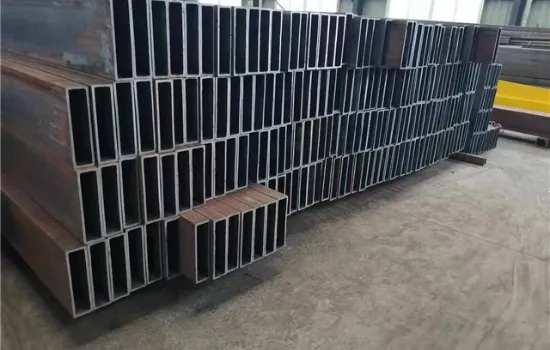
When selecting a steel hollow section for a building, bridge, industrial facility, or other structural project, the material standard affects design compatibility, mechanical performance, dimensional requirements, testing, and project compliance.ASTM A500 and EN 10219 are two important standards for cold-formed structural hollow sections. ASTM A500 is widely used in North American structural engineering, while EN 10219 is widely used within European standardization systems.However, these standards are not directly interchangeable. They define materials, manufacturing requirements, dimensions, testing, and grade designations in different ways.This guide explains the key differences between ASTM A500 vs EN 10219 hollow sections, including steel grades, yield strength, tensile strength, manufacturing processes, dimensional tolerances, impact requirements, applications, and purchasing considerations.
What Is ASTM A500 Hollow Section?
ASTM A500 is a specification for cold-formed welded and seamless carbon steel structural tubing.It covers round, square, rectangular, and certain special tubular shapes. The products can be used in welded, riveted, or bolted structural construction, including buildings and bridges.ASTM A500 is particularly familiar in the North American structural steel market. Its products are commonly referred to as Hollow Structural Sections (HSS).
What Is EN 10219 Hollow Section?
EN 10219 is the European standard for cold-formed welded steel structural hollow sections.
It covers structural hollow sections made from non-alloy and fine grain steels. Typical shapes include:
Circular hollow sections (CHS)
Square hollow sections (SHS)
Rectangular hollow sections (RHS)
Elliptical hollow sections
EN 10219 is divided into two main parts.
EN 10219-1 specifies technical delivery conditions, including steel grades, chemical composition, mechanical properties, and related requirements.
EN 10219-2 specifies tolerances, dimensions, and sectional properties. The current EN 10219-2:2019 covers cold-formed welded circular, square, rectangular, and elliptical hollow sections, with specified size ranges and wall thicknesses up to 40 mm.
This makes EN 10219 particularly important when hollow sections are designed according to European structural practices.
Differences and Similarities: ASTM A500 vs. EN 10219 Hollow Section
Although ASTM A500 and EN 10219 are both widely used for structural hollow sections, they differ in scope, grade systems, mechanical requirements, and dimensional specifications. Understanding these differences is important when selecting materials for international structural projects:
Regional Application: ASTM A500 is widely specified in North America and projects following ASTM-based structural practices, while EN 10219 is commonly used in Europe and projects designed according to European standards and Eurocodes.
Grade Designation: ASTM A500 identifies structural tubing by letter grades such as Grade B, Grade C, and Grade D. EN 10219 uses designations such as S235JRH, S275J0H, and S355J2H, which provide information about yield strength and impact toughness requirements.
Impact Testing: Certain EN 10219 grades include specified impact toughness requirements, such as J0 and J2 grades for defined test temperatures. ASTM A500 generally does not establish the same mandatory low-temperature impact requirements, so additional toughness requirements should be confirmed when required by the project.
Chemical Composition: Both standards specify limits for carbon, manganese, phosphorus, sulfur, and other elements. However, the permitted chemical composition and calculation requirements differ between the two standards and should be checked before material substitution.
Dimensional Tolerances: Both ASTM A500 and EN 10219 define requirements for dimensions, wall thickness, straightness, and section geometry. However, their tolerance limits and measurement methods are not identical, so dimensional compatibility should be verified when sourcing or substituting hollow sections internationally.
|
Item
|
ASTM A500
|
EN 10219
|
|
Full name
|
Standard Specification for Cold-Formed Welded and Seamless Carbon Steel Structural Tubing in Rounds and Shapes
|
Cold Formed Welded Steel Structural Hollow Sections
|
|
Main market
|
North America and projects using ASTM/AISC practice
|
Europe and projects using EN/Eurocode practice
|
|
Product type
|
Welded and seamless
|
Welded
|
|
Cross-sectional shapes
|
Round, square, rectangular, special shapes
|
Circular, square, rectangular and elliptical sections
|
|
Common grades
|
Grade A, B, C, D
|
S235JRH, S275J0H, S275J2H, S355J0H, S355J2H, S355K2H
|
|
Grade designation
|
Letter grades
|
Yield strength + toughness designation
|
|
Design units
|
Inch-pound or SI under A500/A500M
|
Metric
|
|
Impact requirements
|
Not generally mandatory under A500
|
Specified for applicable impact grades
|
|
Main structural use
|
Buildings, bridges, general structures
|
Structural hollow sections for buildings and engineering
|
|
Manufacturing
|
Cold forming; welded products use ERW
|
Cold forming and welding
|
|
Dimensional requirements
|
ASTM A500 dimensional tolerances
|
EN 10219-2 dimensional tolerances
|
|
Design compatibility
|
Common with AISC/American structural practice
|
Common with Eurocode-based design
|
ASTM A500 vs EN 10219 Steel Grades
One of the biggest differences between the two standards is their grade designation system.
ASTM A500 uses Grade A, Grade B, Grade C, and Grade D.
EN 10219 uses designations such as S235JRH, S275J0H, and S355J2H.
The EN designation provides more information about the material.
S235 indicates a nominal minimum yield strength class.
S355 indicates a higher yield strength class.
J0 and J2 identify impact toughness requirements and test temperatures.
H identifies the product as a hollow section.
The grade systems should therefore not be treated as direct one-to-one equivalents.
STM A500 Mechanical Properties
For ASTM A500/A500M-23, the specified minimum mechanical properties depend on the grade and section shape.
For shaped structural tubing, commonly referenced values include:
|
ASTM A500 Grade
|
Minimum Yield Strength
|
Minimum Tensile Strength
|
Minimum Elongation
|
|
Grade A
|
270 MPa
|
310 MPa
|
25%
|
|
Grade B
|
315 MPa
|
400 MPa
|
23%
|
|
Grade C
|
345 MPa
|
425 MPa
|
21%
|
|
Grade D
|
250 MPa
|
400 MPa
|
23%
|
The requirements vary between round and shaped tubing, so engineers should use the applicable table in the purchased standard rather than treating these values as universal. Grade D also has specific heat-treatment requirements.
EN 10219 Mechanical Properties
Common EN 10219 grades include S235JRH, S275J0H, S275J2H, S355J0H, and S355J2H.
For example, S355J2H has a minimum yield strength of 355 MPa for wall thicknesses up to 16 mm and a tensile strength range of 470–630 MPa for relevant thicknesses. The standard also specifies impact energy requirements for the J2 grade.
A simplified comparison is shown below.
|
Grade
|
Standard
|
Minimum Yield Strength
|
Tensile Strength
|
|
Grade B
|
ASTM A500
|
315 MPa*
|
400 MPa
|
|
Grade C
|
ASTM A500
|
345 MPa*
|
425 MPa
|
|
S235JRH
|
EN 10219
|
235 MPa
|
360–510 MPa
|
|
S275J0H
|
EN 10219
|
275 MPa
|
430–580 MPa
|
|
S355J2H
|
EN 10219
|
355 MPa
|
470–630 MPa
|
For ASTM A500 shaped structural tubing. Actual requirements depend on grade, shape, and applicable wall thickness.
ASTM A500 vs EN 10219 Impact Testing
Impact toughness is another important difference.
Certain EN 10219 grades include defined impact energy requirements. For example, S355J2H specifies a minimum impact energy of 27 J at −20°C under the applicable requirements.
ASTM A500 does not generally provide the same mandatory low-temperature notch-toughness framework.
ASTM itself notes that A500 products may not be suitable for applications involving dynamically loaded elements where low-temperature notch toughness is important.
This does not mean that every EN 10219 product is automatically better for every application. Instead, the engineer should identify the required toughness level and select a grade that meets the project specification.
For structures exposed to low temperatures, impact loading, or other demanding service conditions, the material specification should be reviewed together with the applicable structural design code.
ASTM A500 vs EN 10219 for Galvanized Hollow Sections
Both ASTM A500 and EN 10219 hollow sections can be used as base material for galvanized structural products.
However, the base pipe standard and galvanizing standard are separate specifications.
For example, a project may specify:
ASTM A500 + ASTM A123/A123M for hot-dip galvanizing
EN 10219 + EN ISO 1461 for hot-dip galvanizing
The exact combination depends on the project specification and applicable regulations.
Hot-dip galvanizing creates a zinc coating that protects the steel substrate against atmospheric corrosion. The galvanizing process does not change the fact that the underlying hollow section must first satisfy its specified structural steel standard.
This distinction is important when purchasing galvanized hollow section, because asking only for "galvanized steel tube" is not enough. The purchase order should identify the structural standard, grade, dimensions, coating requirements, and inspection requirements.
Conclusion
ASTM A500 vs EN 10219 hollow section is not simply a comparison between American and European steel pipes.Both standards provide specifications for structural hollow sections, but they use different grade systems, manufacturing scopes, testing requirements, dimensional requirements, and design conventions.ASTM A500 covers cold-formed welded and seamless structural tubing, while EN 10219 focuses on cold-formed welded structural hollow sections.For procurement, the most important step is to match the hollow section with the project's design code, material grade, dimensions, testing requirements, certification requirements, and service conditions.When comparing ASTM A500 and EN 10219, engineers and buyers should therefore avoid simple grade-to-grade substitutions. A technically suitable material should be confirmed against the complete project specification before ordering.

 English
 Español
 بالعربية



 Phone :
  Whatsapp :
  Email :