In industrial piping systems,
flange selection is not only about choosing the correct pressure rating or material. The flange standard itself determines the dimensions, bolt patterns, facing requirements, and compatibility with the piping system.
Among the most widely used flange standards, ASME B16.5 and ASME B16.47 are often compared because both cover steel pipe flanges used in pressure piping applications. However, they are designed for different size ranges and project requirements.The biggest difference is that ASME B16.5 covers standard pipe flanges from NPS 1/2 to NPS 24, while ASME B16.47 is developed for large diameter steel flanges from NPS 26 to NPS 60.In practical engineering projects, selecting between these two standards depends on more than pipe size. Factors such as flange type, pressure class, mechanical loads, installation space, and project specifications also need to be considered.
What Is ASME B16.5?
ASME B16.5 is one of the most commonly used flange standards for industrial piping systems. It specifies the requirements for pipe flanges and flanged fittings, including dimensions, pressure-temperature ratings, materials, tolerances, marking, and testing requirements.Because of its wide size range and variety of flange designs, ASME B16.5 is the standard most frequently specified in general process piping applications.
Main Specifications of ASME B16.5
|
Item
|
ASME B16.5
|
|
Size Range
|
NPS 1/2 to NPS 24
|
|
Pressure Classes
|
Class 150 to Class 2500
|
|
Covered Flange Types
|
Weld Neck, Slip-On, Blind, Threaded, Lap Joint
|
|
Common Materials
|
Carbon Steel, Stainless Steel, Alloy Steel
|
|
Manufacturing
|
Forged or Cast Materials
|
Common materials include:
ASTM A105 carbon steel flanges
ASTM A182 F304/F304L stainless steel flanges
ASTM A182 F316/F316L stainless steel flanges
These materials allow ASME B16.5 flanges to be used in applications ranging from water pipelines to high-temperature chemical processing systems.
What Is ASME B16.47?
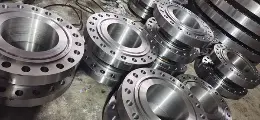
ASME B16.47, also known as Large Diameter Steel Flanges, was developed specifically for large-size piping systems where traditional B16.5 flange dimensions are no longer suitable.
The standard applies to large diameter weld neck and blind flanges from NPS 26 through NPS 60.Compared with B16.5, B16.47 focuses more on large pipeline applications where flange weight, bolt arrangement, and mechanical stability become critical design factors.
Main Specifications of ASME B16.47
|
Item
|
ASME B16.47
|
|
Size Range
|
NPS 26 to NPS 60
|
|
Pressure Classes
|
Class 75, 150, 300, 400, 600, 900
|
|
Covered Flange Types
|
Weld Neck and Blind Flanges
|
|
Design Series
|
Series A and Series B
|
|
Common Materials
|
Carbon Steel, Stainless Steel, Alloy Steel
|
Unlike ASME B16.5, B16.47 does not cover common flange types such as slip-on, threaded, or socket weld flanges. It mainly addresses large diameter connections used in heavy industrial and pipeline systems.
ASME B16.5 vs ASME B16.47
The easiest way to distinguish these two standards is by looking at their intended applications.
|
Comparison
|
ASME B16.5 Flange
|
ASME B16.47 Flange
|
|
Main Application
|
Standard piping systems
|
Large diameter piping systems
|
|
Size Range
|
NPS 1/2 - 24
|
NPS 26 - 60
|
|
Flange Type
|
Weld Neck, Slip On, Blind, Threaded, Socket Weld
|
Weld Neck and Blind mainly
|
|
Pressure Class
|
150 - 2500
|
150 - 900
|
|
Typical Industry
|
Chemical, HVAC, industrial piping
|
Oil & gas, refinery, pipeline
|
|
Diameter
|
Small and medium size
|
Large diameter
|
|
Installation
|
Easier installation
|
Requires more handling equipment
|
|
Cost
|
Lower cost
|
Higher cost
|
The size range is the first selection factor, but it is not the only consideration. For example, a large-diameter project may require additional evaluation of flange series, bolt dimensions, gasket selection, and equipment connection requirements.
5 Key Differences Between ASME B16.5 and ASME B16.47 Flanges
1. Size Range and Application Scope
ASME B16.5 covers pipe flanges and flanged fittings from NPS 1/2 to NPS 24, making it the preferred standard for most process piping and industrial applications.
ASME B16.47 applies to large diameter steel flanges from NPS 26 to NPS 60, where pipeline capacity, mechanical loads, and installation conditions become more critical.
2. Pressure Class Ratings
ASME B16.5 provides a broader pressure range from Class 150 to Class 2500, allowing it to support both standard and high-pressure piping applications.
ASME B16.47 covers Class 75 to Class 900 and focuses on large diameter piping systems where flange size and structural performance are key considerations.
3. Flange Types and Design Applications
ASME B16.5 covers a wider selection of flange designs, including weld neck, slip-on, socket weld, threaded, lap joint, and blind flanges, providing more flexibility for different piping connections.
ASME B16.47 mainly covers weld neck and blind flanges, because large diameter systems typically require stronger welded connections and higher mechanical stability.
4. Dimensions, Bolt Patterns, and Interchangeability
ASME B16.5 uses a single dimensional system, with defined flange dimensions, facing details, and bolt patterns for each size and pressure class.
ASME B16.47 includes Series A and Series B, which have different outside diameters, bolt circle dimensions, and thicknesses, so they should not be considered interchangeable without engineering verification.
5. Project Selection and Typical Applications
ASME B16.5 is commonly selected for refineries, chemical plants, power generation systems, and equipment connections where pipe sizes are generally below 24 inches.
ASME B16.47 is typically specified for large pipeline projects, including oil and gas transmission, offshore facilities, and large water or industrial pipeline systems.
Size Range Difference Between ASME B16.5 and B16.47
The most important difference between these two standards is the flange size range.
ASME B16.5 is commonly selected for piping systems below 24 inches. It provides a complete range of flange designs for general industrial applications.
ASME B16.5 mainly applies to flange sizes from:
NPS 1/2 to NPS 24
Pressure classes: Class 150, 300, 400, 600, 900, 1500, and 2500
However, when pipe sizes exceed NPS 24, ASME B16.47 becomes the preferred standard because large diameter pipelines require stronger flange structures and different bolt patterns.
Unlike ASME B16.5, ASME B16.47 covers larger flange sizes:
NPS 26 to NPS 60
Pressure classes:
Series A: Class 150, 300, 400, 600, 900
Series B: Class 150, 300, 400, 600
|
Pipe Size
|
Recommended Standard
|
|
NPS 2
|
ASME B16.5
|
|
NPS 12
|
ASME B16.5
|
|
NPS 24
|
ASME B16.5
|
|
NPS 30
|
ASME B16.47
|
|
NPS 48
|
ASME B16.47
|
ASME B16.47 Series A vs Series B: What Is the Difference?
When selecting large diameter flanges, understanding the difference between ASME B16.47 Series A and Series B is critical. Both series apply to the same size range (NPS 26 to NPS 60) and cover blind and weld neck flanges, but their dimensions, bolt patterns, and design concepts are different.
Many engineers assume Series A and Series B flanges can replace each other because they share the same pressure classes and nominal sizes. However, they are generally not interchangeable because the flange dimensions and connection details are different.
The main difference is that Series A flanges are designed with heavier dimensions and higher mechanical load capacity, while Series B flanges use a more compact design with smaller dimensions and lower material weight.
Origin of ASME B16.47 Series A and Series B
The two series have different historical backgrounds:
ASME B16.47 Series A
Series A flanges are based on the former MSS SP-44 Steel Pipeline Flanges standard.
They were developed mainly for pipeline and heavy-duty applications where flange strength and rigidity are important.
Series A flanges are commonly selected for critical pipeline systems where mechanical strength and long-term reliability are priorities.
ASME B16.47 Series B
Series B flanges originated from the former API 605 Large Diameter Carbon Steel Flanges standard.
Compared with Series A, Series B uses a more compact design.
This design can reduce material costs and installation space requirements, making Series B popular in certain pipeline and retrofit applications.
ASME B16.47 Series A vs Series B Comparison
|
Feature
|
ASME B16.47 Series A
|
ASME B16.47 Series B
|
|
Original Standard
|
MSS SP-44
|
API 605
|
|
Design Focus
|
Higher mechanical strength
|
Compact and economical design
|
|
Flange Size
|
NPS 26–60
|
NPS 26–60
|
|
Flange Thickness
|
Generally thicker
|
Generally thinner
|
|
Bolt Circle Diameter
|
Larger
|
Smaller
|
|
Weight
|
Heavier
|
Lighter
|
|
Material Usage
|
Higher
|
Lower
|
|
Typical Applications
|
New construction, high-load systems
|
Existing systems, cost-sensitive projects
|
They share the same pressure-temperature rating system.
One fact often overlooked is that B16.47 and B16.5 utilize the same calculation method for pressure-temperature (P-T) ratings. In other words, a Class 300 NPS 30 large-diameter flange and a Class 300 NPS 6 small-diameter flange share the same allowable working pressure at a given temperature; the rating is independent of the nominal pipe size.
This also implies that, despite their large dimensions, B16.47 flanges are capped at a Class 900 rating; if your operating conditions require Class 1500 or 2500, you must revert to B16.5 flanges with sizes of NPS 24 or smaller.
In theory, ASME B16.5 covers pipe sizes up to NPS 24, yet ASME B16.47 also covers NPS 24 at certain pressure ratings—the issue is that their dimensions differ completely. If a project specification simply calls for an "NPS 24 Class 300 flange" without citing the specific standard, a supplier might provide one based on either B16.5 or B16.47, resulting in a component that cannot be installed on-site.
Conclusion
The relationship between ASME B16.5 and B16.47 is clear-cut: one covers small-to-medium pipe sizes while the other handles large sizes; together, they span the entire range from NPS 1/2 to 60. There are only two areas where issues commonly arise: specifying the correct standard for the NPS 24 overlap, and distinguishing between the interchangeable and non-interchangeable nature of B16.47 Series A and Series B. By keeping these two points in mind, you can largely avoid errors during selection and procurement.

 English
 Español
 بالعربية



 Phone :
  Whatsapp :
  Email :