Choosing between a
socket weld flange (SW flange) and a
slip-on flange (SO flange) is one of the most common decisions in industrial piping design. Although both flange types are available in forged
ASTM A182 materials and follow the same dimensional standards such as
ASME B16.5, they are engineered for different service conditions rather than being interchangeable options.
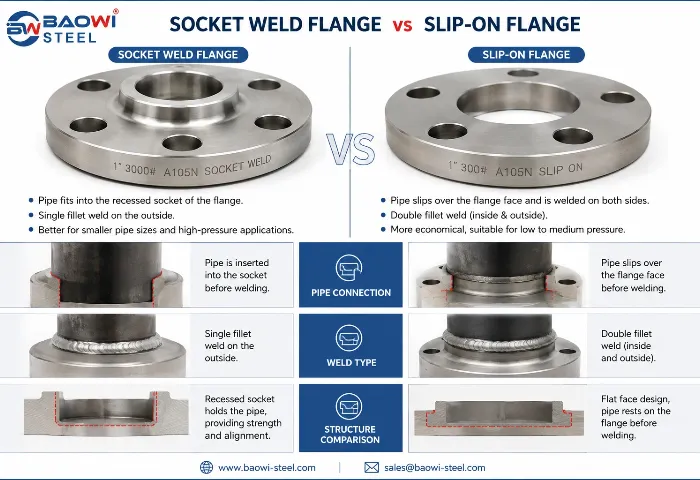
The primary difference lies in how the pipe is connected to the flange. A socket weld flange locates the pipe inside a precision-machined socket before welding, while a slip-on flange slides over the outside of the pipe and is welded from both sides. This structural difference influences not only pressure capability but also fabrication efficiency, fatigue resistance, inspection requirements, and long-term reliability.
One of the biggest differences between socket weld and slip-on flanges is their typical size range.
Socket weld flanges are mainly used for small-bore piping, commonly from NPS 1/2" to NPS 2". Their compact design makes them ideal for instrument lines, hydraulic systems, and small process piping where space and alignment are important.
Slip-on flanges are more common in medium and large diameter piping because their simple design makes fabrication and installation more economical. They are widely used in utility systems, cooling water lines, and general industrial piping.
ASTM A182 Materials Available for Both Flange Types
Both socket weld and slip-on flanges can be manufactured from a wide range of ASTM A182 forged stainless steel and alloy steel grades.
|
ASTM A182 Grade
|
Material Type
|
Typical Applications
|
|
F304
|
Stainless Steel
|
General industrial service
|
|
F304L
|
Low Carbon Stainless
|
Welding applications
|
|
F316
|
Stainless Steel
|
Marine & chemical service
|
|
F316L
|
Low Carbon Stainless
|
Corrosive environments
|
|
F11
|
Chrome-Moly Alloy Steel
|
High-temperature piping
|
|
F22
|
Chrome-Moly Alloy Steel
|
Power plants
|
|
F91
|
Advanced Alloy Steel
|
Superheated steam
|
|
F51
|
Duplex Stainless Steel
|
Offshore & seawater
|
|
F53
|
Super Duplex
|
Severe corrosion environments
|
Many people mistakenly believe that ASTM A182 determines a flange's pressure rating; in reality, it governs the material, not the dimensions.
ASTM A182/A182M covers forged or rolled alloy steel and stainless steel pipe flanges, fittings, and valves intended for high-temperature pressure service, with individual component weights typically not exceeding 10,000 lb (4,540 kg).
Common grades include austenitic stainless steels (F304/F316/L), duplex steels (F51/F53/F55), and chromium-molybdenum alloys (F11/F22/F91); the choice depends on corrosion, temperature, and strength requirements rather than whether the flange type is SW (Socket Weld) or SO (Slip-On).
Dimensions and pressure-temperature ratings are determined by ASME B16.5 (which covers NPS 1/2–24 and Classes 150–2500); thus, "A182 F316 Class 300 RF SO/SW" constitutes a complete flange designation.
ASTM A182 dictates the material used, while ASME B16.5 dictates the dimensions and pressure rating.
Understanding the Design Difference
Although socket weld and slip-on flanges may appear similar externally, their internal geometry is fundamentally different. This difference determines how loads are transferred from the pipe to the flange and influences both fabrication quality and long-term service performance.
Socket Weld Flange Design
A socket weld flange contains a recessed shoulder inside the bore. During assembly, the pipe is inserted into this socket until it reaches the internal stop, then pulled back slightly to allow thermal expansion before welding around the outside.
Slip-On Flange Design
A slip-on flange has an inside diameter slightly larger than the pipe outside diameter, allowing the flange to slide freely into position before welding.
Unlike socket weld flanges, pipe positioning depends entirely on the fabricator before welding begins. Once aligned, fillet welds are applied on both the inside and outside surfaces to secure the connection.
Socket Weld Flange vs Slip-On Flange: Pressure Performance
Although socket weld flanges and slip-on flanges can both be manufactured from ASTM A182 materials and supplied in the same ASME B16.5 pressure classes, they are not typically selected for the same operating conditions.
A socket weld flange is generally preferred for small-bore, higher-pressure piping because its recessed socket provides accurate pipe positioning and a compact welded joint.
A slip-on flange is more commonly used in low- to medium-pressure systems, where ease of installation and lower fabrication costs are more important than maximum joint strength.
The key difference is how the welded joint performs under service loads. A socket weld flange provides better pipe support and alignment, helping maintain joint stability in higher-pressure small-bore applications. A slip-on flange relies on two fillet welds to transfer loads, making it well suited to stable operating conditions but generally less resistant to vibration, thermal cycling, and repeated pressure fluctuations.
|
Parameter
|
Socket Weld (SW) Flange
|
Slip-On (SO) Flange
|
|
Typical Pressure Class
|
Class 300–600
|
Class 150–300
|
|
Pressure Capability
|
Higher pressure service
|
Low to medium pressure
|
|
Static Strength
|
≈70% of Weld Neck strength
|
≈67% of Weld Neck strength
|
|
Fatigue Strength
|
≈150% of SO flange
|
Baseline (100%)
|
|
Leakage Resistance
|
Higher
|
Moderate
|
|
Best Service
|
High-pressure, vibration, thermal cycling
|
Utility and general process piping
|
Socket Weld Flange vs Slip-On Flange: A Detailed Engineering Comparison
1. Welding Method and Fabrication Efficiency
Although both flange types use fillet welds, the welding procedures are quite different.
A socket weld flange requires only one external fillet weld after the pipe is inserted into the socket. During assembly, a small expansion gap is typically left between the pipe end and the bottom of the socket to accommodate thermal expansion during service. Proper gap control is essential to avoid introducing excessive thermal stress into the joint.
A slip-on flange, however, requires two fillet welds—one on the outside and another on the inside of the flange. While the fit-up process is generally straightforward, the additional weld increases fabrication time, welding consumables, and inspection work.
2. Fatigue Resistance and Vibration Performance
Static pressure is only one factor affecting flange reliability. In many industrial plants, piping systems experience repeated thermal expansion, pressure fluctuations, equipment vibration, and cyclic loading throughout their service life.
Under these conditions, fatigue performance becomes increasingly important.
Socket weld flanges generally provide better fatigue resistance than slip-on flanges in small-diameter piping because the socket helps maintain concentric alignment and creates a more stable joint during fabrication.
Slip-on flanges perform well in systems operating under relatively steady conditions but may experience greater stress concentration if alignment or welding quality is inconsistent.
3. Flow Characteristics
Internal flow disturbance is another consideration when selecting a flange.
Because the pipe seats inside a socket weld flange, the internal bore remains relatively smooth after welding. This helps minimize turbulence and pressure loss in many small-bore systems.
Slip-on flanges may create slight internal weld reinforcement depending on fabrication practice. In water distribution or utility services, the effect on flow is usually negligible. However, in systems transporting high-purity fluids or where pressure drop is carefully controlled, engineers generally aim to minimize internal irregularities.
For extremely clean process systems, butt-welded connections are often preferred because they provide the smoothest internal flow path.
4. Inspection and Maintenance
Ease of inspection is often overlooked during the design stage but becomes important throughout the operating life of a plant.
Socket weld flanges have only one external weld, making visual inspection relatively straightforward. However, because the pipe is inserted into the socket, the root area cannot be directly examined after welding.
Slip-on flanges contain two accessible fillet welds that can both be visually inspected, although the increased weld length also creates more locations where defects may occur.
5.Cost Comparison
Slip-on flanges usually cost less because they use less material and are easier to manufacture. Socket weld flanges are more expensive, but their stronger and more reliable connection can provide better long-term value in high-pressure piping systems.
Installation Cost:Slip-on flanges require two welds but are easier to align during installation. Socket weld flanges need only one weld, although the pipe must be positioned more accurately before welding.
6.Installation Differences
Socket Weld (SW) flanges utilize a socket-fit design secured by a single fillet weld; this offers high installation precision and a smoother internal flow path, making them suitable for small-bore, high-pressure systems. Slip-On (SO) flanges are secured by both inner and outer fillet welds, offering installation flexibility and lower costs, and are suitable for a wider range of pipe sizes.
It is important to note that SW installation requires a gap of approximately 1.6 mm (1/16") at the pipe end, whereas SO installation requires careful control of the pipe protrusion and fillet weld dimensions; failure to do so can compromise connection reliability, even when using ASTM A182 materials.
Quick Comparison: Socket Weld vs Slip-On Flange
Before exploring the technical details, the table below summarizes the most important differences.
|
Feature
|
Socket Weld Flange
|
Slip-On Flange
|
|
Pipe Connection
|
Pipe inserted into machined socket
|
Flange slides over pipe
|
|
Weld Configuration
|
One external fillet weld
|
Internal and external fillet welds
|
|
Typical Pipe Size
|
Usually NPS 1/2"–2"
|
NPS 1/2" to 24" and larger
|
|
Typical Service
|
Small-bore, higher-pressure piping
|
Low to medium pressure utility piping
|
|
Installation
|
Accurate positioning before welding
|
Simple fit-up and alignment
|
|
Welding Time
|
Less weld length
|
More welding required
|
|
Fatigue Resistance
|
Better for cyclic small-bore service
|
Suitable for stable operating conditions
|
|
Inspection Accessibility
|
Easier external weld inspection
|
Two welds require additional inspection
|
|
Relative Cost
|
Higher machining cost
|
Lower manufacturing cost
|
Frequently Asked Questions
Is a socket weld flange stronger than a slip-on flange?
For many small-bore, higher-pressure applications, socket weld flanges generally provide a more robust connection and better fatigue performance than slip-on flanges. However, allowable pressure depends on the flange class, material grade, and design code rather than flange type alone.
Why are socket weld flanges usually limited to NPS 2?
As pipe diameter increases, welding becomes less practical, thermal stresses increase, and butt-welded connections become more economical and easier to inspect. For this reason, socket weld flanges are primarily used on piping up to NPS 2.
Can slip-on flanges be used in high-pressure systems?
They can be manufactured in higher pressure classes, but many piping specifications reserve slip-on flanges for low- to medium-pressure services because of their welding configuration and lower fatigue performance compared with weld neck flanges.
Which flange is easier to install?
Slip-on flanges generally require less precise alignment during fit-up, making installation easier. Socket weld flanges provide more consistent positioning but require careful control of the socket gap before welding.
Conclusion
Socket weld and slip-on flanges each have distinct advantages, and neither should be considered a universal replacement for the other. Socket weld flanges are commonly selected for small-diameter, higher-pressure piping where accurate alignment and compact construction are important. Slip-on flanges remain a practical and economical choice for larger-diameter utility systems that operate under relatively stable conditions.
At
Baowi Steel, we manufacture forged ASTM A182 socket weld, slip-on, weld neck, blind, and threaded flanges in carbon steel, stainless steel, alloy steel, and duplex stainless steel. Produced in accordance with ASME B16.5, ASME B16.47, and other international standards, our flanges are supplied with complete material traceability, inspection documentation, and customized solutions for demanding industrial piping projects worldwide.

 English
 Español
 بالعربية
 Phone :
  Whatsapp :
  Email :