1.What Is a Socket Weld?
A socket weld is a pipe connection where the pipe is inserted into a recessed socket in a fitting, flange, or valve and then joined with an external fillet weld. Unlike butt welding, the pipe does not need a beveled end, making installation faster and alignment easier.
Socket welds provide a strong, leak-resistant joint and are widely used in high-pressure, small-diameter piping systems.
socket welding is commonly used with:
Socket weld flanges
Socket weld elbows
Socket weld tees
Socket weld couplings
Socket weld unions
Socket weld caps
Socket weld outlet fittings
These products are collectively known as socket weld fittings and are typically manufactured according to ASME B16.11 or ASME B16.5, depending on the component type.
Engineering Tip: Socket welding is typically used for pipes up to NPS 2 (DN50). For larger pipe sizes, butt welding is usually the better choice because it provides a stronger full-penetration weld.
2.What Is a Socket Weld Flange?
When engineers specify a flange for a high-pressure, small-diameter piping system, socket weld flanges are often one of the first choices. They combine the leak resistance of a welded joint with a simpler installation process than butt weld flanges, making them widely used in oil & gas, petrochemical, power generation, hydraulic systems, and process plants.
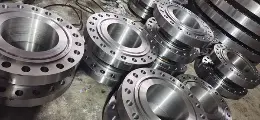
A socket weld flange (SW flange) is a forged flange with a recessed socket that accepts the end of a pipe. During installation, the pipe is inserted into the socket until it reaches a small expansion gap, typically 1.6 mm (1/16 inch) from the bottom. A fillet weld is then applied around the outside of the pipe, creating a permanent, high-strength connection capable of handling demanding operating conditions.
Socket weld flanges are normally used for pipe sizes up to NPS 2 (DN 50). For larger diameters, butt weld flanges are generally preferred because they provide full-penetration welds and are easier to inspect.
3.How Does a Socket Weld Flange Work?
The strength of a socket weld flange comes from both its mechanical design and its welding method.
Instead of butting the pipe directly against the flange face, the pipe is inserted into the machined socket until it reaches a controlled stop. Before welding, experienced fabricators intentionally pull the pipe back slightly to leave an expansion gap of approximately 1.6 mm (1/16 inch) between the pipe end and the bottom of the socket.
This small gap plays a critical role during welding. As heat is applied, the pipe expands. Without sufficient clearance, thermal expansion can force the pipe against the socket, creating residual stress that may lead to cracking or premature fatigue during service.
Once the correct gap is established, a continuous fillet weld is deposited around the outside circumference of the pipe, permanently securing it to the flange.
The installation sequence is straightforward:
Insert the pipe into the flange socket.
Withdraw the pipe approximately 1.6 mm (1/16 inch) to create the expansion gap.
Verify alignment and tack if necessary.
Complete the external fillet weld.
Inspect the weld according to project specifications.
Compared with threaded connections, this design provides significantly better leak resistance because there are no threaded sealing surfaces that can loosen under vibration or repeated thermal cycling.
4.ASTM A182 Socket Weld Flanges
Although the flange design is governed by ASME B16.5, the material itself is frequently specified according to ASTM A182, the industry standard covering forged or rolled alloy steel and stainless steel flanges, fittings, valves, and related components intended for high-temperature service.
Selecting the correct
ASTM A182 grade is just as important as choosing the right pressure class. The material determines corrosion resistance, temperature capability, weldability, and long-term service life.
The most commonly used grades include:
|
ASTM Grade
|
Material
|
Typical Applications
|
|
ASTM A182 F304
|
Austenitic stainless steel
|
Food processing, water treatment, general chemical service
|
|
ASTM A182 F316
|
Molybdenum-bearing stainless steel
|
Marine environments, offshore platforms, chemical processing
|
|
ASTM A182 F304L
|
Low-carbon stainless steel
|
Projects requiring extensive welding
|
|
ASTM A182 F316L
|
Enhanced corrosion resistance
|
Pharmaceutical, desalination, aggressive chemical media
|
|
ASTM A182 F11
|
Chromium-molybdenum alloy steel
|
High-temperature steam lines, power plants
|
|
ASTM A182 F22
|
Alloy steel
|
Refineries, boilers, high-pressure process piping
|
|
ASTM A182 F51
|
Duplex stainless steel
|
Offshore, seawater, chloride-rich environments
|
For non-stainless applications, ASTM A105 forged carbon steel remains the most widely used material for general industrial piping operating at ambient or moderately elevated temperatures. When low-temperature toughness is required, ASTM A350 LF2 is often selected instead.
5.Types of Socket Weld Flanges
Although the welding method is the same, socket weld flanges are manufactured with different facing designs to suit various sealing requirements.
The most common types include:
Raised Face (RF) Socket Weld Flange – The standard choice for most industrial piping systems, offering reliable gasket compression and sealing performance.
Flat Face (FF) Socket Weld Flange – Commonly paired with cast iron equipment or low-pressure systems where full-face gaskets are preferred.
Ring Type Joint (RTJ) Socket Weld Flange – Designed for extreme pressure and temperature service, using a precision-machined metal ring gasket to achieve superior sealing in critical applications.
Reducing Socket Weld Flange – Allows connection between different pipe sizes while maintaining a socket weld end connection, helping simplify compact piping layouts.
Orifice Socket Weld Flange – Used together with orifice plates for accurate flow measurement in instrumentation and process control systems.
Different flange types may share the same pressure class and material specification, but selecting the correct facing design is equally important for achieving reliable sealing performance under actual operating conditions.
6.Socket Weld Flange Pressure Ratings
One of the most common misconceptions is that a socket weld flange has a fixed pressure capacity. In reality, the allowable working pressure depends on the pressure class, material grade, operating temperature, and flange dimensions defined by ASME B16.5.
Socket weld flanges are available in six standard pressure classes:
|
Pressure Class
|
Typical Service
|
Common Applications
|
|
Class 150
|
Low-pressure service
|
Water, HVAC, utility piping
|
|
Class 300
|
Medium-pressure service
|
General process piping
|
|
Class 600
|
High-pressure service
|
Steam systems, refineries, chemical plants
|
|
Class 900
|
Severe operating conditions
|
High-pressure process lines
|
|
Class 1500
|
Very high-pressure service
|
Power generation, offshore production
|
|
Class 2500
|
Extreme pressure and temperature
|
Critical process and high-energy piping
|
Higher pressure classes generally feature thicker flange hubs, larger bolt sizes, and increased mechanical strength. However, a higher class does not automatically mean a higher allowable pressure under all conditions. As operating temperature increases, the pressure rating of every flange decreases according to the ASME B16.5 pressure-temperature tables.
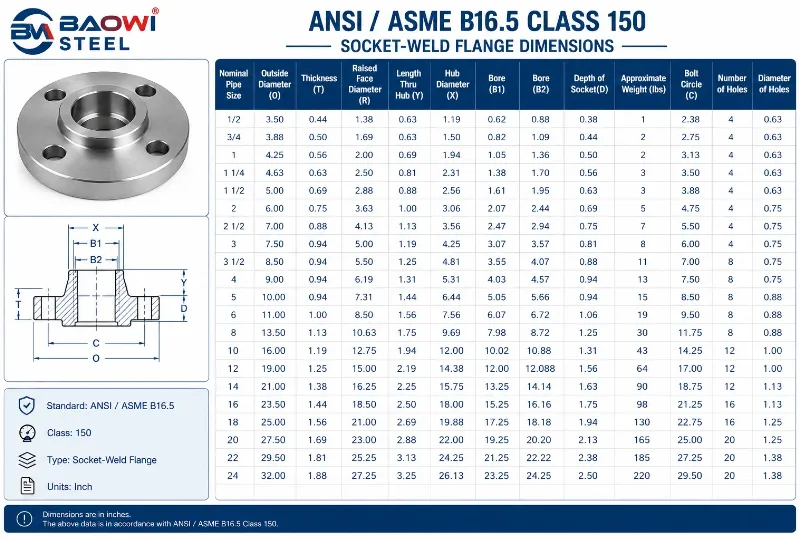
7.Socket Weld Flange Dimensions
The dimensions of socket weld flanges are standardized by ASME B16.5, ensuring interchangeability between manufacturers worldwide.
When reviewing a dimension chart, the most important parameters include:
Nominal Pipe Size (NPS)
Outside Diameter (OD)
Flange Thickness
Socket Bore Diameter
Hub Diameter
Raised Face Height
Bolt Circle Diameter (BCD)
Number and Diameter of Bolt Holes
Because the socket bore is machined to fit the outside diameter of the pipe, selecting the correct pipe schedule is equally important. A mismatch between the flange socket and the pipe outside diameter can affect fit-up quality and welding performance.
For projects outside ASME standards, socket weld flanges may also be manufactured according to DIN, EN, JIS, or GOST specifications depending on regional project requirements.
Although both flange types are commonly used in industrial piping, they are designed for different operating conditions.
|
Feature
|
Socket Weld Flange
|
Slip-On Flange
|
|
Typical Pipe Size
|
Up to NPS 2
|
All pipe sizes
|
|
Pipe Positioning
|
Pipe inserted into socket
|
Pipe slides through flange
|
|
Welding Method
|
Single external fillet weld
|
Internal and external fillet welds
|
|
Pressure Capability
|
Higher
|
Moderate
|
|
Alignment
|
Excellent
|
Good
|
|
Installation Cost
|
Slightly higher
|
Lower
|
|
Leak Resistance
|
Better
|
Good
|
9.Advantages and Limitations of Socket Weld Flanges
Like any piping connection, socket weld flanges offer significant advantages but also have application limits that should be considered during system design.
Advantages
Excellent leak-tight performance for high-pressure services.
Simple pipe alignment due to the machined socket.
No pipe end beveling required, reducing fabrication time.
High resistance to vibration and cyclic pressure loading.
Compact design suitable for confined installation spaces.
Lower welding preparation cost than butt weld flanges on small-diameter piping.
Limitations
Generally limited to NPS 2 and smaller.
Internal weld root cannot be fully inspected by radiography.
The socket clearance may create a crevice where corrosion can develop in aggressive environments.
Not recommended for hygienic, pharmaceutical, or slurry services where complete internal cleanliness is required.
Installation quality depends on maintaining the correct expansion gap before welding.
Frequently Asked Questions
What pipe sizes are socket weld flanges used for?
Socket weld flanges are typically used for piping from NPS 1/2 to NPS 2, where they provide excellent alignment and leak resistance.
Why is a 1.6 mm (1/16 inch) expansion gap required?
The gap allows the pipe to expand during welding, reducing residual stress and helping prevent weld cracking during long-term service.
Are socket weld flanges stronger than slip-on flanges?
For small-diameter, high-pressure piping, socket weld flanges generally provide better joint integrity and vibration resistance than slip-on flanges.
Can socket weld flanges be used for steam service?
Yes. They are widely used in steam systems when the appropriate pressure class and material grade are selected.
Why choose Baowi Steel for socket weld flanges?
Baowi Steel supplies ASME B16.5 socket weld flanges in ASTM A105, ASTM A182 stainless steel, duplex, and alloy steel. We provide Class 150–2500 flanges with EN 10204 3.1 certification, third-party inspection, and global delivery for industrial piping projects.

 English
 Español
 بالعربية
 Phone :
  Whatsapp :
  Email :