If you are looking for an
H beam size chart in mm, the most important point is that “H beam” is not one single standardized size series. European H sections are commonly classified as HEA, HEB and HEM, with different web and flange thicknesses even when the nominal size is similar.
This guide provides a practical H beam dimensions chart in mm, including section height, flange width, web thickness,
flange thickness and weight. It also explains how to read H beam dimensions, the differences between HEA, HEB and HEM, and what to check before ordering structural steel sections.
The dimensional data below follows the European EN 10365 designation system. For example, HEA 200 has an actual height of 190 mm, while HEB 200 has an actual height of 200 mm.
H Beam Size Chart in mm
The following table lists commonly specified European H beam sizes. Dimensions are given in millimeters unless otherwise stated.
HEA H Beam Dimensions
HEA is the lighter series of the European HE wide-flange sections. Its lower mass makes it useful where structural requirements can be met without the heavier HEB or HEM profiles.
|
H Beam Size
|
Height h (mm)
|
Flange Width b (mm)
|
Web Thickness tw (mm)
|
Flange Thickness tf (mm)
|
Weight (kg/m)
|
|
HEA 100
|
96
|
100
|
5
|
8
|
16.7
|
|
HEA 120
|
114
|
120
|
5
|
8
|
19.9
|
|
HEA 140
|
133
|
140
|
5.5
|
8.5
|
24.7
|
|
HEA 160
|
152
|
160
|
6
|
9
|
30.4
|
|
HEA 180
|
171
|
180
|
6
|
9.5
|
35.5
|
|
HEA 200
|
190
|
200
|
6.5
|
10
|
42.3
|
|
HEA 220
|
210
|
220
|
7
|
11
|
50.5
|
|
HEA 240
|
230
|
240
|
7.5
|
12
|
60.3
|
|
HEA 260
|
250
|
260
|
7.5
|
12.5
|
68.2
|
|
HEA 280
|
270
|
280
|
8
|
13
|
76.4
|
|
HEA 300
|
290
|
300
|
8.5
|
14
|
88.3
|
he important point is that the number in HEA 200 does not mean that the actual beam depth is exactly 200 mm. The actual height is 190 mm. This is one of the most common points to check when matching drawings, fabrication dimensions and purchase specifications.
HEB H Beam Dimensions
HEB is the standard or heavier European HE series. Compared with HEA at the same nominal designation, HEB generally has thicker webs and flanges and therefore a higher mass per meter.
|
H Beam Size
|
Height h (mm)
|
Flange Width b (mm)
|
Web Thickness tw (mm)
|
Flange Thickness tf (mm)
|
Weight (kg/m)
|
|
HEB 100
|
100
|
100
|
6
|
10
|
20.4
|
|
HEB 120
|
120
|
120
|
6.5
|
11
|
26.7
|
|
HEB 140
|
140
|
140
|
7
|
12
|
33.7
|
|
HEB 160
|
160
|
160
|
8
|
13
|
42.6
|
|
HEB 180
|
180
|
180
|
8.5
|
14
|
51.2
|
|
HEB 200
|
200
|
200
|
9
|
15
|
61.3
|
|
HEB 220
|
220
|
220
|
9.5
|
16
|
71.5
|
|
HEB 240
|
240
|
240
|
10
|
17
|
83.2
|
|
HEB 260
|
260
|
260
|
10
|
17.5
|
93
|
|
HEB 280
|
280
|
280
|
10.5
|
18
|
103.1
|
|
HEB 300
|
300
|
300
|
11
|
19
|
117
|
For example, a HEB 200 is 200 mm high and 200 mm wide, with a 9 mm web and 15 mm flange. Its nominal mass is approximately 61.3 kg/m.
HEM H Beam Dimensions
HEM is the heavy-duty series within the European HE family. It uses substantially thicker webs and flanges than HEA and HEB, resulting in much higher section mass and structural capacity.
|
H Beam Size
|
Height h (mm)
|
Flange Width b (mm)
|
Web Thickness tw (mm)
|
Flange Thickness tf (mm)
|
Weight (kg/m)
|
|
HEM 100
|
120
|
106
|
12
|
20
|
41.8
|
|
HEM 120
|
140
|
126
|
12.5
|
21
|
52.1
|
|
HEM 140
|
160
|
146
|
13
|
22
|
63.2
|
|
HEM 160
|
180
|
166
|
14
|
23
|
76.2
|
|
HEM 180
|
200
|
186
|
14.5
|
24
|
88.9
|
|
HEM 200
|
220
|
206
|
15
|
25
|
103.1
|
|
HEM 220
|
240
|
226
|
15.5
|
26
|
117.3
|
|
HEM 240
|
270
|
248
|
18
|
32
|
156.7
|
|
HEM 260
|
290
|
268
|
18
|
32.5
|
172.4
|
|
HEM 280
|
310
|
288
|
18.5
|
33
|
188.5
|
|
HEM 300
|
340
|
310
|
21
|
39
|
237.9
|
A particularly important detail is that HEM 300 is 340 mm high, so the nominal designation should not be interpreted as the actual overall height. Cross Section Properties
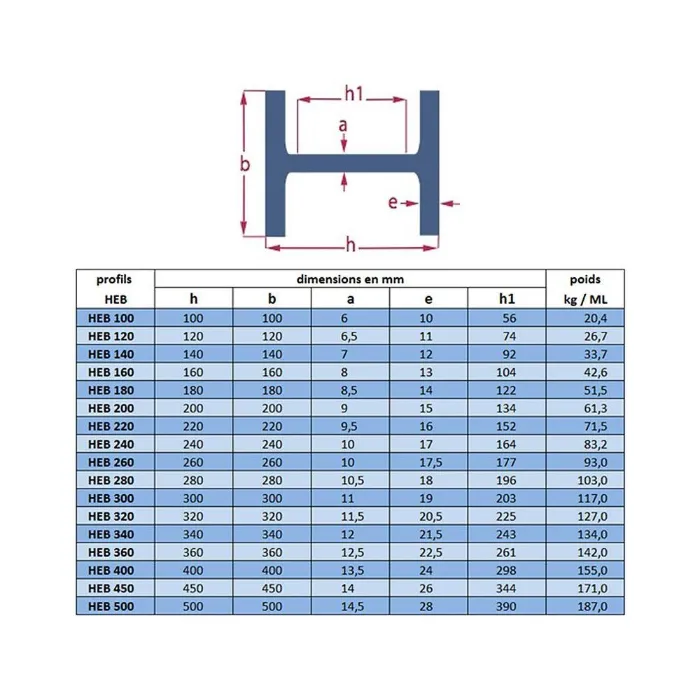
What Do H Beam Dimensions Mean?
An H beam size chart normally contains several dimensions rather than just the beam height.
The four dimensions most often required for purchasing and fabrication are:
- h = overall beam height
- b = flange width
- tw = web thickness
- tf = flange thickness
A typical H section can be represented as:
H × B × tw × tf
For example:
HEB 200 = 200 × 200 × 9 × 15 mm
This means:
- Height = 200 mm
- Flange width = 200 mm
- Web thickness = 9 mm
- Flange thickness = 15 mm
The section may also have a specified fillet radius (r) between the web and flange. This radius is important when preparing connections or checking fabrication clearances.
H Beam vs I Beam: What's the Difference?
H beams and I beams have similar cross-sectional shapes, but their proportions and applications can differ.
European HE sections have relatively wide flanges compared with many IPE sections. This gives H sections a substantial cross-sectional area and strong resistance about both principal axes.
An IPE 300, for example, is a different profile from an HEA 300 or HEB 300 even though the designation contains the number 300.
Therefore:
IPE 300 ≠ HEA 300 ≠ HEB 300
The dimensions, mass and section properties must be checked individually rather than assuming that the nominal number represents the same size.
H Beam Size in mm vs H Beam Weight
H beam buyers often need both dimensional and weight information.
The theoretical weight is normally expressed in kg/m.
For example:
- HEB 200 = 61.3 kg/m
- HEB 300 = 117.0 kg/m
- HEM 200 = 103.1 kg/m
To estimate the theoretical weight of a straight beam:
Total weight = weight per meter × beam length
For example, a 12 m HEB 200 has an approximate theoretical weight of:
61.3 × 12 = 735.6 kg
Actual delivered weight can differ depending on manufacturing tolerances, cutting, surface condition and the specific purchasing specification.
More related articles:
Difference Between C Channel and I Beam

 English
 Español
 بالعربية






 Phone :
  Whatsapp :
  Email :


