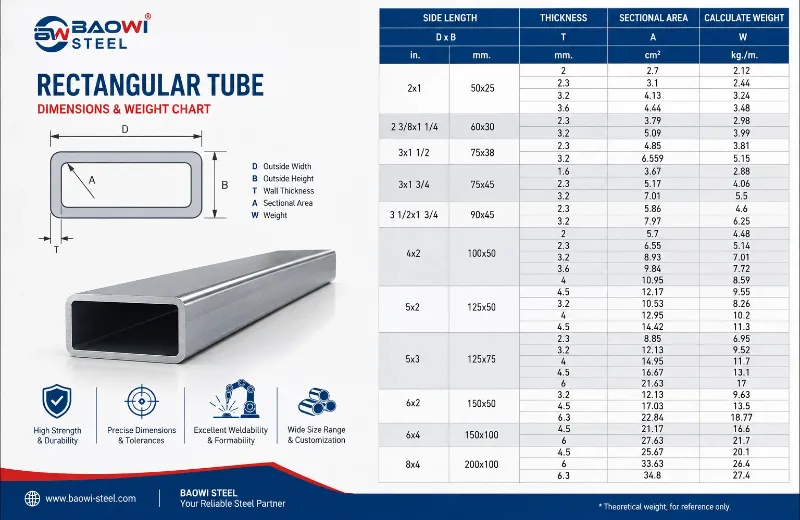
ASTM A513 rectangular tubes are available in a wide range of sizes to meet different mechanical and fabrication requirements. Although ASTM A513 does not specify a fixed dimensional chart, it covers electric resistance welded (ERW) mechanical tubing manufactured in various outside dimensions and wall thicknesses. Standard rectangular tube sizes typically range from 1 × 1.5 in. to 4 × 6 in. for stock products, while custom sizes can extend from 10 × 15 mm to 800 × 1100 mm, depending on the manufacturing process and mill capabilities. Wall thicknesses generally range from 0.020 in. (0.5 mm) to 1.000 in. (25 mm).For dimensions across multiple international standards and materials, see our
Standard Rectangular Tube Size Table.
ASTM A513 is the standard specification for electric resistance welded (
ERW) carbon and alloy steel mechanical tubing, including round, square, and rectangular shapes. Compared with ASTM A500 structural tubing, ASTM A513 places greater emphasis on dimensional accuracy, surface finish, and machinability, making it widely used in automotive components, machinery, agricultural equipment, conveyor systems, furniture, and other precision fabrication applications.
This guide provides standard ASTM A513 rectangular tube sizes, wall thicknesses, dimensions, specifications, and a comparison with ASTM A500 to help engineers, fabricators, and buyers select the right mechanical tubing for their applications.
ASTM A513 Rectangular Tube Sizes Chart
ASTM A513 rectangular tubing is manufactured in a wide range of outside dimensions and wall thicknesses. The standard itself specifies manufacturing requirements and tolerances rather than fixed dimensions, so available sizes may vary by manufacturer.
The following table lists some of the most commonly supplied ASTM A513 rectangular tube sizes.
|
Outside Dimensions (in.)
|
Wall Thickness (in.)
|
Approx. Weight (lb/ft)
|
|
1 × 1/2
|
0.065
|
0.7
|
|
1-1/2 × 1/2
|
0.065
|
0.82
|
|
1-1/2 × 3/4
|
0.065
|
0.94
|
|
1-1/2 × 3/4
|
0.083
|
1.18
|
|
1-1/2 × 1
|
0.065
|
1.05
|
|
1-1/2 × 1
|
0.083
|
1.32
|
|
2 × 1
|
0.065
|
1.3
|
|
2 × 1
|
0.12
|
2.25
|
|
2 × 2
|
0.12
|
2.93
|
|
2 × 3
|
0.12
|
3.53
|
|
2 × 4
|
0.188
|
7.35
|
|
2 × 6
|
0.25
|
11
|
|
3 × 4
|
0.25
|
13.2
|
|
4 × 6
|
0.25
|
16.9
|
ASTM A513 rectangular tubes are available in a wide range of outside dimensions and wall thicknesses for mechanical and fabrication applications. The ASTM A513 specification does not define a fixed list of standard rectangular tube sizes. Instead, available dimensions depend on the manufacturing process, steel grade, and mill capabilities. Common stock sizes range from small mechanical tubing to larger custom sections, with wall thicknesses available in both light-gauge and heavy-wall configurations.
Standard Wall Thickness of ASTM A513 Rectangular Tubes
ASTM A513 rectangular tubes are available in multiple wall thicknesses to satisfy different mechanical and fabrication requirements. Thinner walls help reduce weight and material costs, while heavier walls provide greater rigidity and load resistance for demanding applications.
Common wall thicknesses include:
|
Gauge
|
Wall Thickness
|
|
16 Gauge
|
0.065 in
|
|
14 Gauge
|
0.083 in
|
|
11 Gauge
|
0.120 in
|
|
3/16 in
|
0.188 in
|
|
1/4 in
|
0.250 in
|
|
5/16 in
|
0.313 in
|
|
3/8 in
|
0.375 in
|
For most mechanical fabrication projects, wall thicknesses between 0.065 in and 0.120 in are the most commonly used because they offer an excellent balance between strength, weight, and ease of machining. Heavier wall sections are typically selected for equipment frames, trailers, and industrial machinery that require additional stiffness.
ASTM A513 Size Range
A common misconception is that ASTM A513 provides a fixed list of standard rectangular tube dimensions. In practice, the specification establishes requirements for mechanical tubing rather than prescribing one universal rectangular tube size chart.
The actual size range available to buyers depends on the manufacturer, production equipment, steel grade, manufacturing type, and order quantity.
When specifying ASTM A513 rectangular tubing, buyers should normally provide four primary dimensions:
Outside Height (H)
Outside Width (W)
Wall Thickness (T)
Overall Length (L)
For example:
2 × 4 × 0.188 × 20 ft ASTM A513 Rectangular Tube
This designation describes a rectangular tube with:
2 in. outside height
4 in. outside width
0.188 in. wall thickness
20 ft overall length
For custom requirements, buyers should also specify the ASTM A513 type, steel grade, surface condition, dimensional tolerances, and any required mechanical or testing requirements.
ASTM A513 Specifications
ASTM A513 covers electric-resistance-welded (ERW) carbon and alloy steel mechanical tubing intended for applications that require precise dimensions, a smooth surface finish, and consistent mechanical performance. Unlike structural tubing specifications that focus on load-bearing capacity, ASTM A513 is designed for components that will be machined, fabricated, bent, or assembled into mechanical equipment.
The specification includes several manufacturing types, with Type 1 (As-Welded) and Type 5 (Drawn Over Mandrel, DOM) being the most widely used in industry.
Typical ASTM A513 rectangular tubing features include:
|
Specification
|
Description
|
|
Manufacturing Process
|
Electric Resistance Welded (ERW)
|
|
Product Shape
|
Rectangular, Square, Round, Special Shapes
|
|
Material
|
Carbon Steel / Low Alloy Steel
|
|
Surface Finish
|
Mill Finish or Light Oil Coating
|
|
Dimensional Accuracy
|
High
|
|
Weldability
|
Excellent
|
|
Machinability
|
Excellent
|
|
Formability
|
Good
|
One important point to understand is that ASTM A513 does not prescribe a fixed strength level for every tube. Mechanical properties depend on the steel grade and manufacturing type selected. For example, DOM tubing generally offers higher strength and better dimensional consistency than standard as-welded tubing.
ASTM A513 Type 1 vs Type 5
ASTM A513 includes different tubing types based on the manufacturing process and material condition. Two commonly specified types are Type 1 and Type 5.
|
Feature
|
ASTM A513 Type 1
|
ASTM A513 Type 5
|
|
Manufacturing
|
As-Welded
|
Drawn Over Mandrel (DOM)
|
|
Main Process
|
ERW
|
ERW + Cold Drawing
|
|
Dimensional Accuracy
|
Good
|
Higher
|
|
Surface Quality
|
Standard
|
Smoother
|
|
Typical Use
|
General Mechanical Fabrication
|
Precision Mechanical Components
|
|
Cost
|
Generally Lower
|
Generally Higher
|
ASTM A513 Type 1 and Type 5 are both electric-resistance-welded (ERW) mechanical steel tubing, but they differ significantly in their manufacturing processes, dimensional accuracy, surface condition, and typical applications.
ASTM A513 Type 1 is as-welded hot-rolled electric-resistance-welded (HREW) tubing. It retains the welded condition after forming and is typically supplied with standard dimensional tolerances and a mill or scaly surface finish. Type 1 is generally selected for general mechanical fabrication where moderate dimensional accuracy and cost efficiency are more important than a highly finished surface.
ASTM A513 Type 5 is Drawn Over Mandrel (DOM) tubing. After the initial ERW process, the tube undergoes a cold-drawing operation over a mandrel. This additional processing improves dimensional accuracy, surface smoothness, concentricity, and mechanical consistency. Type 5 DOM tubing is therefore commonly used for precision mechanical components, machining, forming, and applications requiring tighter dimensional control.
ASTM A513 vs ASTM A500: What's the Difference?
Although ASTM A513 and ASTM A500 are both commonly manufactured using the ERW process, they are designed for different purposes. Choosing the correct specification depends on whether your project requires precision or structural performance.
|
Feature
|
ASTM A513
|
ASTM A500
|
|
Primary Use
|
Mechanical Tubing
|
Structural Tubing
|
|
Main Priority
|
Dimensional Accuracy
|
Structural Strength
|
|
Manufacturing
|
ERW
|
ERW
|
|
Surface Finish
|
Smooth
|
Standard Mill Finish
|
|
Dimensional Tolerance
|
Tight
|
Standard
|
|
Typical Applications
|
Machinery, Automotive, Equipment
|
Buildings, Bridges, Steel Structures
|
In practical applications, ASTM A513 is often selected when accurate outside dimensions are essential, such as for machine frames, conveyor systems, agricultural equipment, or automotive components. Tight tolerances help reduce machining time and improve assembly accuracy.
By contrast, ASTM A500 is the preferred choice for load-bearing structures, including columns, building frames, sign supports, and other structural members where yield strength and structural performance are the primary design considerations.
If your project involves fabrication rather than structural engineering, ASTM A513 is generally the more suitable option.
How to Choose an ASTM A513 Rectangular Tube Size ?
Selecting the correct ASTM A513 rectangular tube size depends on more than the outside dimensions. Engineers and fabricators should consider the following factors:
1. Outside Dimensions
The height and width determine the overall envelope of the tube and must match the available installation or assembly space.
2. Wall Thickness
Wall thickness affects the tube's weight, stiffness, resistance to deformation, and machining requirements. A thicker wall is generally selected when greater rigidity is required.
3. Material and Mechanical Properties
The selected steel grade affects strength, ductility, weldability, and other mechanical properties. The required grade should be matched to the intended application.
4. Manufacturing Type
ASTM A513 tubing is available in different manufacturing types. As-welded tubing is commonly used for general mechanical fabrication, while DOM tubing provides tighter dimensional control and improved surface characteristics for more demanding applications.
For example, a 2 × 4 × 0.188 in. rectangular tube may be selected for a machine frame when greater rigidity is required than a lighter-wall section can provide. The final size should always be determined based on the actual loading, span, connection method, and design requirements.

 English
 Español
 بالعربية
 Phone :
  Whatsapp :
  Email :


