Ductile iron pipe (DIP) has become the main pipe material for buried pipelines in urban water supply, fire protection, and industrial water transmission due to its advantages such as high strength, good toughness, and strong corrosion resistance. However, no matter how reliable the pipe material itself is, the safety of the pipeline system always depends on whether the pressure is controlled - overpressure will cause the pipe to burst, underpressure will affect the water supply, and hidden pressure drops often mean leakage.The pressure gauge on the ductile iron pipe is the only eye on this "underground lifeline".
What Is Ductile Iron Pipe Pressure Rating?
The pressure rating of ductile iron pipes refers to the maximum allowable working pressure (PFA) that a pipe system can safely withstand under normal operating conditions.
In addition, engineers design pressure systems based on:
Internal water pressure
Water hammer effect
Soil load and external forces
Safety factors defined by ISO/EN standards
Unlike burst pressure, pressure rating focuses on long-term safe operation, not failure limits.
Definition of AWWA C150
Many people confuse AWWA C150 and AWWA C151, but these standards serve different purposes.
AWWA C150
AWWA C150 provides the design methodology for calculating the thickness of ductile iron pipes. It considers operating pressure, surge pressure, trench conditions, and external loading requirements.
AWWA C151
AWWA C151 (ANSI/AWWA C151/A21.51) is the manufacturing standard for centrifugally cast ductile iron pressure pipe. It establishes requirements for dimensions, wall thickness, material properties, testing procedures, and quality control.
AWWA C151 (full name: ANSI/AWWA C151/A21.51) is a manufacturing standard for ductile iron pipes developed by the American Water Association. It mainly specifies the dimensions, wall thickness, weight, material properties, testing requirements, and acceptance standards for centrifugally cast ductile iron pressure pipes.Main Requirements of AWWA C151:
|
Item
|
Description
|
|
Material
|
Ductile iron
|
|
Manufacturing Process
|
Centrifugally cast
|
|
Pipe Size Range
|
3 in. to 64 in. (DN80–DN1600)
|
|
Pressure Classes
|
150, 200, 250, 300, 350
|
|
Joint Types
|
Push-on, Mechanical, Flanged
|
|
Testing
|
Hydrostatic pressure test
|
|
Quality Control
|
Inspection and acceptance requirements
|
|
Applications
|
Water supply, wastewater, reclaimed water
|
Ductile Iron Pipe Pressure Rating Chart ( AWWA C150)
The following table shows commonly used pressure classes based on AWWA C150.
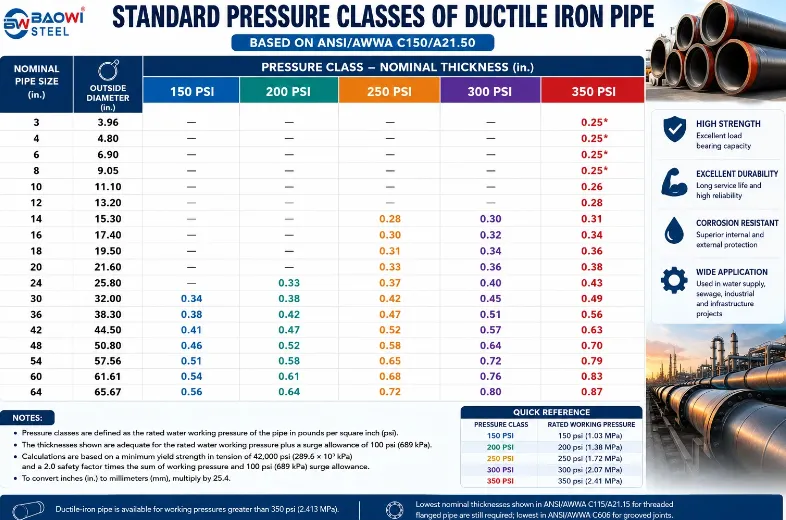
In addition to pressure ratings, pipe dimensions are also critical for system design and selection.You can view the full detailed size table and technical specifications here:Ductile Iron Pipe Size Chart and Specifications
This section covers standard DN sizes, wall thickness, weight, and manufacturing standards based on ISO 2531 and EN 545.
Pressure advantages of ductile iron pipes
One of the biggest advantages of ductile iron pipe is its ability to withstand high operating pressures and sudden pressure surges.
Compared with many alternative piping materials, ductile iron provides significantly higher tensile strength, yield strength, and impact resistance. This strength allows the pipeline to maintain structural integrity even under challenging operating conditions.
Factory Hydrostatic Testing Ensures Reliability
The long-term reliability of ductile iron pipe begins during manufacturing.
Every pipe produced according to AWWA C151 undergoes rigorous hydrostatic pressure testing before lining and coating operations. The test pressure typically reaches at least 500 psi, far exceeding the pressure levels encountered during normal system operation.
This stringent testing process helps identify:
Internal cracks
Pinholes
Casting defects
Structural imperfections
Any pipe that fails to meet quality requirements is removed from production before shipment.
Higher Testing Standards Than Field Testing
After installation, pipeline systems generally undergo field hydrostatic testing at pressures between 150 psi and 200 psi.
Because factory testing is substantially higher than field testing, every ductile iron pipe effectively undergoes an additional safety verification before leaving the manufacturer.
As a result, project owners gain greater confidence in:
Pipeline safety
Pressure resistance
Leak prevention
Long-term service life
This combination of material strength and rigorous quality control is one of the key reasons why ductile iron pipe remains the preferred choice for critical water infrastructure worldwide.
Hydraulic Test of Ductile Iron Pipe
Water pressure testing is an essential step in the installation of ductile iron water supply pipelines. The pressure test verifies the sealing and pressure-bearing capacity of the pipeline system, ensuring that no leaks or pipe bursts occur during later use, and guaranteeing the safety and stability of the water supply.
Before the test, three basic tasks must be completed: Both ends of the pipeline must be tightly sealed with blind flanges; the concrete strength of supports, anchor blocks, and other fixing facilities must reach at least 90% of the design value; and the rubber rings at pipe connections must be fully embedded in the socket, with the exposed length of the joint not exceeding 5mm.
|
Item
|
Technical Requirement
|
|
Working Pressure
|
0.6 MPa / 0.8 MPa / 1.0 MPa (standard grades)
|
|
Test Pressure
|
1.5 × working pressure
|
|
Holding Time
|
Not less than 30 minutes
|
|
Allowable Pressure Drop
|
≤ 0.02 MPa
|
|
Acceptance Standard
|
GB/T 132 “Ductile Iron Pipes, Fittings and Accessories for Water and Gas” or project-specific design requirements
|
|
Special Conditions
|
In high elevation or complex terrain areas, test pressure shall be recalculated separately
|
|
Auxiliary Testing
|
Air pressure test may be added when necessary as supplementary inspection method
|
More related articles:
What Are Ductile Iron Pipes? A Comprehensive Guide
What is a ductile iron pipe used for?

 English
 Español
 بالعربية
 Phone :
  Whatsapp :
  Email :


