Nominal Pipe Size (NPS) Chart: Dimensions, DN, NB, OD & Pipe Schedule Guide
Choosing the correct pipe size is essential for pipeline design, fluid transportation, pressure calculations, and selecting compatible fittings. However, many engineers, buyers, and contractors are often confused by terms such as Nominal Pipe Size (NPS), Nominal Bore (NB), and Diameter Nominal (DN) because these designations do not represent the actual pipe dimensions.
For example, a 2-inch NPS pipe does not have an outside diameter of exactly 2 inches. Instead, it has a standardized outside diameter of 2.375 inches (60.3 mm), while its inside diameter changes depending on the pipe schedule (wall thickness).
What Is Nominal Pipe Size (NPS)?
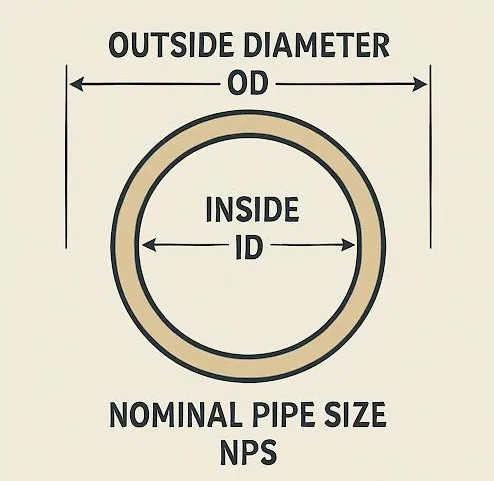
Nominal Pipe Size (NPS) is the standard sizing system used primarily in North America to identify steel pipe sizes. Rather than representing the pipe's exact inside or outside diameter, NPS is a nominal (reference) designation that corresponds to a standardized outside diameter (OD).
Unlike tubing, where the stated size usually matches the outside diameter, steel pipes use a nominal sizing system because different wall thicknesses can share the same outside diameter.
Why Is It Called "Nominal"?
The word nominal means in name only or approximately designated rather than representing an exact measurement.
Historically, early steel pipes were identified by their approximate inside diameter because fluid capacity depended primarily on the bore. As manufacturing technology evolved and different wall thicknesses became available, the outside diameter was standardized while the inside diameter varied.
As a result:
Pipe Size = Standard Outside Diameter + Variable Wall Thickness
Therefore:
Outside Diameter (OD) remains fixed
Wall Thickness depends on Schedule
Inside Diameter (ID) changes accordingly
NPS remains the same
This system simplifies manufacturing and ensures compatibility across fittings, valves, supports, and piping components.
Understanding Pipe Dimensions
Before selecting a pipe, it is important to understand the four dimensions commonly used in piping systems.
|
Term
|
Meaning
|
Changes with Schedule?
|
Used For
|
|
NPS
|
Nominal Pipe Size
|
No
|
Pipe designation
|
|
OD
|
Outside Diameter
|
No
|
Fittings, flanges, supports
|
|
Wall Thickness
|
Pipe wall thickness
|
Yes
|
Pressure rating
|
|
ID
|
Inside Diameter
|
Yes
|
Flow capacity
|
The relationship between these dimensions can be expressed as:
Inside Diameter = Outside Diameter − (2 × Wall Thickness)
This simple formula explains why two pipes with the same NPS can have different internal flow capacities.
NPS, NB and DN – What's the Difference?
One of the most common questions is whether NPS, NB, and DN refer to the same pipe size.
Although these terms are closely related, they originate from different standards and regions.
|
Term
|
Full Name
|
Unit
|
Primary Region
|
|
NPS
|
Nominal Pipe Size
|
Inch
|
North America
|
|
NB
|
Nominal Bore
|
Inch
|
UK, Australia, Asia
|
|
DN
|
Diameter Nominal
|
Millimetres
|
Europe & ISO countries
|
Nominal Pipe Size (NPS)
NPS is defined by ASME standards and is widely used in the United States, Canada, and industries following ASTM or API specifications.
Examples include:
API 5L Line Pipe
ASTM A53 Pipe
ASTM A106 Pipe
ASME Pressure Piping
Diameter Nominal (DN)
DN is the international metric designation defined by ISO standards.
Unlike NPS, DN uses metric numbers such as:
DN15
DN20
DN50
DN100
However, DN values are still nominal rather than actual measured diameters.
For instance:
DN50 corresponds approximately to NPS 2
DN100 corresponds approximately to NPS 4
The actual outside diameter is determined by the corresponding NPS standard.
NPS to DN Conversion Chart
The following chart provides the most commonly used conversions between North American and metric pipe size designations.
|
NPS (inch)
|
DN (mm)
|
NB
|
Outside Diameter (mm)
|
|
1/8
|
DN6
|
6 NB
|
10.3
|
|
1/4
|
DN8
|
8 NB
|
13.7
|
|
3/8
|
DN10
|
10 NB
|
17.1
|
|
1/2
|
DN15
|
15 NB
|
21.3
|
|
3/4
|
DN20
|
20 NB
|
26.7
|
|
1
|
DN25
|
25 NB
|
33.4
|
|
1¼
|
DN32
|
32 NB
|
42.2
|
|
1½
|
DN40
|
40 NB
|
48.3
|
|
2
|
DN50
|
50 NB
|
60.3
|
|
2½
|
DN65
|
65 NB
|
73
|
|
3
|
DN80
|
80 NB
|
88.9
|
|
4
|
DN100
|
100 NB
|
114.3
|
|
6
|
DN150
|
150 NB
|
168.3
|
|
8
|
DN200
|
200 NB
|
219.1
|
|
10
|
DN250
|
250 NB
|
273.1
|
|
12
|
DN300
|
300 NB
|
323.9
|
Note: DN values are nominal metric designations and should not be interpreted as actual outside or inside diameters. Always refer to
ASME B36.10M or ASME B36.19M dimensions when specifying pipe sizes.
Nominal Pipe Size Chart (Standard Dimensions)
The following chart lists the standard outside diameters for the most commonly used Nominal Pipe Sizes.
|
NPS
|
DN
|
Outside Diameter (in)
|
Outside Diameter (mm)
|
|
1/8
|
6
|
0.405
|
10.3
|
|
1/4
|
8
|
0.54
|
13.7
|
|
3/8
|
10
|
0.675
|
17.1
|
|
1/2
|
15
|
0.84
|
21.3
|
|
3/4
|
20
|
1.05
|
26.7
|
|
1
|
25
|
1.315
|
33.4
|
|
1¼
|
32
|
1.66
|
42.2
|
|
1½
|
40
|
1.9
|
48.3
|
|
2
|
50
|
2.375
|
60.3
|
|
2½
|
65
|
2.875
|
73
|
|
3
|
80
|
3.5
|
88.9
|
|
4
|
100
|
4.5
|
114.3
|
|
5
|
125
|
5.563
|
141.3
|
|
6
|
150
|
6.625
|
168.3
|
|
8
|
200
|
8.625
|
219.1
|
|
10
|
250
|
10.75
|
273.1
|
|
12
|
300
|
12.75
|
323.9
|
Important: For NPS sizes up to 12 inches, the outside diameter is larger than the nominal size. From NPS 14 (DN350) and above, the nominal size and outside diameter are numerically the same in inches, a historical convention retained in modern piping standards.
How Pipe Schedule Affects Nominal Pipe Size ?
One of the biggest misconceptions about Nominal Pipe Size (NPS) is that all pipes with the same NPS have the same inside diameter. In reality, while the outside diameter (OD) remains constant, the inside diameter (ID) changes according to the pipe schedule.
A pipe schedule refers to the wall thickness of a pipe. Higher schedule numbers indicate thicker walls, resulting in a smaller inside diameter and a higher pressure rating.
For example, a 2-inch NPS pipe has a fixed outside diameter of 2.375 inches (60.3 mm) regardless of the schedule. However, the inside diameter decreases as the wall becomes thicker.
|
NPS
|
Schedule
|
Wall Thickness (in)
|
Inside Diameter (in)
|
Outside Diameter (in)
|
|
2
|
Sch 10
|
0.109
|
2.157
|
2.375
|
|
2
|
Sch 40
|
0.154
|
2.067
|
2.375
|
|
2
|
Sch 80
|
0.218
|
1.939
|
2.375
|
|
2
|
Sch 160
|
0.344
|
1.687
|
2.375
|
NPS does not determine the wall thickness.
Pipe Schedule determines the pressure capability.
Outside diameter remains unchanged for the same NPS.
Inside diameter decreases as wall thickness increases.
This standardized system ensures that valves, flanges, fittings, clamps, and supports remain compatible across different pressure classes.
Nominal Pipe Size vs Actual Pipe Size
Many first-time buyers expect a 2-inch pipe to measure exactly 2 inches across its outside diameter. However, this is one of the most common misunderstandings in the piping industry.
The following table compares nominal pipe sizes with their actual outside diameters.
|
Nominal Pipe Size (NPS)
|
Actual Outside Diameter
|
|
1/2"
|
0.840" (21.3 mm)
|
|
3/4"
|
1.050" (26.7 mm)
|
|
1"
|
1.315" (33.4 mm)
|
|
2"
|
2.375" (60.3 mm)
|
|
3"
|
3.500" (88.9 mm)
|
|
4"
|
4.500" (114.3 mm)
|
|
6"
|
6.625" (168.3 mm)
|
|
8"
|
8.625" (219.1 mm)
|
|
10"
|
10.750" (273.1 mm)
|
|
12"
|
12.750" (323.9 mm)
|
Why Are They Different?
Historically, pipe sizes were based on the approximate inside diameter because flow capacity was the primary concern. As manufacturing evolved and multiple wall thicknesses became available, the outside diameter was standardized to maintain compatibility with fittings and accessories.
This is why the nominal size no longer matches the actual measured diameter for most pipe sizes.
Note: From NPS 14 (DN350) and above, the nominal pipe size and outside diameter are numerically the same in inches.
Pipe Schedule Chart (Common Wall Thickness)
The following chart lists the most commonly used pipe schedules and their typical applications.
|
Pipe Schedule
|
Relative Wall Thickness
|
Typical Applications
|
|
Sch 5
|
Very Thin
|
Low-pressure stainless steel systems
|
|
Sch 10
|
Thin
|
Water supply, food processing, HVAC
|
|
Sch 20
|
Light
|
Drainage and low-pressure piping
|
|
Sch 40 (STD)
|
Standard
|
General industrial and construction piping
|
|
Sch 80 (XS)
|
Heavy
|
High-pressure oil & gas, steam, chemical plants
|
|
Sch 120
|
Extra Heavy
|
High-pressure industrial systems
|
|
Sch 160
|
Very Heavy
|
Refineries, power plants, offshore projects
|
|
XXS
|
Double Extra Strong
|
Extreme pressure applications
|
Common NPS Questions
Is NPS the same as pipe diameter?
No.NPS is a nominal pipe size designation. It does not directly represent the actual OD or ID.For example, NPS 2 has an actual OD of 2.375 inches.
Does NPS determine pipe wall thickness?
No.The pipe schedule determines the standardized wall thickness for a given NPS.
Does NPS change when the schedule changes?
No.An NPS 2 Schedule 40 pipe and an NPS 2 Schedule 80 pipe both remain NPS 2.
Does pipe OD change with schedule?
For a given NPS, the standard OD remains the same while wall thickness changes.
What is NPS 2 in DN?
NPS 2 corresponds approximately to DN 50.
What is NPS 4 in DN?
NPS 4 corresponds approximately to DN 100.
Is DN 50 exactly 50 mm?
No.DN is a nominal designation and should not be interpreted as an actual measured pipe diameter.
Is NPS the same as NB?
NPS and NB are related nominal pipe size designations. In many applications, NB is used as an alternative nominal bore designation.However, actual pipe dimensions should always be checked against the applicable standard.
Why is a 2-inch pipe actually 2.375 inches?
The NPS system uses nominal size designations rather than directly specifying the actual outside diameter. The standardized OD for NPS 2 is 2.375 inches.

 English
 Español
 بالعربية






 Phone :
  Whatsapp :
  Email :