API 5L and
ASTM A106 are both widely used carbon steel pipe standards, but they are designed for different purposes. The main difference is that API 5L is mainly used for oil and gas pipeline transportation, while ASTM A106 is designed for
seamless carbon steel pressure pipes used in high-temperature services.
Although API 5L Grade B and ASTM A106 Grade B pipes have similar mechanical properties, they are not interchangeable in all applications. API 5L focuses on pipeline transportation requirements, including PSL1 and PSL2 specifications, while ASTM A106 focuses on pressure resistance and high-temperature performance.
When selecting between API 5L vs ASTM A106 seamless pipe, engineers and buyers should consider the service environment, operating temperature, pressure requirements, pipeline standards, and project specifications.
What is ASTM A106 Pipe?
ASTM A106 pipe is a seamless carbon steel pipe specification developed for high-temperature pressure service. It is commonly used in industries such as oil refineries, petrochemical plants, power generation facilities, and industrial piping systems.ASTM A106, established by the American Society for Testing and Materials (
ASTM), is the "Standard Specification for Seamless Carbon Steel Pipe for High-Temperature Service."
Applicable exclusively to seamless pipe manufacturing, it is designed for high-temperature and high-pressure operating conditions, emphasizing high-temperature creep strength, thermal stability, and rupture strength. It is a benchmark standard for power plants, refineries, boilers, and steam systems, and corresponds widely to ASME SA-106 for use in pressure vessel and pressure piping applications. ASTM A106 only covers seamless carbon steel pipes, which are manufactured without welded joints. This makes A106 pipes suitable for applications requiring high pressure resistance, excellent mechanical strength, and reliable performance under elevated temperatures.
API 5L Pipe
API 5L pipe is a steel pipe specification developed by the American Petroleum Institute (API) for pipeline transportation systems in the oil and natural gas industries.API 5L Line Pipe Standard
Developed by the American Petroleum Institute (API), API 5L—officially titled "Specification for Line Pipe"—primarily addresses steel pipes used for the long-distance transport of oil, gas, and water. Covering both seamless and welded steel pipes, the standard emphasizes pressure ratings, low-temperature toughness, field serviceability, weldability, and pipeline integrity. It is the prevailing global standard for oil and gas gathering systems, trunklines, and subsea pipelines. The standard categorizes products into two levels—PSL1 and PSL2—with PSL2 imposing stricter mandatory requirements regarding impurity control, impact toughness, carbon equivalent, and non-destructive testing.
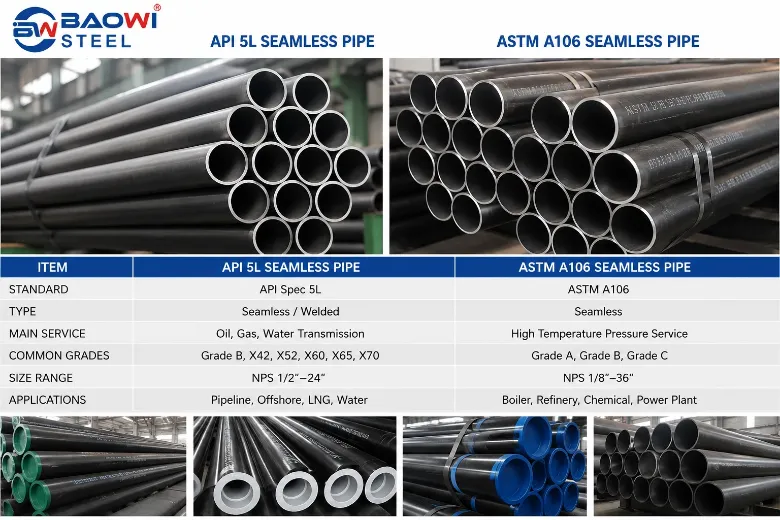
API 5L vs ASTM A106 Comparison Table
The following table shows the main differences between API 5L and ASTM A106 seamless pipe:
|
Comparison
|
API 5L
|
ASTM A106
|
|
Standard
|
API 5L
|
ASTM A106
|
|
Main Purpose
|
Pipeline transportation
|
Pressure piping
|
|
Industry
|
Oil & gas transmission
|
Refinery, power plant, petrochemical
|
|
Pipe Type
|
Seamless and welded
|
Seamless only
|
|
Grades
|
B, X42-X80
|
A, B, C
|
|
PSL Classification
|
PSL1 / PSL2
|
No PSL classification
|
|
Temperature Service
|
Pipeline transportation
|
High-temperature service
|
|
Manufacturing
|
Seamless, ERW, LSAW, SSAW
|
Seamless
|
|
Common Grade
|
API 5L Grade B
|
ASTM A106 Grade B
|
1.Manufacturing Process Difference Between API 5L and ASTM A106 Pipe
The manufacturing process is another important difference between API 5L pipe and ASTM A106 pipe.
Although both standards may include seamless steel pipes, API 5L has a wider manufacturing range because it covers both seamless and welded line pipes. ASTM A106, however, is limited to seamless carbon steel pipes for pressure and high-temperature applications.
2.Chemical Composition Comparison: API 5L vs ASTM A106
Chemical composition is another area where API 5L and ASTM A106 have different requirements.
ASTM A106 is designed for high-temperature pressure service, while API 5L focuses on pipeline performance, weldability, and strength requirements.
API 5L Grade B vs ASTM A106 Grade B Chemical Composition
|
Element
|
API 5L Grade B
|
ASTM A106 Grade B
|
|
Carbon (C)
|
≤0.28%
|
≤0.30%
|
|
Manganese (Mn)
|
≤1.20%
|
0.29-1.06%
|
|
Phosphorus (P)
|
≤0.030%
|
≤0.035%
|
|
Sulfur (S)
|
≤0.030%
|
≤0.035%
|
|
Silicon (Si)
|
≤0.45%
|
≥0.10%
|
3.API 5L Grade B vs ASTM A106 Grade B
Are API 5L Grade B and ASTM A106 Grade B the Same?
This is one of the most searched questions related to API 5L vs ASTM A106.
No. API 5L Grade B and ASTM A106 Grade B are not the same standard, although their mechanical properties are very similar.
Both grades are widely used carbon steel pipes, but they serve different purposes:
API 5L Grade B : designed for pipeline transportation
ASTM A106 Grade B: designed for high-temperature pressure piping
|
Property
|
API 5L Grade B
|
ASTM A106 Grade B
|
|
Standard
|
API 5L
|
ASTM A106
|
|
Product Type
|
Line pipe
|
Pressure pipe
|
|
Manufacturing
|
Seamless and welded
|
Seamless
|
|
Yield Strength
|
Approx. 245 MPa
|
Approx. 240 MPa
|
|
Tensile Strength
|
Approx. 415 MPa
|
Approx. 415 MPa
|
|
Main Application
|
Oil and gas pipelines
|
Refinery and process piping
|
Although the strength values are close, the selection should be based on the required standard and application rather than mechanical properties alone.
4.Differences in Manufacturing Processes, Dimensions, and Smelting Requirements
4.1. Manufacturing Process Limitations
ASTM A106: Strictly seamless; produced only via hot-rolling or cold-drawing processes. The pipe body has no welded joints, making it suitable for boiler and heat exchanger applications involving frequent thermal cycling and eliminating the risk of high-temperature weld cracking.
API 5L: Supports both seamless and welded pipe production. Large-diameter long-distance trunk lines typically utilize submerged-arc welded (SAW) pipe, while small-diameter branch lines use seamless pipe, meeting the need for cost-effective, high-volume, long-distance oil and gas transport.
4.2. Smelting and Deoxidation Requirements (Key Distinction)
ASTM A106: Mandates the use of killed steel with a minimum silicon content of 0.10%. Silicon acts as a strong deoxidizer to eliminate gas bubbles within the steel, significantly enhancing high-temperature oxidation resistance and thermal stability—the metallurgical foundation for A106's high-temperature performance.
API 5L: No mandatory minimum silicon content; designed based on low-carbon micro-alloying principles. It prioritizes low-temperature impact toughness and weldability, resulting in lower long-term high-temperature service stability compared to A106.
4.3. Size Range Coverage
ASTM A106: NPS 1/2″ to 26″ (OD 13.7–660 mm); wall thicknesses ranging from SCH10, SCH40 to SCH160, including XS and XXS. Primarily used for small-to-medium diameter high-pressure, high-temperature process piping.
API 5L: Extremely broad size range, spanning from NPS 1/8″ to ultra-large diameters of 80 inches. Capable of meeting full-scale requirements for municipal networks, inter-provincial trunk lines, and high-capacity subsea pipelines.
More related articles
API 5L vs ASTM A106 Seamless Pipe
API 5L VS API 5CT

 English
 Español
 بالعربية
 Phone :
  Whatsapp :
  Email :