Rectangular tubes, also known as rectangular hollow sections (RHS) or rectangular steel tubes, are one of the most commonly used structural steel profiles in construction and industrial applications. Unlike round pipes and square hollow sections, rectangular tubes feature an asymmetric width-to-height cross-section, providing excellent bending strength, high structural stability, and flexible design options.
The Rectangular Tube Weight Chart is an essential reference for engineers, fabricators, contractors, and steel buyers when calculating material requirements, estimating project costs, checking load capacity, and planning cutting operations. The theoretical weights listed in this article are based on commonly used structural steel standards, including GB/T 6728-2017 Cold-Formed Steel Sections, and cover popular rectangular tube sizes used in residential, commercial, and industrial projects.
In this guide, you will find a complete rectangular tube weight chart, weight calculation formula, size selection tips, and practical considerations to help you choose the right rectangular steel tube for your application.
Basic Parameters of Rectangular Hollow Section (RHS)
The weight of a rectangular hollow section (RHS) is mainly determined by its cross-sectional dimensions and wall thickness. In international steel standards, rectangular tubes are commonly specified by the format:
Length × Width × Wall Thickness (mm)
For example, 100 × 50 × 3.0 mm represents a rectangular steel tube with a 100 mm long side, 50 mm short side, and 3.0 mm wall thickness.
For standard rectangular hollow sections, the outside dimensions remain fixed while different wall thickness options are available. A thicker wall generally results in higher unit weight, greater load-bearing capacity, improved structural strength, and better resistance to deformation.
Common Parameter Definitions
1. Section Dimensions
Section dimensions refer to the outside length and width measurements of the rectangular tube. They define the basic profile size and directly affect the section properties, including bending strength and structural stability.
2. Wall Thickness
Wall thickness indicates the thickness of the steel tube wall. Common rectangular tube wall thicknesses include 1.5 mm, 2.0 mm, 2.5 mm, 3.0 mm, 4.0 mm, 5.0 mm, and 6.0 mm. Increasing wall thickness improves strength but also increases material weight.
3. Theoretical Weight
Theoretical weight refers to the calculated weight of the rectangular tube per meter (kg/m) under standard conditions. It is widely used for material estimation, transportation planning, structural load calculations, and project cost evaluation.
4. Material Grades
Common rectangular hollow section materials include:
Q235B carbon steel – widely used for general structural applications;
Q355B low-alloy high-strength steel – provides higher yield strength for heavy-duty structures.
For galvanized rectangular tubes, the theoretical weight is slightly higher than bare carbon steel tubes because of the additional zinc coating layer.
Rectangular Tube Weight Chart
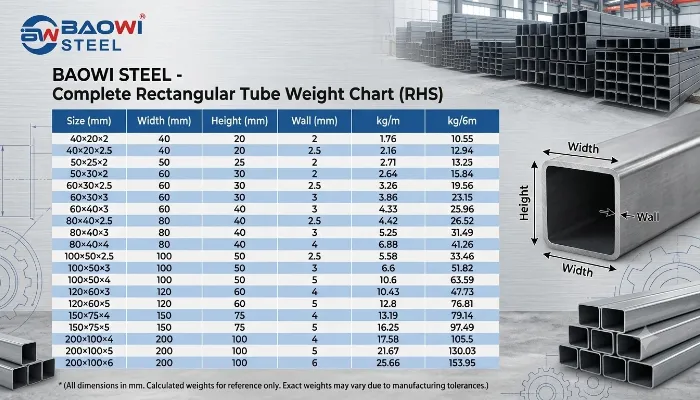
The following chart shows common rectangular steel tube sizes and theoretical weights based on standard carbon steel density.
|
Length × Width × Wall Thickness (mm)
|
per meter (kg/m)
|
(Length × Width × Wall Thickness, mm)
|
per meter (kg/m)
|
|
40×20×1.5
|
1.38
|
120×60×3.0
|
8.64
|
|
40×20×2.0
|
1.78
|
120×60×4.0
|
11.28
|
|
50×30×1.5
|
1.79
|
120×80×3.0
|
9.54
|
|
50×30×2.0
|
2.32
|
120×80×4.0
|
12.48
|
|
60×40×2.0
|
2.83
|
150×80×3.0
|
11.04
|
|
60×40×2.5
|
3.46
|
150×80×4.0
|
14.4
|
|
80×40×2.0
|
3.48
|
150×100×3.0
|
11.94
|
|
80×40×2.5
|
4.29
|
150×100×4.0
|
15.6
|
|
80×40×3.0
|
5.07
|
200×100×4.0
|
18.84
|
|
100×50×2.0
|
4.08
|
200×100×5.0
|
23.26
|
|
100×50×2.5
|
5.03
|
200×100×6.0
|
27.6
|
|
100×50×3.0
|
5.95
|
250×150×5.0
|
30.6
|
|
100×60×2.5
|
5.42
|
250×150×6.0
|
36.36
|
|
100×60×3.0
|
6.41
|
300×150×6.0
|
41.04
|
Complete Rectangular Tube Weight Chart (RHS)
Rectangular Tube Weight Calculation Formula
The theoretical weight of a rectangular steel tube can be calculated using the cross-sectional area method.
Formula:
Weight (kg/m) = Cross-sectional Area × Steel Densit
For carbon steel:
Weight = Area × 7.85
where:
Weight = kg/m
Area = steel cross-sectional area (cm²)
7.85 = steel density (g/cm³)
A simplified formula is:
Weight ≈ [(A+B)×2 - 4T] × T × 0.00785
Where:
A = outside width (mm)
B = outside height (mm)
T = wall thickness (mm)
Example:
For a 100×50×3 mm rectangular tube:
[(100+50)×2 - (4×3)] × 3 × 0.00785
≈ 6.99 kg/m
Standard Rectangular Tube Sizes
Rectangular steel tubes are available in a wide range of standard sizes to meet different structural and fabrication requirements. Manufacturers typically specify each tube by its outside width × outside height × wall thickness, such as 100 × 50 × 3 mm.
|
Size (mm)
|
Common Wall Thickness (mm)
|
|
40 × 20
|
1.5–3.0
|
|
50 × 25
|
1.5–4.0
|
|
60 × 40
|
2.0–5.0
|
|
80 × 40
|
2.0–6.0
|
|
100 × 50
|
2.0–8.0
|
|
120 × 60
|
3.0–8.0
|
|
150 × 75
|
3.0–10.0
|
|
200 × 100
|
4.0–12.0
|
For a more detailed version, you can view the
Standard Rectangular Tube Size Table.
The available wall thickness varies by manufacturing standard and supplier. In practice, tube size determines the overall profile, while wall thickness has the greatest influence on weight and load-bearing capacity. For this reason, engineers usually refer to the weight chart together with the size specification when selecting rectangular steel tubes.
Rectangular Hollow Section (RHS) Standards
Common standards include:
ASTM A500
EN 10219
EN 10210
JIS G3466
Different standards define:
Dimension tolerance
Mechanical properties
Chemical composition
Manufacturing requirements
For international projects, confirming the required standard before purchasing is essential.

 English
 Español
 بالعربية





 Phone :
  Whatsapp :
  Email :