What Is a Rectangular Tube (RHS)Thickness Chart?
Rectangular tube wall thickness is the thickness of the steel forming the four sides of a rectangular tube. People usually show it as the third value in the tube specification, after width and height. It appears as Width × Height × Wall Thickness.
Common rectangular tube wall thicknesses range from about 1.6 mm to 16 mm.
The exact thickness depends on tube size, the standard used, and the application. Wall thickness directly affects the tube’s weight, structural strength, load-bearing capacity, and resistance to bending or deformation.
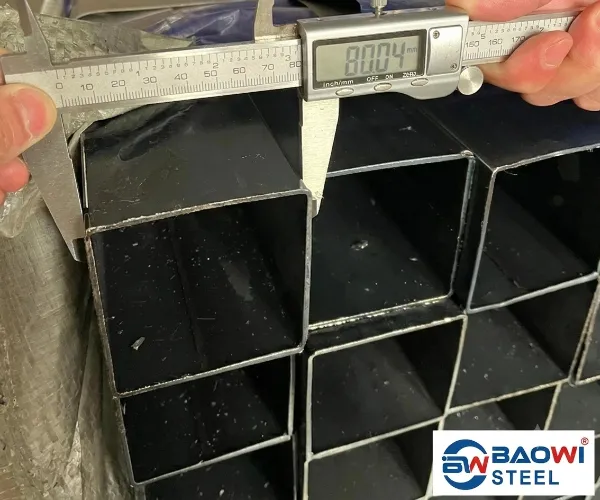
Rectangular tube wall thickness refers to the distance between the outer and inner surfaces of the steel tube. People usually express it in millimeters (mm) or inches.
A rectangular tube is typically specified using:
Outside Width × Outside Height × Wall Thickness
Example:
100 × 50 × 3 mm
4" × 2" × 0.188"
Although two tubes may have identical outside dimensions, a thicker wall provides:
Higher bending strength
Greater load-bearing capacity
Better resistance to deformation
Improved impact resistance
Longer service life
However, thicker walls also increase weight and material cost.
International Standards for Rectangular Tube (RHS) Wall Thickness
Three major international standards are widely used for overseas projects and exported equipment.
They are
ASTM A500/A513, BS EN 10210, and JIS G3466.
These standards cover wall thicknesses from 0.5 mm to 25 mm. Compared to Chinese national standards, these international standards have more detailed wall thickness classes. They also have stricter tolerance controls. This makes them best for overseas steel structure projects. They also suit precision machinery. They are also used for import and export profile procurement.
Rectangular Tube (RHS) Thickness Chart
|
Standards
|
Wall thickness
|
Standards
|
Wall thickness
|
Standards
|
Wall thickness
|
Standards
|
Wall thickness
|
|
10*20
|
0.6-2.0
|
14*20
|
0.6-2.0
|
15*25
|
0.6-2.0
|
20*30
|
0.6-2.0
|
|
20*40
|
0.6-3.0
|
20*50
|
0.6-3.0
|
25*40
|
0.8-3.0
|
25*50
|
0.8-3.0
|
|
30*40
|
0.8-3.5
|
30*50
|
0.8-3.5
|
30*60
|
0.8-3.5
|
30*70
|
0.8-4.0
|
|
40*60
|
0.8-4.0
|
40*70
|
1.0-4.0
|
40*80
|
1.0-4.0
|
40*90
|
1.0-4.0
|
|
40*100
|
1.2-4.0
|
40*120
|
1.2-5.0
|
50*70
|
1.2-4.0
|
50*80
|
1.2-4.0
|
|
50*90
|
1.2-4.0
|
50*100
|
1.2-4.0
|
50*120
|
1.2-5.0
|
50*150
|
1.2-6.0
|
|
60*80
|
1.2-5.0
|
60*90
|
1.2-5.0
|
60*100
|
1.2-5.0
|
60*120
|
1.2-5.0
|
|
60*180
|
2.0-6.0
|
60*200
|
2.0-6.0
|
70*140
|
2.0-6.0
|
70*190
|
2.0-6.0
|
|
80*100
|
2.0-6.0
|
80*120
|
2.0-6.0
|
80*160
|
2.0-6.0
|
80*180
|
3.0-6.0
|
|
80*200
|
3.0-6.0
|
85*175
|
3.0-6.0
|
90*190
|
3.0-6.0
|
100*120
|
2.0-6.0
|
|
100*125
|
2.0-6.0
|
100*140
|
2.0-6.0
|
100*150
|
2.0-6.0
|
100*160
|
2.0-6.0
|
|
100*180
|
3.0-6.0
|
100*200
|
3.75-8.0
|
110*140
|
4.0-6.0
|
120*130
|
4.0-6.0
|
|
120*140
|
4.0-6.0
|
120*200
|
4.0-8.0
|
125*135
|
4.0-8.0
|
150*200
|
4.0-12
|
|
150*250
|
4.0-12
|
150*300
|
4.0-12
|
|
|
|
|
Note: Rectangular tubes with extra-large cross-sections (over 200 mm), ultra-thin walls (0.5–1.2 mm), or extra-thick non-standard walls (25 mm) can be custom-manufactured according to project design specifications.
Common RHS Wall Thickness Options
Thin Wall Rectangular Tubes (1.6–4 mm)
Thin-wall rectangular tubes are commonly used where lightweight structures and easy fabrication are required.
Typical applications:
Furniture frames
Decorative structures
Greenhouse structures
Light equipment frames
Storage racks
Common examples:
40 × 20 × 2 mm
50 × 25 × 2.5 mm
80 × 40 × 3 mm
Advantages:
Lower material consumption
Easy cutting and welding
Reduced structural weight
Limitations:
Lower resistance to heavy loads
Rectangular Tube(RHS) Wall Thickness Tolerance and Acceptance Criteria
During the manufacturing process, slight variations in wall thickness may occur due to forming, welding, and material processing conditions. Therefore, wall thickness tolerance is an important factor when inspecting rectangular tubes before delivery.
Applicable standards such as ASTM A500, EN 10219, and other structural tube specifications define allowable dimensional variations to ensure the required strength and performance.
Typical wall thickness acceptance ranges are:
|
Wall Thickness Range
|
Typical Allowable Deviation
|
Common Applications
|
|
Less than 3 mm
|
Around 0.3 mm maximum negative deviation
|
Light structures, furniture, decorative applications
|
|
3–12 mm
|
Approximately within ±8% depending on standard requirements
|
General structural applications
|
|
Above 12 mm
|
Around 1.2 mm maximum negative deviation
|
Heavy-duty structures and load-bearing applications
|
Different standards define their own tolerance requirements, including:
ASTM A500
EN 10219
EN 10210
JIS G3466
For precision rectangular tubing, such as cold-drawn mechanical tubes or galvanized precision tubes, tighter dimensional control may be required. Some precision applications can achieve wall thickness tolerances close to ±0.1 mm to meet strict assembly and machining requirements.
ASTM A500 Rectangular Tube Thickness Chart
ASTM A500 is one of the most widely used standards for structural rectangular tubing in North America.
Typical ASTM A500 rectangular tube thickness options:
|
Nominal Size
|
Common Wall Thickness
|
|
2 × 1 inch
|
0.120", 0.188"
|
|
3 × 2 inch
|
0.120", 0.188", 0.250"
|
|
4 × 2 inch
|
0.120", 0.188", 0.250", 0.313"
|
|
6 × 4 inch
|
0.188", 0.250", 0.313", 0.375", 0.500"
|
|
8 × 4 inch
|
0.250", 0.313", 0.375", 0.500"
|
|
10 × 6 inch
|
0.250", 0.313", 0.375", 0.500", 0.625"
|
Rectangular Tube Gauge Chart
|
Gauge
|
Thickness (inch)
|
Thickness (mm)
|
|
20 Gauge
|
0.035"
|
0.89 mm
|
|
18 Gauge
|
0.049"
|
1.24 mm
|
|
16 Gauge
|
0.065"
|
1.65 mm
|
|
14 Gauge
|
0.083"
|
2.11 mm
|
|
12 Gauge
|
0.109"
|
2.77 mm
|
|
11 Gauge
|
0.120"
|
3.05 mm
|
|
10 Gauge
|
0.134"
|
3.40 mm
|
FAQ
What is the standard thickness of rectangular tubing?
Common rectangular tube wall thickness ranges from approximately 1.6 mm to 16 mm depending on size, standard, and application.
What is the most common rectangular tube thickness?
For general structural applications, 3 mm to 6 mm wall thickness is widely used.
Is thicker rectangular tubing stronger?
Yes. Increasing wall thickness generally improves strength, stiffness, and resistance to deformation.
How is rectangular tube wall thickness measured?
Wall thickness is measured from the outside surface to the inside surface of the steel tube wall.
What is the difference between rectangular tube size and thickness?
Tube size describes the outside dimensions, while thickness describes the steel wall thickness.
What is the standard length of a rectangular tube?
The standard length of a rectangular tube is typically 6 meters (20 feet) or 12 meters (40 feet), with custom lengths available upon request.For a more detailed version, you can view the Standard Rectangular Tube Size Table.

 English
 Español
 بالعربية



 Phone :
  Whatsapp :
  Email :


