Schedule 40 seamless steel pipe is a widely used piping specification in industrial systems due to its balanced mechanical strength, standardized dimensions, and broad material compatibility. It is defined under
ASME B36.10M, which governs the dimensional system for seamless and welded carbon steel pipes.Unlike application-specific piping grades, Schedule 40 represents a standard wall thickness classification, making it one of the most commonly adopted pipe schedules in oil & gas, water supply, power generation, and general industrial engineering.
1. Overview of Schedule 40 Seamless Steel Pipe
Schedule 40 seamless steel pipe refers to a pipe that:
Follows ASME B36.10M dimensional standards
Has a “medium wall thickness” classification
Is manufactured using a seamless process (no weld seam)
Is used for general to medium-pressure service conditions
Key Engineering Insight:
Schedule numbers (Sch 10, 40, 80, etc.) define wall thickness relationships, not fixed pressure ratings or material strength.
For a given Nominal Pipe Size (NPS):
Outside diameter (OD) remains constant
Wall thickness varies by schedule
Inside diameter (ID) changes accordingly
2.Seamless pipe schedule 40 specifications
The table below outlines key dimensions for Schedule 40 carbon steel pipes. All measurements align with ASME B36.10M standards.The table below presents the key dimensional data for Schedule 40 carbon steel pipes in accordance with ASME B36.10M standards. Schedule 40 is a standardized pipe wall thickness designation rather than a direct pressure or strength rating. It defines the relationship between nominal pipe size (NPS), outside diameter (OD), and wall thickness (WT), which together determine the pipe’s mechanical performance and weight characteristics.
This Schedule 40 pipe chart provides essential engineering reference data, including dimensions in both imperial and metric units, and is commonly used for pipe selection, design calculation, and material estimation in industrial applications.
|
Nominal size [inches]
|
Outside diameter [inches]
|
Outside diameter [mm]
|
Wall thickness [inches]
|
Wall thickness [mm]
|
Weight [lb/ft]
|
Weight [kg/m]
|
1/8
|
0.405
|
10.3
|
0.068
|
1.73
|
0.24
|
0.37
|
1/4
|
0.54
|
13.7
|
0.088
|
2.24
|
0.42
|
0.84
|
1/2
|
0.84
|
21.3
|
0.109
|
2.77
|
0.85
|
1.27
|
3/4
|
1.05
|
26.7
|
0.113
|
2.87
|
1.13
|
1.69
|
|
1
|
1.315
|
33.4
|
0.133
|
3.38
|
1.68
|
2.5
|
|
1.25
|
1.66
|
42.2
|
0.14
|
3.56
|
2.27
|
3.39
|
|
1.5
|
1.9
|
48.3
|
0.145
|
3.68
|
2.72
|
4.05
|
|
2
|
2.375
|
60.3
|
0.154
|
3.91
|
3.65
|
5.44
|
|
2.5
|
2.875
|
73
|
0.203
|
5.16
|
5.79
|
8.63
|
|
3
|
3.5
|
88.9
|
0.216
|
5.49
|
7.58
|
11.29
|
|
3.5
|
4
|
101.6
|
0.226
|
5.74
|
9.11
|
13.57
|
|
4
|
4.5
|
114.3
|
0.237
|
6.02
|
10.79
|
16.07
|
|
5
|
5.563
|
141.3
|
0.258
|
6.55
|
14.62
|
21.77
|
|
6
|
6.625
|
168.3
|
0.28
|
7.11
|
18.97
|
28.26
|
|
8
|
8.625
|
219.1
|
0.322
|
8.18
|
28.55
|
42.55
|
|
10
|
10.75
|
273
|
0.365
|
9.27
|
40.48
|
60.31
|
|
12
|
12.75
|
323.8
|
0.406
|
10.31
|
53.52
|
79.73
|
|
14
|
14
|
355.6
|
0.375
|
11.13
|
54.57
|
94.55
|
|
16
|
16
|
406.4
|
0.5
|
12.7
|
82.77
|
123.3
|
|
18
|
18
|
457
|
0.562
|
14.27
|
104.67
|
155.8
|
|
20
|
20
|
508
|
0.594
|
15.09
|
123.11
|
183.42
|
|
24
|
24
|
610
|
0.688
|
17.48
|
171.29
|
255.41
|
|
32
|
32
|
813
|
0.688
|
17.48
|
230.08
|
342.91
|
3.Applications of Schedule 40 Seamless Pipes
Oil & gas transportation (low and medium pressure pipelines)
Water supply systems in municipal infrastructure
Steam and condensate lines in power plants
Fire protection sprinkler systems (
ASTM A53/
A106)
Structural steel applications in construction frameworks
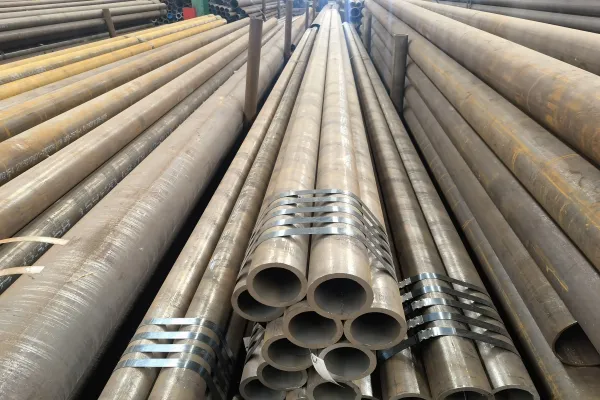
4.Schedule 40 Seamless Pipe Dimensions, Wall Thickness, and Standardization
Schedule 40 seamless steel pipes are manufactured in accordance with the Nominal Pipe Size (NPS) system, where dimensional relationships are standardized under ASME B36.10M. In this system, NPS serves as an index identifier rather than a direct physical measurement. For each nominal size, the outside diameter (OD) remains constant, while the wall thickness is determined by the corresponding schedule classification.
Typical Schedule 40 Pipe Dimensions
|
NPS
|
OD (mm)
|
Wall Thickness (mm)
|
|
1"
|
33.4
|
3.38
|
|
2"
|
60.3
|
3.91
|
|
3"
|
88.9
|
5.49
|
|
4"
|
114.3
|
6.02
|
|
6"
|
168.3
|
7.11
|
These standardized relationships ensure compatibility across global piping systems, allowing pipes from different manufacturers to be interchangeable when following the same ASME dimensional code.
5.Pressure Capacity of Schedule 40 Seamless Pipe
The pressure-bearing capacity of Schedule 40 seamless steel pipe is not determined solely by its nominal size or schedule designation. Instead, it is influenced by multiple engineering variables, including material strength, wall thickness, operating temperature, and corrosion allowance.
From a mechanical engineering standpoint, internal pressure can be estimated using the Barlow formula, expressed as:
P = (2St) / D
Where:
P = internal pressure
S = allowable stress of the material
t = wall thickness
D = outside diameter
This relationship indicates that pressure capacity increases with greater wall thickness and higher material strength, while it decreases as pipe diameter increases.
However, in real engineering applications, pressure design must also account for operating temperature, fluid characteristics, and safety factors defined in applicable codes such as ASME B31.3 or B31.4, ensuring safe and reliable system performance under actual working conditions.
6.Schedule 40 vs Schedule 80 Seamless Pipe Specifications
Schedule 40 and Schedule 80 seamless steel pipes are both defined under ASME B36.10M. They maintain the same outside diameter for each NPS size, while the main difference lies in wall thickness, which directly affects weight, pressure capacity, and application scope.
Comprehensive Comparison Table
|
Item
|
Schedule 40 Seamless Pipe
|
Schedule 80 Seamless Pipe
|
|
Standard
|
ASME B36.10M
|
ASME B36.10M
|
|
Wall Thickness
|
Medium
|
Thicker
|
|
Outside Diameter (OD)
|
Same per NPS
|
Same per NPS
|
|
Inside Diameter (ID)
|
Larger
|
Smaller
|
|
Pressure Capacity
|
Medium pressure service
|
High pressure service
|
|
Mechanical Strength
|
Standard industrial level
|
Higher strength and durability
|
|
Weight
|
Lighter
|
Heavier
|
|
Cost
|
More economical
|
Higher material cost
|
|
Common Materials
|
ASTM A106 Gr.B, ASTM A53 Gr.B, API 5L Gr.B
|
ASTM A106 Gr.B, API 5L, alloy steel
|
|
Manufacturing Type
|
Seamless / ERW
|
Seamless / ERW
|
|
Temperature Suitability
|
Normal to medium temperature
|
Medium to higher stress conditions
|
|
Typical Applications
|
Water systems, HVAC, structural piping, general industry
|
Oil & gas, refinery, chemical processing, high-pressure pipelines
|
|
Engineering Design Basis
|
ASME B31.3 / B31.4 (system design)
|
ASME B31.3 / B31.4 (higher safety margin)
|
Read on to discover more differences:Difference Between Schedule 40 And Schedule 80 Steel Pipe
7.Material Grades of Schedule 40 Seamless Pipe
Common materials used for Schedule 40 seamless steel pipes include:
Carbon steel (most common)
ASTM A106 Grade B (high-temperature service)
ASTM A53 Grade B (general structural and pressure use)
Alloy steel (for high-strength requirements)
These materials ensure good mechanical strength and adaptability for different industrial environments.
Conclusion
Schedule 40 seamless steel pipe is a fundamental specification in modern piping systems. Defined by ASME B36.10M, it combines standardized dimensions with seamless manufacturing technology to deliver reliable performance across a wide range of industrial applications.Its balance of strength, cost, and versatility makes it one of the most widely used pipe schedules in oil & gas, construction, power generation, and general industrial engineering.
FAQ – Schedule 40 Seamless Steel Pipe
Q1. What is Schedule 40 pipe?
Schedule 40 is a standard pipe wall thickness classification under ASME B36.10M.
Q2. Is Schedule 40 a pressure rating?
No. It defines wall thickness, not pressure rating.
Q3. What is the difference between Schedule 40 and Schedule 80?
Schedule 80 has thicker walls and higher pressure capacity than Schedule 40.
Q4. What materials are used for Schedule 40 seamless pipe?
Common materials include ASTM A106 Gr.B, ASTM A53 Gr.B, and API 5L Gr.B.
Read more
Schedule 40 Pipe Pressure Rating Chart and Guide
Schedule 40 Pipe Size Guide (OD, ID, NPS Explained)

 English
 Español
 بالعربية





 Phone :
  Whatsapp :
  Email :