Pipe schedule dimensions are used to identify the wall thickness of a pipe for a specific
nominal pipe size (NPS). Common schedules include SCH 5, SCH 10,
SCH 20,
SCH 40, SCH 80, SCH 120, SCH 160, and XXS.However, pipe schedule does not directly indicate the pipe's
outside diameter (OD). The OD is determined by the NPS, while the wall thickness is determined by the applicable pipe schedule.Understanding the relationship between NPS, outside diameter, wall thickness, and pipe schedule is essential when selecting pipes for industrial, mechanical, structural, and pressure applications.
This guide provides a practical pipe schedule dimensions chart and explains how to read pipe dimensions correctly.
What Does Pipe Schedule Mean?
Pipe schedule, commonly written as SCH, is a standardized designation used to identify pipe wall thickness for a specific nominal pipe size.
The schedule number is not a direct measurement of wall thickness.
SCH 40 does not mean that the wall is 40 mm thick or 0.040 inches thick.
Instead, the schedule works together with NPS.
For NPS 2 pipe:
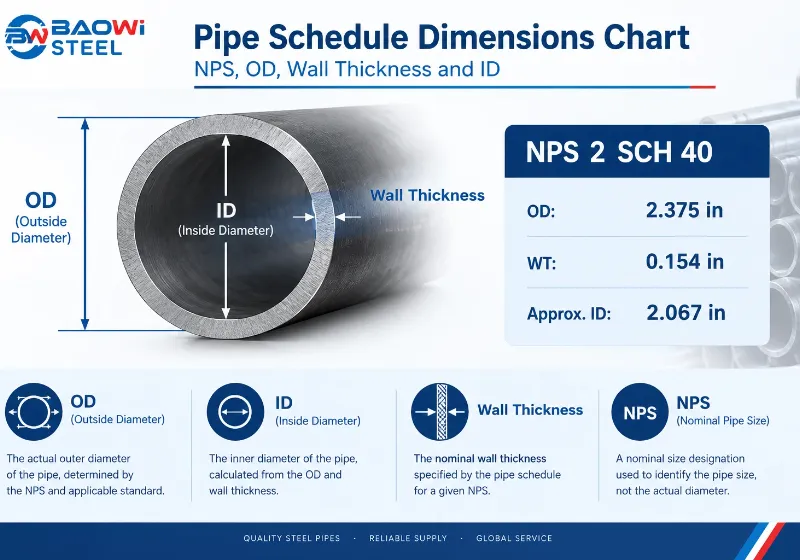
SCH 40 has a nominal wall thickness of 0.154 in.
SCH 80 has a nominal wall thickness of 0.218 in.
SCH 160 has a nominal wall thickness of 0.344 in.
The standardized outside diameter remains 2.375 in (60.3 mm) for these schedules.
As the schedule increases, the wall becomes thicker. The additional wall thickness extends toward the inside of the pipe, reducing the available internal diameter.
This is the basic relationship behind a pipe schedule chart.
Standard Pipe Schedules Pipe Sizes Chart Table
The table below shows common pipe sizes and wall thicknesses for several widely used schedules. Dimensions are based on standard nominal pipe dimensions commonly used in
ASME B36.10M and ASME B36.19M applications.
|
NPS
|
DN
|
OD (in)
|
OD (mm)
|
SCH 10 (in)
|
SCH 40 (in)
|
SCH 80 (in)
|
SCH 160 (in)
|
XXS (in)
|
|
1/2
|
15
|
0.84
|
21.3
|
0.083
|
0.109
|
0.147
|
0.188
|
0.294
|
|
3/4
|
20
|
1.05
|
26.7
|
0.083
|
0.113
|
0.154
|
0.219
|
0.308
|
|
1
|
25
|
1.315
|
33.4
|
0.109
|
0.133
|
0.179
|
0.25
|
0.358
|
|
1-1/4
|
32
|
1.66
|
42.2
|
0.109
|
0.14
|
0.191
|
0.25
|
0.382
|
|
1-1/2
|
40
|
1.9
|
48.3
|
0.109
|
0.145
|
0.2
|
0.281
|
0.4
|
|
2
|
50
|
2.375
|
60.3
|
0.109
|
0.154
|
0.218
|
0.344
|
0.436
|
|
2-1/2
|
65
|
2.875
|
73
|
0.12
|
0.203
|
0.276
|
0.375
|
0.552
|
|
3
|
80
|
3.5
|
88.9
|
0.12
|
0.216
|
0.3
|
0.438
|
0.6
|
|
3-1/2
|
90
|
4
|
101.6
|
0.12
|
0.226
|
0.318
|
—
|
0.636
|
|
4
|
100
|
4.5
|
114.3
|
0.12
|
0.237
|
0.337
|
0.531
|
0.674
|
|
5
|
125
|
5.563
|
141.3
|
0.134
|
0.258
|
0.375
|
0.625
|
0.75
|
|
6
|
150
|
6.625
|
168.3
|
0.134
|
0.28
|
0.432
|
0.719
|
0.864
|
|
8
|
200
|
8.625
|
219.1
|
0.148
|
0.322
|
0.5
|
0.906
|
0.875
|
|
10
|
250
|
10.75
|
273
|
0.165
|
0.365
|
0.5
|
1.125
|
1
|
|
12
|
300
|
12.75
|
323.8
|
0.18
|
0.406
|
0.5
|
1.312
|
1
|
|
14
|
350
|
14
|
355.6
|
0.25
|
0.438
|
0.594
|
1.406
|
—
|
|
16
|
400
|
16
|
406.4
|
0.25
|
0.5
|
0.656
|
1.594
|
—
|
|
18
|
450
|
18
|
457.2
|
0.25
|
0.562
|
0.75
|
1.781
|
—
|
|
20
|
500
|
20
|
508
|
0.25
|
0.594
|
0.812
|
1.969
|
—
|
|
24
|
600
|
24
|
610
|
0.25
|
0.688
|
0.969
|
2.344
|
—
|
|
30
|
750
|
30
|
762
|
0.312
|
—
|
—
|
—
|
—
|
|
36
|
900
|
36
|
914
|
0.375
|
—
|
—
|
—
|
—
|
Note: WT means nominal wall thickness. Actual measured wall thickness can vary within the tolerances allowed by the applicable product specification. Not every schedule is available for every NPS.
For stainless steel pipe, dimensional requirements may follow ASME B36.19M, where schedule designations such as 10S, 40S, and 80S are used. Do not treat an “S” schedule as automatically interchangeable with the corresponding carbon steel dimensions.
NPS vs Pipe Schedule
NPS and pipe schedule work together to describe pipe dimensions.
|
Pipe Designation
|
NPS
|
Schedule
|
Meaning
|
|
NPS 1 SCH 40
|
1
|
40
|
1-inch nominal pipe with SCH 40 wall
|
|
NPS 2 SCH 40
|
2
|
40
|
2-inch nominal pipe with SCH 40 wall
|
|
NPS 2 SCH 80
|
2
|
80
|
2-inch nominal pipe with SCH 80 wall
|
|
NPS 4 SCH 40
|
4
|
40
|
4-inch nominal pipe with SCH 40 wall
|
|
NPS 6 SCH 80
|
6
|
80
|
6-inch nominal pipe with SCH 80 wall
|
One important point is that NPS 2 does not mean the pipe has a 2-inch outside diameter.
For NPS 2 pipe, the standardized OD is 2.375 inches (60.3 mm).
Pipe Outside Diameter and Schedule
A pipe’s outside diameter (OD) and schedule define different aspects of its dimensions. The OD is primarily determined by the Nominal Pipe Size (NPS), while the schedule determines the pipe wall thickness.
Outside Diameter (OD): For most pipe sizes, the actual OD differs from the nominal pipe size. An NPS 2 pipe has an actual OD of 2.375 inches (60.3 mm). For NPS 14 and larger, the actual OD generally corresponds to the nominal size.
Schedule: Pipe schedules such as SCH 10, SCH 40, SCH 80, and SCH 160 specify wall thickness for a particular NPS. A higher schedule generally indicates a thicker pipe wall.
Inside Diameter (ID): The ID depends on the OD and wall thickness. With the same NPS, increasing the schedule increases wall thickness and reduces the available inside diameter.
NPS 2 SCH 40 and NPS 2 SCH 80 pipes have the same 2.375-inch outside diameter. Their wall thickness and inside diameter are different because SCH 80 has a heavier wall.
Practical note: Pipe schedule should not be selected based on OD alone. Design pressure, operating temperature, pipe material, corrosion allowance, and applicable piping standards should also be considered when determining the appropriate pipe specification.
|
Schedule
|
OD (in)
|
Wall Thickness (in)
|
Approx. ID (in)
|
|
SCH 10
|
2.375
|
0.109
|
2.157
|
|
SCH 40
|
2.375
|
0.154
|
2.067
|
|
SCH 80
|
2.375
|
0.218
|
1.939
|
|
SCH 160
|
2.375
|
0.343
|
1.689
|
The approximate inside diameter can be calculated as:
ID = OD − 2 × Wall Thickness
Therefore, increasing the schedule readuces the internal diameter.
Common Pipe Schedule Numbers
Several pipe schedules are commonly used in industrial piping systems.
Schedule 5 and Schedule 5S
Schedule 5 and 5S represent relatively thin-wall pipe dimensions.
They are commonly selected where low weight and adequate corrosion allowance are more important than high pressure resistance.The 5S designation is commonly associated with stainless steel pipe dimensions under ASME B36.19M.
Schedule 10 and Schedule 10S
SCH 10 is a relatively light wall thickness series.
SCH 10S is commonly used for stainless steel pipe.
These schedules are often used for:
Water systems
Low-pressure process piping
Drainage systems
Architectural applications
Stainless steel piping
Schedule 20
Schedule 20 provides a thicker wall than SCH 10 for many pipe sizes.It is used when additional wall thickness is required without moving to heavier schedules such as SCH 40 or SCH 80.
Schedule 40
Schedule 40 is one of the most widely used pipe schedules.It provides a practical balance between:
Wall thickness
Pressure capability
Weight
Cost
Availability
SCH 40 carbon steel pipe is widely used in industrial, construction, water, fire protection, and mechanical piping systems.
Schedule 80
Schedule 80 has a thicker wall than SCH 40 for the same NPS.It provides a smaller internal diameter and generally allows greater pressure capacity, subject to material, temperature, design code, and allowable stress.
SCH 80 is commonly used for:
High-pressure piping
Steam systems
Industrial process piping
Hydraulic applications
Chemical processing
Schedule 120
Schedule 120 is a heavy-wall pipe series.It is less common than SCH 40 and SCH 80 but may be selected for demanding pressure or mechanical requirements.
Schedule 160
Schedule 160 is one of the heavier standardized pipe schedules.It provides substantially greater wall thickness for many smaller NPS sizes.SCH 160 is commonly considered when pressure, mechanical strength, or severe service conditions require a heavy-wall pipe.
A pipe schedule dimensions chart provides a quick way to compare pipe wall thicknesses for different NPS sizes. The key is to understand that NPS, OD, wall thickness, and schedule are different designations.For the same NPS, changing from SCH 40 to SCH 80 generally keeps the OD unchanged while increasing the wall thickness. This reduces the internal diameter and can improve the pipe's pressure-handling capability, depending on the material and design conditions.When selecting pipe for a project, always verify the NPS, schedule, OD, wall thickness, material grade, manufacturing method, and applicable ASTM/ASME/API standard before placing an order.
NPS vs DN vs OD
NPS, DN, and OD describe different aspects of pipe sizing.NPS (Nominal Pipe Size) is the nominal size designation used in the inch-based pipe sizing system.DN (Nominal Diameter) is the metric-based nominal designation commonly used in international piping systems.
OD (Outside Diameter) is the actual standardized outside diameter associated with a pipe size.
NPS and DN should not be treated as direct measurements of the pipe OD.
For example:
NPS 1 = DN 25, OD 1.315 in (33.4 mm)
NPS 2 = DN 50, OD 2.375 in (60.3 mm)
NPS 4 = DN 100, OD 4.500 in (114.3 mm)
NPS 6 = DN 150, OD 6.625 in (168.3 mm)
For NPS 14 and larger, the numerical NPS generally corresponds closely to the outside diameter in inches.
How to Read a Pipe Specification?
A pipe designation can contain several pieces of information.
Consider:NPS 2 SCH 40 ASTM A106 Grade B Seamless Pipe
This means:
NPS 2 — nominal pipe size
OD 2.375 in — standardized outside diameter
SCH 40 — pipe schedule
0.154 in — nominal wall thickness
ASTM A106 Grade B — material/product specification
Seamless — manufacturing method
The schedule is only one part of the complete pipe specification.
A purchasing specification may also need to define the material grade, manufacturing process, length, ends, surface condition, testing requirements, and applicable standard.For seamless carbon steel pipe, you can also refer to our guide on [
ASTM A106 vs API 5L Seamless Pipe] when the material and application requirements overlap.
FAQ
What does SCH 40 mean on a pipe?
SCH 40 is a standardized pipe schedule designation that identifies the nominal wall thickness for a particular NPS. It does not mean that the wall is 40 mm or 0.040 inches thick.
Does pipe schedule determine the outside diameter?
No. For standardized pipe dimensions, the OD is associated with the NPS and applicable dimensional standard. The schedule identifies the nominal wall thickness for that NPS.
Does a higher pipe schedule mean a thicker wall?
Generally, yes, when comparing schedules for the same NPS. A higher schedule normally corresponds to a thicker nominal wall.
What is the OD of NPS 2 pipe?
The standardized OD of NPS 2 pipe is 2.375 inches (60.3 mm).
What is the difference between SCH 40 and SCH 80?
For the same NPS, SCH 80 generally has a thicker wall than SCH 40. The OD remains the same, while the ID becomes smaller with SCH 80.
Does pipe schedule determine pressure rating?
No. Pipe schedule is a dimensional designation, not a pressure rating. Allowable pressure depends on material, temperature, design code, wall thickness, and other engineering factors.
What is the difference between NPS and DN?
NPS is a nominal pipe size designation used primarily in inch-based systems. DN is a nominal diameter designation used in metric-based systems. Neither should be treated as a direct measurement of OD.

 English
 Español
 بالعربية







 Phone :
 Whatsapp :
 Email :