Schedule 40 and Schedule 160 are two standardized pipe wall thickness ratings commonly used in piping systems. For a given nominal pipe size, these two types of pipe typically share the same outside diameter. The primary differences are that Schedule 160 pipe has a thicker wall, a smaller inside diameter, and greater weight.
These differences are particularly significant when the choice of pipe specification impacts pressure-bearing capacity, flow capacity, weight, installation, and project costs. Selecting a pipe with a higher wall thickness rating is not always the optimal choice; the correct selection depends on design pressure, temperature, material, corrosion allowance, applicable piping codes, and required flow rate.
For carbon steel and alloy steel piping, dimensional standards are defined by ASME B36.10M, whereas stainless steel piping follows the ASME B36.19M standard, which utilizes designations such as 40S and 80S.
Schedule 40 vs Schedule 160: What's the Difference?
The main difference is wall thickness.For a given
NPS, increasing the schedule normally increases wall thickness while keeping the nominal outside diameter unchanged. This reduces the inside diameter and increases pipe weight.
|
Feature
|
Schedule 40
|
Schedule 160
|
|
Wall thickness
|
Thinner
|
Much thicker
|
|
Outside diameter
|
Same for the same NPS
|
Same for the same NPS
|
|
Inside diameter
|
Larger
|
Smaller
|
|
Pipe weight
|
Lower
|
Higher
|
|
Flow area
|
Larger
|
Smaller
|
|
Pressure capability
|
Lower than a thicker wall, all else equal
|
Higher wall capacity, all else equal
|
|
Material cost
|
Lower
|
Higher
|
|
Installation
|
Easier to handle
|
Requires more handling and support
|
|
Typical use
|
General and moderate-duty service
|
High-pressure or severe-service applications
|
Important: A schedule number is a dimensional designation, not a universal pressure rating. A Schedule 160 pipe does not have one fixed pressure rating across all sizes, materials, and temperatures.
Schedule 160 is substantially thicker and heavier than Schedule 40. It provides a smaller bore but more wall thickness for pressure and mechanical requirements. Schedule 40 offers a larger bore and lower weight, so it is often more economical when the design does not require the additional wall.
Schedule 40 vs Schedule 160 Dimensions
The easiest way to understand the difference is to compare actual dimensions.
The following values are based on ASME B36.10M dimensional data for steel pipe. Outside diameter remains fixed for the same NPS, while wall thickness changes with schedule.
|
NPS
|
OD (in)
|
Sch 40 Wall (in)
|
Sch 160 Wall (in)
|
Sch 40 ID (in)
|
Sch 160 ID (in)
|
|
1/2
|
0.84
|
0.109
|
0.188
|
0.622
|
0.464
|
|
3/4
|
1.05
|
0.113
|
0.219
|
0.824
|
0.612
|
|
1
|
1.315
|
0.133
|
0.25
|
1.049
|
0.815
|
|
1 1/4
|
1.66
|
0.14
|
0.25
|
1.38
|
1.16
|
|
1 1/2
|
1.9
|
0.145
|
0.281
|
1.61
|
1.338
|
|
2
|
2.375
|
0.154
|
0.344
|
2.067
|
1.687
|
|
2 1/2
|
2.875
|
0.203
|
0.375
|
2.469
|
2.125
|
|
3
|
3.5
|
0.216
|
0.438
|
3.068
|
2.624
|
|
4
|
4.5
|
0.237
|
0.531
|
4.026
|
3.438
|
|
5
|
5.563
|
0.258
|
0.625
|
5.047
|
4.313
|
|
6
|
6.625
|
0.28
|
0.719
|
6.065
|
5.187
|
|
8
|
8.625
|
0.322
|
0.906
|
7.981
|
6.813
|
|
10
|
10.75
|
0.365
|
1.125
|
10.02
|
8.5
|
|
12
|
12.75
|
0.406
|
1.312
|
11.938
|
10.126
|
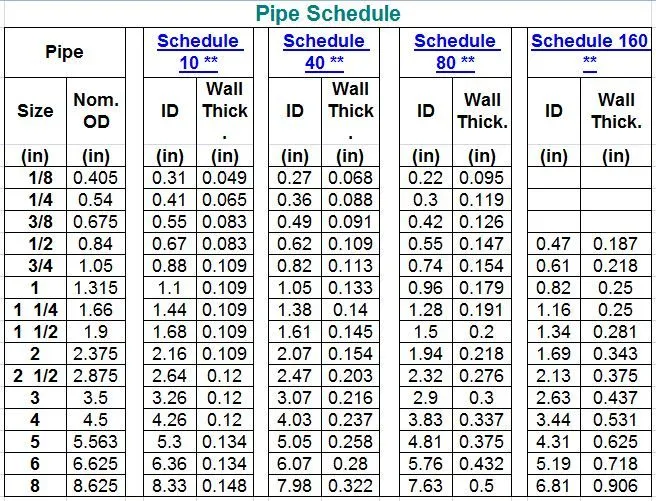
The inside diameter is calculated from:
ID = OD − 2 × wall thickness
The table shows why the same NPS does not mean the same flow capacity. A thicker wall occupies more of the available cross-section.
NPS 2 Schedule 40 vs Schedule 160
NPS 2 provides a useful example.
Schedule 40 wall: 0.154 in (3.91 mm)
Schedule 160 wall: 0.344 in (8.74 mm)
Schedule 40 ID: 2.067 in (52.50 mm)
Schedule 160 ID: 1.687 in (42.85 mm)
At NPS 2, Schedule 160 has more than twice the Schedule 40 wall thickness. The larger wall also reduces the bore by about 0.38 inch.
This is why replacing Schedule 40 with Schedule 160 can affect both mechanical design and hydraulic performance.
Schedule 40 vs Schedule 160 Wall Thickness
Wall thickness is the most obvious difference between the two schedules.
For example, at NPS 6:
Schedule 40 = 0.280 in (7.11 mm)
Schedule 160 = 0.719 in (18.26 mm)
At NPS 8:
Schedule 40 = 0.322 in (8.18 mm)
Schedule 160 = 0.906 in (23.01 mm)
At NPS 12:
Schedule 40 = 0.406 in (10.31 mm)
Schedule 160 = 1.312 in (33.32 mm)
As the schedule increases, more steel is added to the pipe wall. The effect becomes particularly significant at larger diameters.
Why does Schedule 160 have a thicker wall?
A thicker wall provides more metal to resist internal pressure and mechanical loads. It can also provide additional thickness for erosion or corrosion allowances when the engineering design requires it.
However, wall thickness should not be selected from the schedule number alone. A piping design normally considers the material's allowable stress, design temperature, design pressure, corrosion allowance, fabrication requirements, and applicable design code.
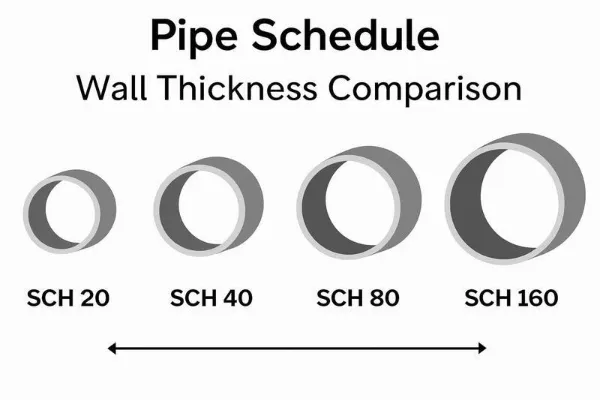
Schedule 40 vs Schedule 160 Inside Diameter
For the same NPS, Schedule 40 has a larger inside diameter than Schedule 160.
For NPS 2:
Schedule 40
OD = 2.375 in
Wall = 0.154 in
ID = 2.067 in
Schedule 160
OD = 2.375 in
Wall = 0.344 in
ID = 1.687 in
The outside diameter stays the same, but the thicker Schedule 160 wall reduces the internal bore.
This distinction is important when a piping system is sized for a specific flow rate. A pipe with the same NPS can have different hydraulic performance depending on its schedule.
Schedule 40 vs Schedule 160 Flow Area
The smaller inside diameter of Schedule 160 also means a smaller internal flow area.
The approximate flow area can be calculated from:
Flow Area = π × ID² / 4
Because flow area depends on the square of the inside diameter, even a moderate reduction in bore can have a noticeable effect on hydraulic capacity.
For example, NPS 2 has:
Schedule 40 ID = 2.067 in
Schedule 160 ID = 1.687 in
The resulting flow area is substantially smaller with Schedule 160.This creates an important design trade-off:More wall thickness improves pressure and mechanical capacity, but less bore can increase velocity and pressure drop.Therefore, changing from Schedule 40 to Schedule 160 should not be treated as a simple material upgrade. The hydraulic design should also be checked.
Schedule 40 vs Schedule 160 Pipe Weight
Schedule 160 uses significantly more steel than Schedule 40.
Selected examples based on standard dimensional and weight data include:
|
NPS
|
Sch 40 Weight
|
Sch 160 Weight
|
Approx. Increase
|
|
1/2
|
0.85 lb/ft
|
1.31 lb/ft
|
54%
|
|
1
|
1.68 lb/ft
|
2.84 lb/ft
|
69%
|
|
2
|
3.65 lb/ft
|
7.46 lb/ft
|
104%
|
|
3
|
7.58 lb/ft
|
14.32 lb/ft
|
89%
|
|
4
|
10.79 lb/ft
|
22.51 lb/ft
|
109%
|
|
6
|
18.97 lb/ft
|
45.35 lb/ft
|
139%
|
|
8
|
28.55 lb/ft
|
74.69 lb/ft
|
162%
|
|
10
|
40.48 lb/ft
|
115.64 lb/ft
|
186%
|
|
12
|
53.53 lb/ft
|
160.27 lb/ft
|
199%
|
Schedule 40 vs Schedule 160 Pressure Rating
One of the most common misunderstandings is treating the schedule number as a fixed pressure rating.It is not.Schedule 160 indicates a thicker standardized wall. The actual allowable pressure depends on additional engineering variables.
Important factors include:
|
Factor
|
Why It Matters
|
|
Pipe size
|
Wall thickness changes with NPS
|
|
Material grade
|
Different grades have different allowable stresses
|
|
Design temperature
|
Allowable stress can change with temperature
|
|
Design pressure
|
Determines required wall thickness
|
|
Corrosion allowance
|
Additional thickness may be required
|
|
Manufacturing method
|
Seamless and welded products may have different requirements
|
|
Joint efficiency
|
Welded construction may require design consideration
|
|
Design code
|
ASME B31.1, B31.3 and other codes establish design requirements
|
his is why there is no single answer to “What pressure can Schedule 160 pipe handle?”
A Schedule 160 carbon steel pipe, for example, cannot be assigned one universal PSI value without knowing the pipe grade, NPS, temperature, design code, and other design parameters.
ASME B36.10M establishes dimensional information; piping design codes such as ASME B31.3 address process piping design requirements.
Does Schedule 160 always have a higher pressure rating than Schedule 40?
For the same pipe size, material, and relevant design conditions, the thicker wall generally provides greater pressure capacity.
However, “Schedule 160 = a specific pressure rating” is not technically correct.
The proper approach is to calculate or verify the allowable pressure according to the applicable design code.
Schedule 40 vs Schedule 160 Applications
Schedule 40 is commonly selected when the required wall thickness can meet the system's pressure, temperature, mechanical, and corrosion requirements.
Water and utility piping
General industrial piping
HVAC systems
Compressed air systems
Low- to moderate-pressure services
General process piping
Schedule 160
High-pressure process piping
Boiler and steam connections
High-pressure hydraulic systems
High-pressure gas service
Refinery and petrochemical systems
Short, high-pressure process connections
Severe mechanical or erosion service
Schedule 40 vs Schedule 160 for Stainless Steel Pipe
There is an important standards distinction for stainless steel.ASME B36.10M covers welded and seamless wrought steel pipe, while ASME B36.19M covers stainless steel pipe. Stainless steel uses schedule designations such as:5S,10S,40S,80S
The “S” suffix matters.
NPS 2 stainless steel pipe has:
40S wall thickness = approximately 3.91 mm
80S wall thickness = approximately 5.54 mm
These dimensions are based on ASME B36.19M.
Therefore, when specifying stainless steel pipe, do not assume that a carbon-steel Schedule 40 or Schedule 160 designation can be transferred directly without checking the applicable material standard.
Conclusion
The difference between Schedule 40 and Schedule 160 mainly comes down to wall thickness, weight, internal diameter, pressure capability, and cost.Schedule 40 provides a practical solution for many general piping applications. Schedule 160 is a heavy-wall option for systems that require substantially greater wall thickness.When selecting between them, do not choose based on schedule number alone. Consider NPS, material, pressure, temperature, corrosion allowance, flow requirements, design code, and project specifications.For industrial piping, the safest and most economical choice is the schedule that meets the calculated design requirements without unnecessary wall thickness.
Read more
Schedule 40 Pipe Pressure Rating Chart and Guide

 English
 Español
 بالعربية







 Phone :
  Whatsapp :
  Email :


